Prognostic value of pan-immune-inflammation value in colorectal cancer patients: A systematic review and meta-analysis
Xiao-Chuan Yang, Hui Liu, Ding-Cheng Liu, Chao Tong, Xian-Wen Liang, Ri-Hui Chen

TL;DR
This study reviews evidence showing that the pan-immune-inflammation value (PIV) can predict survival outcomes in colorectal cancer patients.
Contribution
The study provides a meta-analysis confirming PIV as a novel prognostic biomarker for colorectal cancer.
Findings
High baseline PIV is linked to worse overall and progression-free survival in colorectal cancer patients.
An early increase in PIV after treatment is associated with reduced overall survival.
There is significant heterogeneity in PIV cut-off values across studies.
Abstract
The pan-immune-inflammation value (PIV) has been reported as a novel prognostic biomarker in multiple malignancies. The aim of this study is to investigate the prognostic value of the PIV in patients with colorectal cancer. We comprehensively searched electronic databases including PubMed, Embase and Web of Science up to August 2022. The endpoints were survival outcomes. Hazard ratios (HRs) with 95% confidence intervals (CIs) for survival data were collected for analysis. Six studies including 1879 participants were included. A significant heterogeneity in the PIV cut-off value among studies was observed. The combined results indicated that patients in the high baseline PIV group had a worse overall survival (HR=2.09; 95%CI: 1.67-2.61; P<0.0001; I2 = 7%) and progression-free survival (HR=1.82; 95%CI: 1.49-2.22; P<0.0001; I2 = 15%). In addition, early PIV increase after treatment…
Genes, proteins, chemicals, diseases, species, mutations and cell lines named across the full text — each resolved to its canonical identifier and authoritative record.
Click any figure to enlarge with its caption.
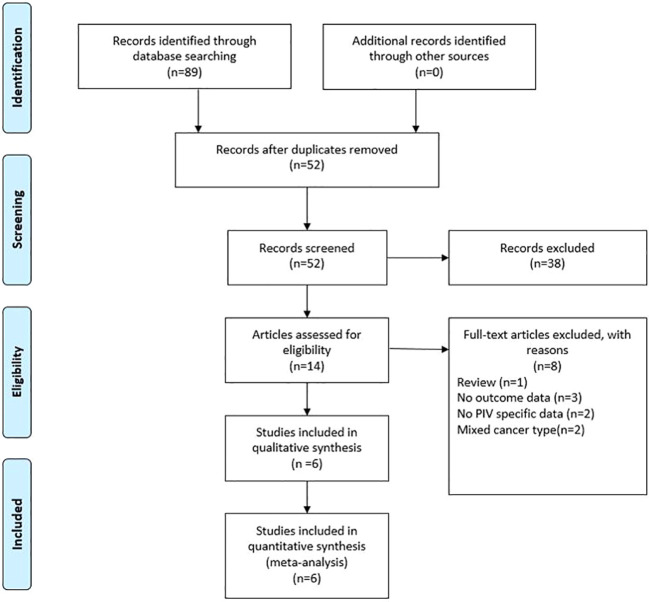 Figure 1
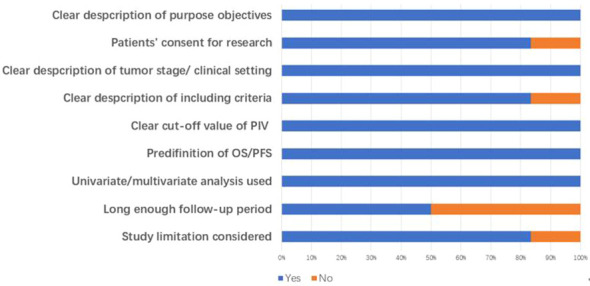 Figure 2
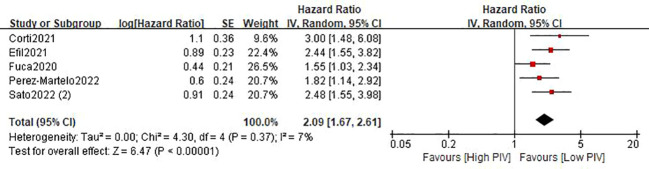 Figure 3
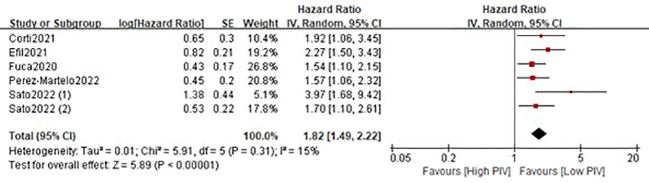 Figure 4
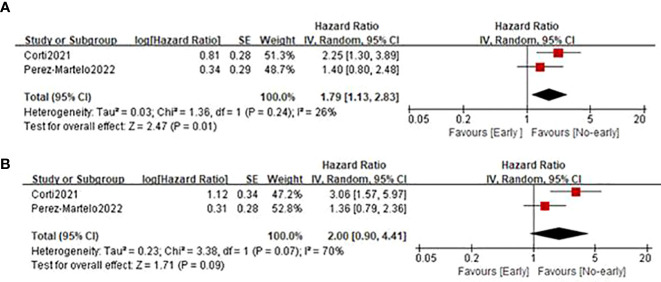 Figure 5
| Reference | Country | Study design | Study interval | Sample size | Age, years | Sex(Male/Female) | Tumor stage | Survival analysis |
|---|---|---|---|---|---|---|---|---|
| Corti, 2021[21] | Italy | M; R | 2014-2020 | 163 | NR | 90/73 | Metastatic | OS; PFS |
| Efile, 2021 [22] | Turkey | S; R | 2008-2016 | 304 | NR | NR | Non-metastatic | OS; DFS |
| Fuca, 2020 [23] | Italy | M; R | 2008-2018 | 438 | 62(IQR:53-68) | 275/163 | Metastatic | OS; PFS |
| Perez-Martelo, 2022 [24] | Spain | S; R | 2015-2018 | 130 | 68.8(range:26-88) | 96/34 | Metastatic | OS; PFS |
| Sato (1), 2022 [25] | Japan | S; R | 2013-2020 | 86 | 70(range:37-93) | 50/36 | Non-Metastatic | RFS |
| Sato (2), 2022 [26] | Japan | S; R | 2000-2019 | 758 | NR | 466/292 | Non-metastatic | OS; RFS |
| Reference | Sample size (High / Low) | Selection method | Cut-off value | Survival analysis | Median follow-up (months) | Analysis method | OSHR (95%CI) | RFS/PFS/DFSHR (95%CI) |
|---|---|---|---|---|---|---|---|---|
| Corti, 2021[21] | 163(63:100) | MSR | 492 | OS; PFS | 31 | Multivariate | 3.00 (1.49-6.04) | 1.91 (1.06-3.44) |
| Efile, 2021 [22] | 304(152:152) | Median | 491 | OS; DFS | NR | Multivariate | 2.43(1.55-3.79) | 2.28 (1.51-3.45) |
| Fuca, 2020 [23] | 438(230:208) | MSR | 380 | OS; PFS | 38.4(IQR:27.4-50.9) | Multivariate | 1.55 (1.02–2.37) | 1.53 (1.09–2.15) |
| Perez-Martelo, 2022 [24] | 130(70:60) | Literature | 380 | OS; PFS | NR | Multivariate | 1.82 (1.15–2.90) | 1.56 (1.05–2.31) |
| Sato (1), 2022 [25] | 86(63:23) | ROC | 209 | RFS | 35(range:1-104) | Multivariate | NR | 3.99 (1.69–9.45) |
| Sato (2), 2022 [26] | 758(190:568) | ROC | 376 | OS; RFS | 63.5 | Multivariate | 2.49( 1.55–3.98) | 1.70 (1.10–2.62) |
| Studies, n | Patients, n | HR (95%CI) | P value | I2 (%) | ||
|---|---|---|---|---|---|---|
| Overall survival | ||||||
| Total | 5 | 1793 | 2.09(1.67-2.61) | <0.0001 | 7 | |
| Country | Eastern | 1 | 758 | 2.48(1.55-3.98) | 0.0001 | – |
| Western | 4 | 1035 | 2.00(1.53-2.61) | <0.0001 | 17 | |
| Sample size | >200 | 3 | 1500 | 2.08(1.52-2.83) | <0.0001 | 32 |
| ≤200 | 2 | 293 | 2.18(1.36-3.48) | 0.001 | 25 | |
| Study design | Multi-center | 2 | 601 | 2.02(1.07-3.82) | 0.03 | 60 |
| Single-center | 3 | 1192 | 2.23(1.71-2.92) | <0.0001 | 0 | |
| Tumor stage | Non-metastatic | 2 | 1062 | 2.46(1.78-3.40) | <0.0001 | 0 |
| Metastatic | 3 | 731 | 1.86(1.35-2.58) | 0.0002 | 20 | |
| Progression-free survival | ||||||
| Total | 6 | 1879 | 1.82(1.49-2.22) | <0.0001 | 15 | |
| Country | Eastern | 2 | 844 | 2.39(1.06-5.40) | 0.04 | 67 |
| Western | 4 | 379 | 1.74(1.42-2.14) | <0.0001 | 0 | |
| Sample size | >200 | 3 | 1500 | 1.77(1.41-2.23) | <0.0001 | 6 |
| ≤200 | 3 | 449 | 2.02(1.28-3.20) | 0.003 | 46 | |
| Study design | Multi-center | 2 | 601 | 1.62(1.21-2.17) | 0.001 | 0 |
| Single-center | 4 | 1278 | 1.97(1.46-2.64) | <0.0001 | 36 | |
| Tumor stage | Non-metastatic | 3 | 1148 | 2.20(1.51-3.20) | <0.0001 | 37 |
| Metastatic | 3 | 731 | 1.60(1.27-2.02) | <0.0001 | 0 | |
Peer Reviews
No public reviews on file for this paper yet. If you reviewed it on a platform where reviews are public (OpenReview, ICLR, NeurIPS, ICML), you can paste yours below so the community can read it here.
Videos
No videos yet. Explain this paper in a talk, walkthrough, or lecture? Add one.
Taxonomy
TopicsInflammatory Biomarkers in Disease Prognosis · Cancer Immunotherapy and Biomarkers · Cancer, Lipids, and Metabolism
1 Background
Colorectal cancer is one of the most common malignancies in the world, accounting for about 10% of newly diagnosed cancers and cancer-related deaths (1). Despite significant advances in surgery-based multimodal therapy for colorectal malignancy, the prognosis of most patients, especially those with advanced stages, is still unsatisfactory (2–4). Consequently, it is essential to develop a useful prognostic index to predict postoperative recurrence and survival in colorectal cancers, aiming to formulate treatment plans for patients in the clinic.
Cancer-related inflammation is prevalent in most patients with malignancy, which can promote tumor progression and suppress treatment response (5, 6). Increasing evidence has reported that cancer-related inflammation plays an important role in postoperative recovery and prognosis of cancer patients (7, 8). Therefore, inflammation-based biomarkers are expected to be valuable predictors of surgical and long-term outcomes. For example, as the most common indicators of systemic inflammation, neutrophil (9), platelet (10) and monocyte (11) have been reported as strong indicators for increased postoperative complications, prolongation of hospital stays and poor survival outcomes in several types of malignancies. On the contrary, tumor-infiltrating lymphocyte subsets, such as CD8+ T cells and memory T cells, are associated with better prognosis in various tumors (12, 13).
In recent years, a novel biomarker, the pan-immune-inflammation value (PIV), which integrates peripheral neutrophil, platelet, monocyte and lymphocyte (neutrophil x platelet x monocyte/lymphocyte), has been reported as a promising predictor of long-term outcomes in cancers, because it can precisely reflect the inflammatory and immune status of patients with malignancy (14–17). A recent meta-analysis demonstrated that high PIV before treatment indicates poor prognosis in cancer patients (18). Nevertheless, the role of the PIV in survival outcomes of colorectal cancer remains inconclusive and no meta-analysis is available so far. In addition, emerging studies on the PIV and survival outcomes in colorectal cancer have been reported in recent years. Thus, we performed a systematic review and meta-analysis based on existing evidence to investigate the value of the PIV in long-term survival outcomes in patients with colorectal cancer.
2 Methods
2.1 Search strategy
The current study was performed in line with the Preferred Reporting Items for Systematic Reviews and Meta-Analyses (PRISMA) guidelines to identify studies that assess the association of PIV with survival outcomes in colorectal cancer patients. Relevant studies from PubMed, Embase and Web of Science were comprehensively examined up to August 20, 2022. Published language was not restricted during the search process. The MeSH term “pan-immune-inflammation value” was used to comprehensively identify potential studies. In addition, the references of the included studies were scanned for additional reports. The search was independently performed by two investigators (XC-Y and H-L).
2.2 Inclusion and exclusion criteria
The inclusion criteria were as follows:
(1) Studies examined the relationship between the PIV and long-term survival of patients with colorectal cancer;(2) Hazard ratios (HRs) with 95% confidence intervals (CIs) were available;(3) The cutoff value of the PIV was clearly reported.
The exclusion criteria were as follows:
(1) Studies were reported as case reports, reviews and letters;(2) Duplicated data.
2.3 Data extraction and quality assessment
Two reviewers (XC-Y and H-L) conducted the data extraction independently and cross-checked all the results. The extracted data included first author, publication year, study interval, country, study design and sample size, selection method, cut-off value, clinicopathological features like age, sex and tumor stage, and survival data.
The quality of included studies were also evaluated following this method described by Lin et al. (19), which contains predefined nine items. A study could get a final score from 0 to 9 after assessment.
2.4 Outcomes
In the present study, the primary outcomes were to investigate the relationship between the PIV and long-term survival in patients with colorectal cancer. Long-term outcomes included OS and PFS. Of note, since disease-free survival (DFS), recurrence-free survival (RFS) and PFS share the similar endpoints, they were analyzed together as one outcome, PFS, as previously suggested (20).
2.5 Statistical analysis
The HRs with their 95% CIs were used as the effect size for OS and PFS. Statistical heterogeneity among enrolled studies was assessed using I^2^ statistic. All pooled analyses were conducted assuming the random-effects model, which accounts for variance across included studies. Subgroup analysis and sensitivity analysis were utilized to evaluate the credibility of pooled results. Begg’s funnel plot was applied to assess the possibility of publication bias. A two-tailed P value <0.05 was considered statistically significant. All of these statistical analyses were performed by Review Manager Software, version 5.3 (Cochrane, London, UK) and Stata, version 12.0 (Statacorp, College Station, TX).
3 Results
3.1 Study characteristics
As shown in Figure 1, the search strategy yielded a total of 89 records. After careful title, abstract assessment and full text assessment, 6 studies (21–26) were finally included in the present study. The basic information of the included studies was shown in Tables 1, 2. A total of 1879 patients from Italy (21, 23), Turkey (22), Spain (24) and Japan (25, 26) were included in this study. These studies were published from 2020 to 2022 with a sample size ranging from 86 to 758. Among these studies, two studies (21, 23) were designed as multicenter studies, and another four studies (22, 24–26) were single-center studies. In addition, five (21–24, 26) and six studies (21–26) reported the relationship between baseline PIV and OS and PFS, respectively; and two studies (21, 24) reported the relationship between early PIV increase after treatment initiation and OS and PFS, respectively. Moreover, the cut-off value of the PIV varies a lot among these studies, ranging from 209 to 492. The quality of the included studies was good with a median score of 8 (range: 6-9, Figure 2 and Table S1).
The PRISMA Flowchart of study selection.
Quality assessment of included studies.
3.2 Relationship between baseline PIV and OS
Five studies (21–24, 26) involving 1793 patients described the association between the baseline PIV and OS. The pooled HR was 2.09 (95%CI: 1.67-2.61; P<0.0001; I^2 =^ 7%), which indicated that a high PIV was significantly associated with decreased OS in patients with colorectal cancer (Figure 3 and Table 3). Furthermore, subgroup analyses based on country, study design, sample size, and tumor stage were performed. As shown in Table 3 and Figure S1, the pooled results of all subgroup analyses revealed that patients in the high PIV group had a substantially reduced OS when compared with these in the low PIV group. Additionally, sensitivity analysis by deleting one study at a time showed that the pooled outcome did not substantially change (Figure S3A).
Forest plot assessing the relationship between PIV and OS.
3.3 Relationship between baseline PIV and PFS
A total of six studies (21–26) involving 1879 patients reported on PFS. The pooled HR was 1.82 (95%CI: 1.49-2.22; P<0.0001; I^2 =^ 15%), which suggested that patients in the high PIV group had a worse PFS when compared with patients in the low PIV group (Figure 4 and Table 3). Similarly, subgroup analyses based on country, study design, sample size, and tumor stage demonstrated that the pooled results remained consistent in each subgroup (Table 3 and Figure S2). Sensitivity analysis showed that the combined effect was not significantly changed (Figure S3B).
Forest plot accessing the relationship between PIV and PFS.
3.4 Relationship between early PIV increase and OS/PFS
Only two studies (21, 24) involving 277 cases reported the relationship between early PIV increase after the treatment initiation and survival outcomes. As shown in Figure 5, the combined results suggested that early PIV increase was substantially correlated with decreased OS (HR=1.79; 95%CI: 1.13-2.93; P=0.01; I^2 =^ 26%), and a trend toward poor PFS (HR=2.00; 95%CI: 0.90-4.41; P=0.09; I^2 =^ 70%).
Forest plot assessing the relationship between PIV dynamics and survival outcomes including OS (A) and PFS (B).
3.5 Publication bias
The Begg’s funnel plot was performed to assess the possibility of publication bias. As shown in Figure S4, the funnel plots of OS and PFS were symmetric, and the P values of Begg’s test were 0.130 and 0.060, respectively, indicating that these pooled outcomes were absence of publication bias.
4 Discussion
In 2020, Fuca et al. (23) first developed the PIV based on commonly used peripheral blood count parameters as a systemic inflammation-related prognostic biomarker for metastatic colorectal cancer. Since then, the PIV has been widely used as a cheap, readily available and reliable index to evaluate the prognosis of various cancers (27–29). In the present study, we included six studies with 1879 patients with colorectal cancer and found that high PIV was significantly associated with decreased OS and PFS. Meanwhile, we have further identified that the early PIV increase after the treatment initiation was also associated with significantly poor OS and a trend toward worse PFS in colorectal cancer patients. Therefore, the PIV may have a good discriminatory value and remains an effective inflammatory index for predicting long-term survival outcomes in colorectal cancer.
Systemic inflammatory reflection has been well confirmed to be closely associated with the occurrence and progression of malignancies (5). Increased neutrophils and monocytes in the tumor microenvironment have been reported to induce myeloid-derived suppressor cells, thereby suppressing the host immunity and prompting the tumor growth (30, 31). In addition, monocytes can differentiate into tumor-associated macrophages, which is associated with creating a favorable microenvironment for cancer development (32). Platelets are reported to secrete TGF-β, FGF and VEGF, which contribute to the epithelial–mesenchymal transition and angiogenic process (33, 34). Moreover, the interaction between platelets and tumor cells recruits and activates neutrophils and monocytes, which is required for the formation of distal metastasis sites (34). While lymphocytes, especially cytotoxic T lymphocytes, as the most important cell-mediated anti-tumor immune cells, inhibit tumor cell proliferation and metastasis by inducing the lysis and apoptosis of tumor cells (35, 36). Low lymphocyte counts have been demonstrated to lead to poor prognosis in colorectal cancer patients (37). Reasonably, the PIV, combined with neutrophils, monocytes, lymphocytes, and platelets, may enable better understanding of the functional state of patients and predict the prognosis of patients with colorectal cancer.
In our combined analysis involving 1793 samples, we identified that the baseline PIV is an independent prognostic factor of OS in patients with colorectal cancer. Furthermore, subgroup analyses based on country, study design, sample size and tumor stage showed our results were consistent and robust. Meanwhile, the sensitivity analysis showed that there was no significant change in the correlation between high PIV and decreased OS. Additionally, we have further investigated the relationship between the PIV and PFS. The pooled result including 1879 patients showed that patients in the high PIV group has a substantially decreased PFS. Similarly, the subgroup analyses and sensitivity analysis supported the reliability of this incorporated result. Furthermore, we have also preliminarily explored the relationship between the early PIV increase after the treatment initiation and survival outcomes. The integrated results showed that the early PIV increase was correlated with decreased OS and tended to have a poor PFS. However, given that there were only two studies with small samples included, these results should be interpreted with caution and more studies with big sample size were required to further classify this issue. Based on these results, the PIV may be regarded as an effective prognostic indicator of long-term results of colorectal cancer.
There are some limitations to be noted in the present study. First, all involved studies were retrospective in nature, which may increase the risk of bias, and more prospective studies and randomized controlled trials are required to further investigate this issue. Second, due to the limited number of included studies, the value of the PIV dynamics in survival outcomes needs to be further clarified. Third, the cut-off value of PIV varies greatly among studies, which might affect the clinical utility of these findings. Finally, we were also unable to compare the prognostic predictability of PIV with other biomarkers in colorectal cancer patients, with few data eligible.
5 Conclusions
The findings of the meta-analysis suggested that the PIV is of great significance in predicting long-term survival results in patients with colorectal cancer. However, further research is still required to validate the value of PIV in colorectal malignancy.
Author contributions
X-CY wrote the manuscript. X-CY and HL performed the data search and data analysis. X-CY and HL and D-CL prepared figures and tables. All authors reviewed the manuscript. X-WL and R-HC approved the final manuscript.
The reference list from the paper itself. Each links out to its DOI / PubMed record.
- 1Sung H Ferlay J Siegel RL Laversanne M Soerjomataram I Jemal A. Global cancer statistics 2020: GLOBOCAN estimates of incidence and mortality worldwide for 36 cancers in 185 countries. CA Cancer J Clin (2021) 71 (3):209–49. doi: 10.3322/caac.21660 33538338 · doi ↗ · pubmed ↗
- 2Deng Y Sun Y Lin Y Huang Y Chi P. Clinical implication of the advanced lung cancer inflammation index in patients with right-sided colon cancer after complete mesocolic excision: A propensity score-matched analysis. World J Surg Oncol (2022) 20(1):246. doi: 10.1186/s 12957-022-02712-0 35909159 PMC 9341074 · doi ↗ · pubmed ↗
- 3Ren HBösch F Pretzsch E Jacob S Westphalen CB Holch JW. Identification of an EMT-related gene signature predicting recurrence in stage II/III colorectal cancer - a retrospective study in 1780 patients. Ann Surg (2022) 276(5):897–904. doi: 10.1097/SLA.0000000000005644 35880752 · doi ↗ · pubmed ↗
- 4Gusakov EA Topchu IA Mazitova AM Dorogan LV Bulatov ER Serebriiskii IG. Design, synthesis and biological evaluation of 2-quinolyl-1,3-tropolone derivatives as new anti-cancer agents. RSC advances (2021) 11(8):4555–71. doi: 10.1039/d 0ra 10610 k PMC 812126733996031 · doi ↗ · pubmed ↗
- 5Colotta F Allavena P Sica A Garlanda C Mantovani A. Cancer-related inflammation, the seventh hallmark of cancer: Links to genetic instability. Carcinogenesis (2009) 30(7):1073–81. doi: 10.1093/carcin/bgp 127 19468060 · doi ↗ · pubmed ↗
- 6Xia J Chen Y Wen S Du X Shen B. Peripheral blood inflammation indicators as predictive indicators in Immunotherapy of advanced non-small cell lung cancer. Zhongguo fei ai za zhi = Chin J Lung cancer (2021) 24(9):632–45. doi: 10.3779/j.issn.1009-3419.2021.103.10 PMC 850398434521188 · doi ↗ · pubmed ↗
- 7Jafri SH Shi R Mills G. Advance lung cancer inflammation index (ALI) at diagnosis is a prognostic marker in patients with metastatic non-small cell lung cancer (NSCLC): A retrospective review. BMC cancer (2013) 13:158. doi: 10.1186/1471-2407-13-158 PMC 361800223530866 · doi ↗ · pubmed ↗
- 8Watanabe K Noma D Masuda H Masuda M. Preoperative inflammation-based scores predict early recurrence after lung cancer resection. J Thorac disease (2021) 13(5):2812–23. doi: 10.21037/jtd-20-3458 PMC 818250134164173 · doi ↗ · pubmed ↗