Cu(II) enhances the effect of Alzheimer’s amyloid-β peptide on microglial activation
Fengxiang Yu, Ping Gong, Zhuqin Hu, Yu Qiu, Yongyao Cui, Xiaoling Gao, Hongzhuan Chen, Juan Li

TL;DR
Copper ions increase the harmful effects of Alzheimer's peptides on brain immune cells, leading to increased inflammation and nerve damage.
Contribution
Demonstrates that Cu(II) binding to Aβ peptides enhances microglial activation and neurotoxicity through NF-κB and mitochondrial ROS.
Findings
Cu(II)-Aβ complex induces microglial activation and release of TNF-α and nitric oxide.
NF-κB activation and mitochondrial ROS are involved in Cu(II)-Aβ-induced neurotoxicity.
N-acetyl-cysteine inhibits Cu(II)-Aβ-triggered microglial neurotoxic effects.
Abstract
Aggregated forms of amyloid-β (Aβ) peptides are important triggers for microglial activation, which is an important pathological component in the brains of Alzheimer’s patients. Cu(II) ions are reported to be coordinated to monomeric Aβ, drive Aβ aggregation, and potentiate Aβ neurotoxicity. Here we investigated whether Cu(II) binding modulates the effect of Aβ on microglial activation and the subsequent neurotoxicity. Aβ peptides were incubated with Cu(II) at an equimolar ratio to obtain the Cu(II)-Aβ complex. Primary and BV-2 microglial cells were treated with Cu(II)-Aβ, Aβ, or Cu(II). The tumor necrosis factor-α (TNF-α) and nitric oxide levels in the media were determined. Extracellular hydrogen peroxide was quantified by a fluorometric assay with Amplex Red. Mitochondrial superoxide was detected by MitoSOX oxidation. Incubation of Cu(II) with Aβ confers different chemical…
Genes, proteins, chemicals, diseases, species, mutations and cell lines named across the full text — each resolved to its canonical identifier and authoritative record.
Click any figure to enlarge with its caption.
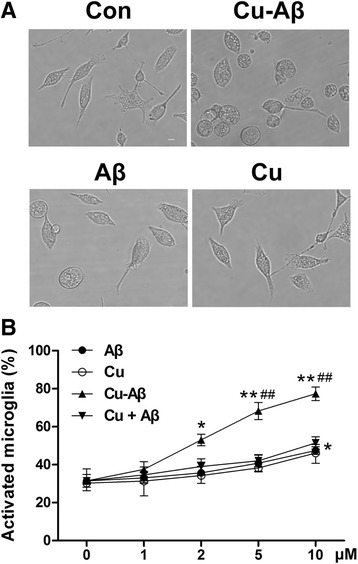 Figure 1
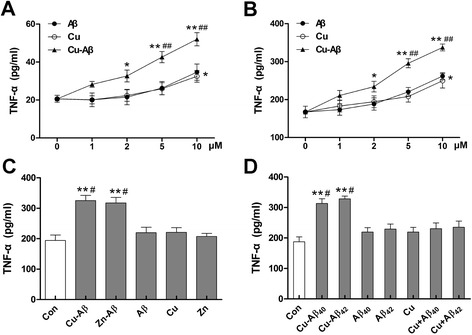 Figure 2
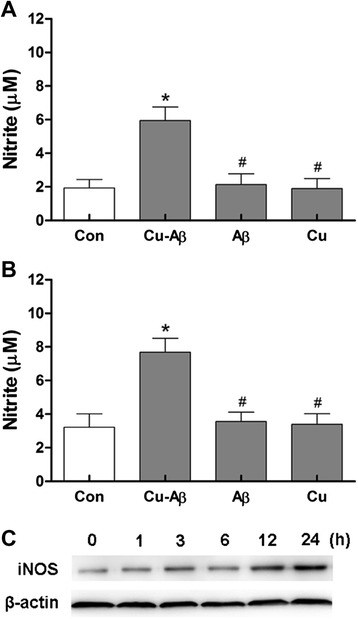 Figure 3
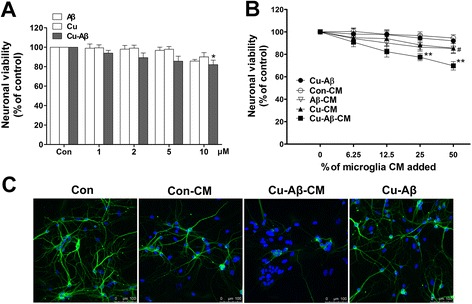 Figure 4
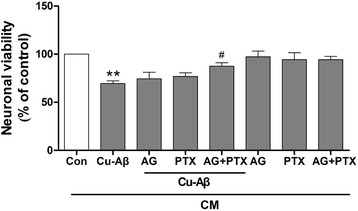 Figure 5
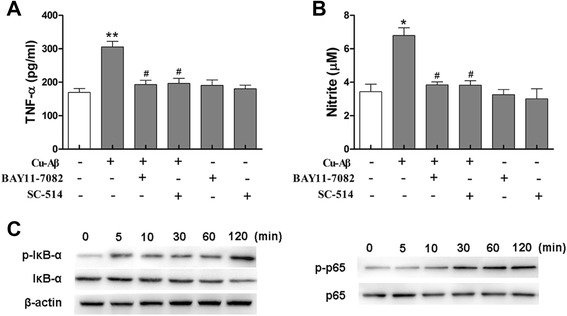 Figure 6
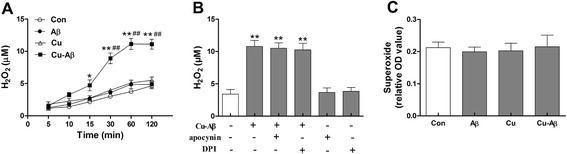 Figure 7
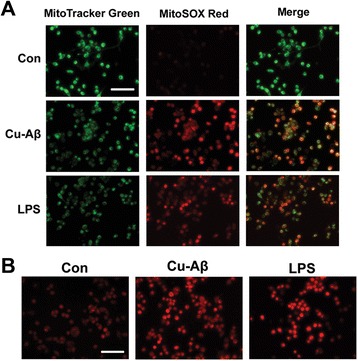 Figure 8
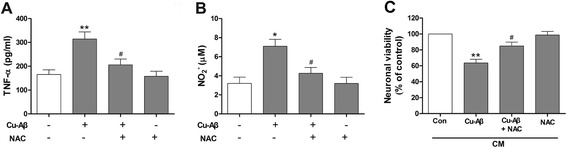 Figure 9
Peer Reviews
No public reviews on file for this paper yet. If you reviewed it on a platform where reviews are public (OpenReview, ICLR, NeurIPS, ICML), you can paste yours below so the community can read it here.
Videos
No videos yet. Explain this paper in a talk, walkthrough, or lecture? Add one.
Taxonomy
TopicsNeuroinflammation and Neurodegeneration Mechanisms · Neuroinflammation and Neurodegeneration Mechanisms · Alzheimer's disease research and treatments