Small noncoding RNA TY2 enhances efferocytosis and improves outcomes in a mouse model of sepsis
Alessandra Ciullo, Xaviar M. Jones, Hiroaki Komuro, Liang Li, Anh Nguyen, Eduardo Marbán, Ahmed Gamal-Eldin Ibrahim

TL;DR
TY2, a natural compound, reduces inflammation and improves survival in mice with severe bacterial infections.
Contribution
TY2 is shown to enhance efferocytosis and improve sepsis outcomes in a mouse model.
Findings
TY2 improves outcomes in mice with severe bacterial infection.
TY2 has potent anti-inflammatory effects.
Abstract
TY2 is a drug based on a natural compound with potent anti-inflammatory effects. TY2 improved outcomes in mice with severe bacterial infection.
Genes, proteins, chemicals, diseases, species, mutations and cell lines named across the full text — each resolved to its canonical identifier and authoritative record.
Click any figure to enlarge with its caption.
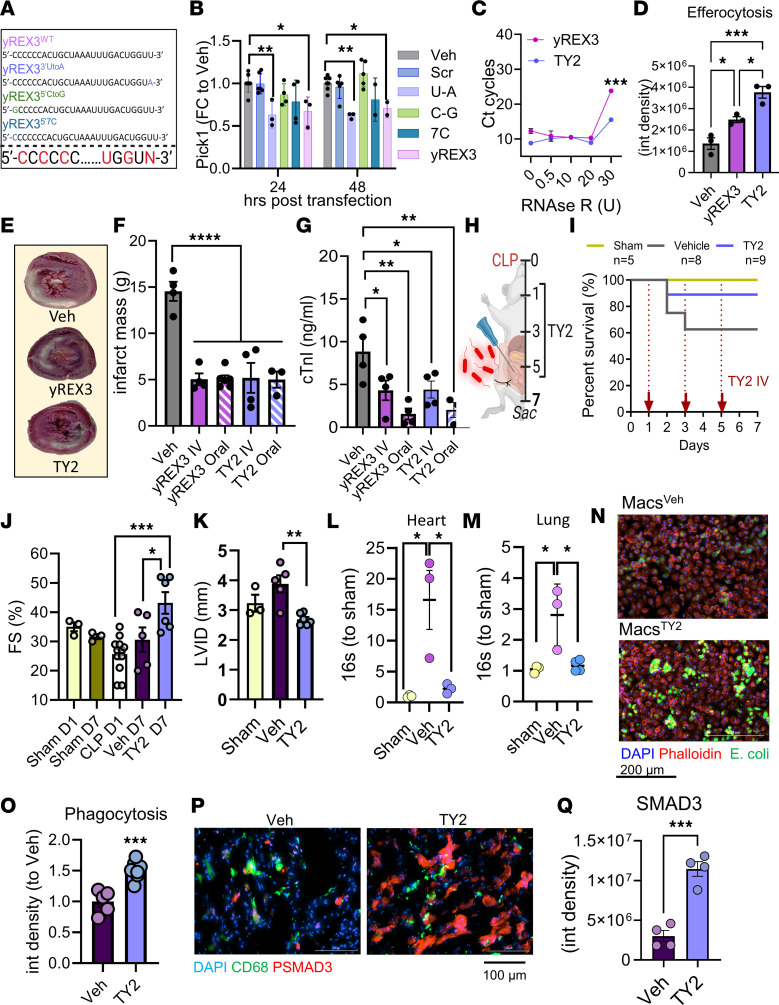 Figure 1
- —National Heart, Lung, and Blood Institutehttps://doi.org/10.13039/100000050
Peer Reviews
No public reviews on file for this paper yet. If you reviewed it on a platform where reviews are public (OpenReview, ICLR, NeurIPS, ICML), you can paste yours below so the community can read it here.
Videos
No videos yet. Explain this paper in a talk, walkthrough, or lecture? Add one.
Taxonomy
Topicsinterferon and immune responses · MicroRNA in disease regulation · Immune Response and Inflammation
To the Editor: Extracellular vesicles contain bioactive noncoding RNAs (1), including yREX3, a small Y RNA that enhances macrophage efferocytosis by suppressing protein interacting with C kinase 1 (Pick1) (2). Here, we report the development of TY2, an exomer (3) bioinspired by yREX3. TY2 includes locked nucleic acids (Figure 1A) and a point mutation (uracil to adenine, yREX3^3’UtoA^) that increased Pick1 downregulation (Figure 1B) to yield yREX3^3’UtoA^ 3 alternated, renamed TY2 by convention (1) (Supplemental Figure 1A). TY2 was more resistant to RNase degradation (Figure 1C) and enhanced efferocytosis more potently compared with yREX3 (Figure 1D and Supplemental Figure 1B). Rats fed (4) TY2 or yREX3 (3.25 ng/g) after reperfusion had smaller infarcts by histology or circulating cardiac troponin I 48 hours after myocardial infarction (MI) (Figure 1, E–G). Thus, relative to yREX3, TY2 is more stable and at least bioequivalent. To test TY2 in sepsis, we induced cecal ligation and puncture (CLP) in 6-week-old C57BL/6 mice (5) (Figure 1H). Seven days after ligation, mice receiving TY2 showed improved survival (Figure 1I) and greater weight loss, largely due to reduced ascites (Supplemental Figure 1, C and D). Spleen weight was significantly reduced in TY2-treated mice compared with sham mice, indicating reduced inflammation (Supplemental Figure 1, E and F). Serum lactate and aspartate aminotransferase (6) were also attenuated by TY2 (Supplemental 1, G and H). Blood glucose levels decreased in all septic animals compared with sham mice (6) (Supplemental Figure 1I). Echocardiography 1 day after CLP (before treatment) and at endpoint (day 7) revealed reduced cardiac dysfunction (Figure 1J and Supplemental Figure 1J) and remodeling (Figure 1K) with TY2 compared with vehicle. Bacterial counts at endpoint were lower in hearts and lungs of TY2-treated mice (cf. vehicle; Figure 1, L and M). In vitro, macrophages from bone marrow take up inactivated E. coli particles conjugated with a fluorophore as a reporter of efferocytosis. Exposure to TY2 increased efferocytosis relative to vehicle (Figure 1, N and O; cf. Supplemental Figure 1, B and D); the effect was independent of animal sex (Supplemental Figure 2, A and B) and time dependent (Supplemental Figure 2C). In vivo, SMAD3 phosphorylation was increased in hearts from CLP mice exposed to TY2, consistent with increased efferocytotic activity (Figure 1, P and Q) and the protective role of PSMAD3 in mitigating inflammation in sepsis (7). Indeed, mice receiving TY2 showed decreased levels of inflammatory cytokines Tnfa, Il1b, and Il10; a trend for a decrease in Il6 in heart samples; and, in the lungs, decreased Il1b (Supplemental Figure 1K), consistent with less severe sepsis (6). Thus, TY2 mimics yREX3 mechanistically while being more stable, making it worth testing in settings such as sepsis where enhanced efferocytosis may be beneficial.
For detailed methods, information regarding sex as a biological variable, statistics, study approval, author contributions, data availability statement, and acknowledgments, see the supplemental materials.
Funding support
This work is the result of NIH funding, in whole or in part, and is subject to the NIH Public Access Policy. Through acceptance of this federal funding, the NIH has been given a right to make the work publicly available in PubMed Central.
National Heart, Lung, and Blood Institute (R01 HL142579 to AGEI, R01 HL175335 to AGEI, and NIH T32 HL116273).CIRM (TRAN1-15317 to AGEI).Mark S. Siegel Family Foundation Distinguished Chair of Cedars-Sinai Medical Center to EM.
Supplementary Material
Supplemental data
Supporting data values
The reference list from the paper itself. Each links out to its DOI / PubMed record.
- 1Marban E Deconstructing regenerative medicine: from mechanistic studies of cell therapy to novel bioinspired RNA drugs Circ Res 2024135887788510.1161/CIRCRESAHA.124.32305839325847 PMC 11469554 · doi ↗ · pubmed ↗
- 2Ciullo A et al Non-coding RNA y REX 3 from human extracellular vesicles exerts macrophage-mediated cardioprotection via a novel gene-methylating mechanism Eur Heart J 202445292660267310.1093/eurheartj/ehae 35738865332 PMC 11297535 · doi ↗ · pubmed ↗
- 3Ibrahim AGE et al Augmentation of DNA exonuclease TREX 1 in macrophages as a therapy for cardiac ischemic injury Sci Transl Med 202517827 eadp 133810.1126/scitranslmed.adp 133841337545 PMC 12991824 · doi ↗ · pubmed ↗
- 4Yamaguchi S et al Oral bioavailability of a noncoding RNA drug, TY 1, that acts on macrophages J Extracell Biol 202548 e 7008110.1002/jex 2.7008140823342 PMC 12353012 · doi ↗ · pubmed ↗
- 5Deitch EA Rodent models of intra-abdominal infection Shock 200524 Suppl 1192310.1097/01.shk.0000191386.18818.0a 16374368 · doi ↗ · pubmed ↗
- 6Bozza FA et al Cytokine profiles as markers of disease severity in sepsis: a multiplex analysis Crit Care 2007112 R 4910.1186/cc 578317448250 PMC 2206478 · doi ↗ · pubmed ↗
- 7Gauthier T et al Activin A activation of Smad 3 mitigates innate inflammation in mouse models of psoriasis and sepsis J Clin Invest 20251359 e 18706310.1172/JCI 18706340067393 PMC 12043092 · doi ↗ · pubmed ↗