Cascade Valorisation of Lemon Processing Residues (Part II): Integrated Biorefinery Design, Circular Economy, and Techno-Economic Feasibility
Jimmy Núñez-Pérez, Jhomaira L. Burbano-García, Rosario Espín-Valladares, Marco V. Lara-Fiallos, Juan Carlos DelaVega-Quintero, Marcelo Cevallos-Vallejos, José-Manuel Pais-Chanfrau

TL;DR
This paper reviews the feasibility of using lemon processing waste in biorefineries to produce valuable products and energy, showing it can be economically and environmentally beneficial at large scales.
Contribution
The paper provides a comprehensive techno-economic and environmental analysis of integrated lemon biorefineries, highlighting their viability and critical success factors.
Findings
Cascade biorefineries can generate USD 400–650 per tonne of dry peel by recovering multiple products.
Industrial-scale biorefineries (100,000+ tonnes/year) can achieve internal rates of return exceeding 18%.
Greenhouse gas emissions can be reduced by 60–85% compared to conventional disposal methods.
Abstract
This review examines the implementation dimensions of integrated lemon biorefinery systems, including cascade valorisation design, circular-economy integration, life-cycle assessment, techno-economic feasibility, and regulatory frameworks. Bibliometric analysis of Web of Science data (2015–2025) reveals exponential growth in citrus-biorefinery research, with lemon representing a burgeoning subset. Techno-economic assessments indicate that cascade biorefineries recovering essential oils, pectin, polyphenols, nanocellulose, and bioenergy can achieve cumulative revenues of USD 400–650 per tonne of dry peel. Whilst small-scale units (<500 tonnes per year) struggle to achieve viability, industrial simulations demonstrate Internal Rates of Return exceeding 18% at processing scales above 100,000 tonnes annually (2025 basis). Life-cycle assessments confirm environmental benefits, with…
Genes, proteins, chemicals, diseases, species, mutations and cell lines named across the full text — each resolved to its canonical identifier and authoritative record.
Click any figure to enlarge with its caption.
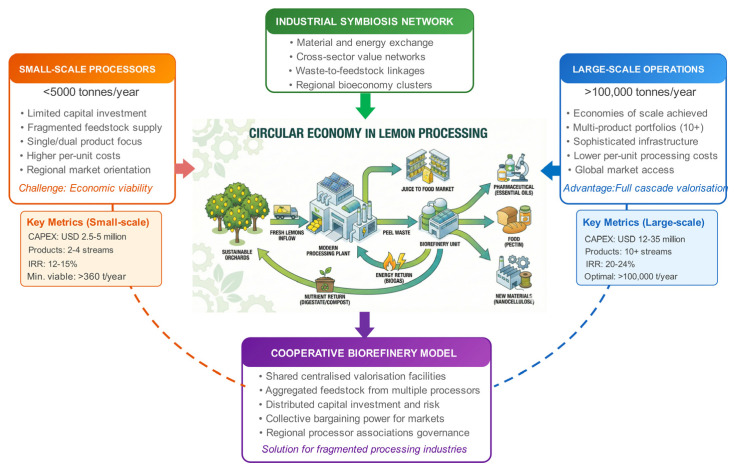 Figure 1
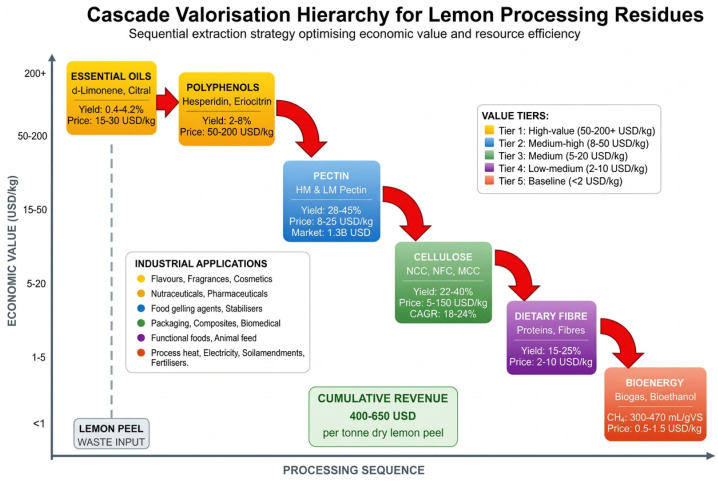 Figure 2
 Figure 3
 Figure 4
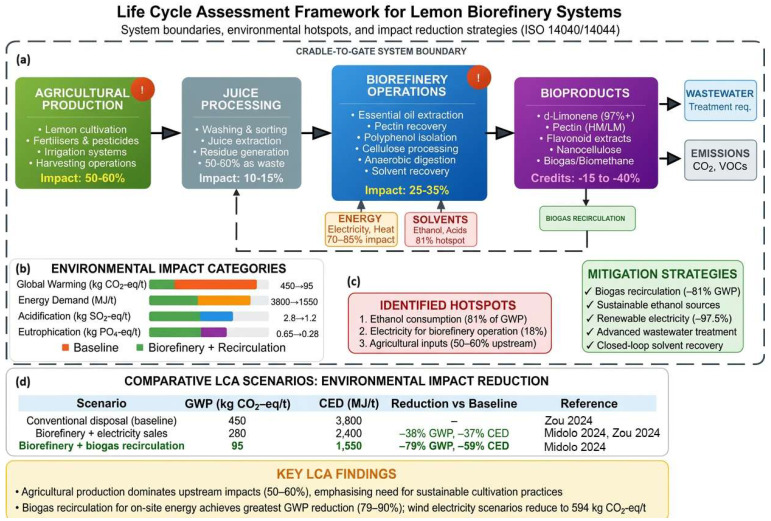 Figure 5
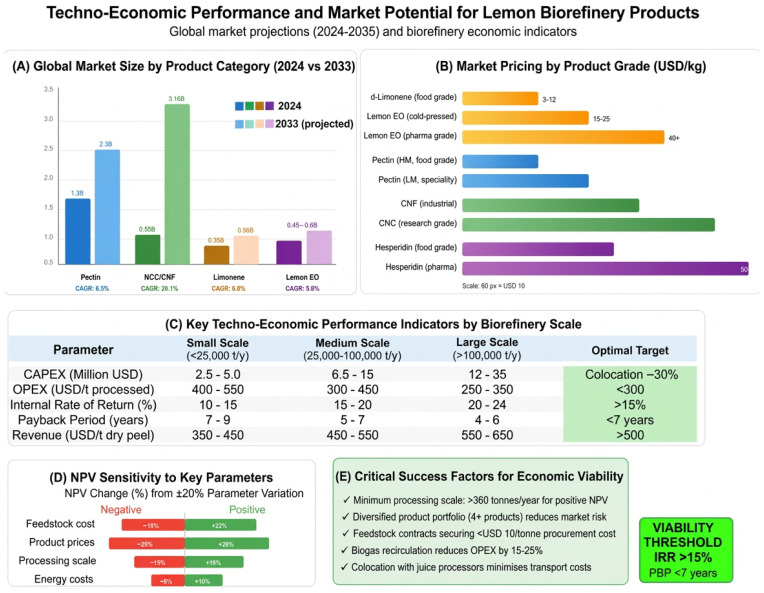 Figure 6
Peer Reviews
No public reviews on file for this paper yet. If you reviewed it on a platform where reviews are public (OpenReview, ICLR, NeurIPS, ICML), you can paste yours below so the community can read it here.
Videos
No videos yet. Explain this paper in a talk, walkthrough, or lecture? Add one.
Taxonomy
TopicsBiofuel production and bioconversion · Enzyme Catalysis and Immobilization · Anaerobic Digestion and Biogas Production