Photocaged FLP recombinase for precise spatio-temporal control of gene expression
Jose Javier Vazquez Rodriguez, Kieran Baxter, Yunchuan Ma, Sebastian Greiss

TL;DR
Researchers created a light-controlled FLP recombinase to precisely turn on gene expression in specific cells of C. elegans using short laser pulses.
Contribution
A photocaged FLP recombinase was developed for spatio-temporal gene control in multicellular organisms.
Findings
Photocaged FLP has no background activity and can be activated with nearly 100% efficiency using light.
The photocaged FLP can be activated with a 405 nm laser for cell-specific gene expression in C. elegans.
The tool is compatible with imaging and optogenetics wavelengths and requires <10 ms illumination per cell.
Abstract
The ability to precisely control gene expression is fundamental to studying biological processes. Using site-specific recombinases such as FLP, gene expression can be controlled, albeit with limited spatio-temporal precision. We develop a photocaged FLP recombinase, which can be precisely controlled using light, and we demonstrate its efficacy in Caenorhabditis elegans. We use genetic code expansion to incorporate photocaged amino acids into FLP, replacing critical residues in the active site with their photocaged counterparts. Photocaged FLP displays no detectable background activity, and brief illumination can be used to activate FLP with near 100% efficiency. We show that photocaged FLP can be activated by light between 365 and 435 nm, and that it is not activated by light above 450 nm, making it fully compatible with wavelengths commonly used for imaging and optogenetics.…
Genes, proteins, chemicals, diseases, species, mutations and cell lines named across the full text — each resolved to its canonical identifier and authoritative record.
Click any figure to enlarge with its caption.
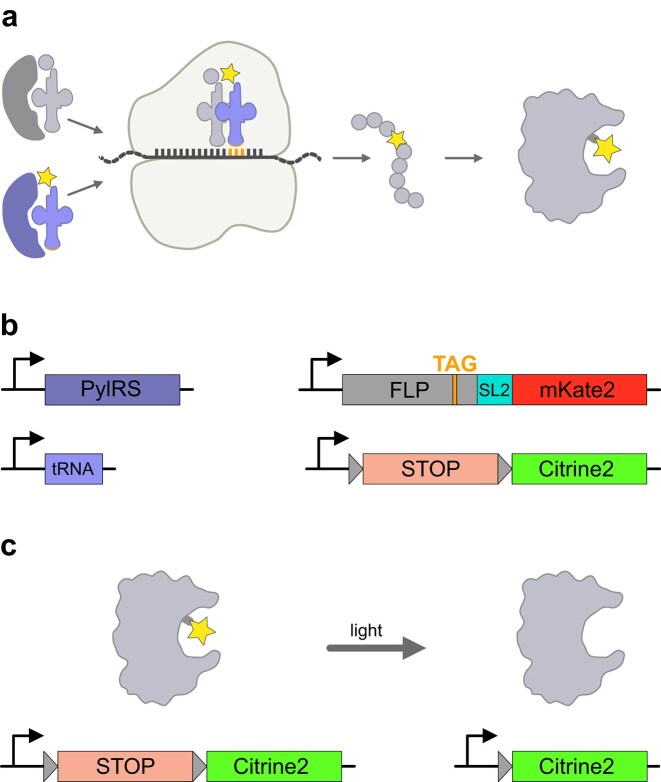 Figure 1
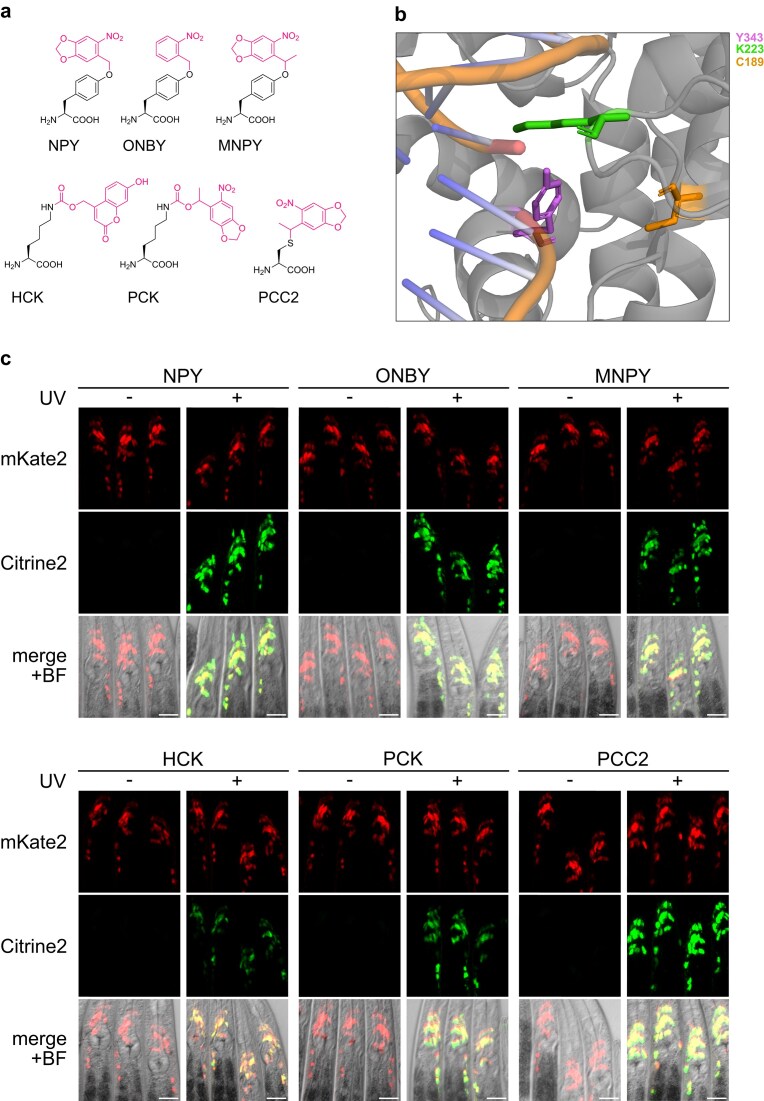 Figure 2
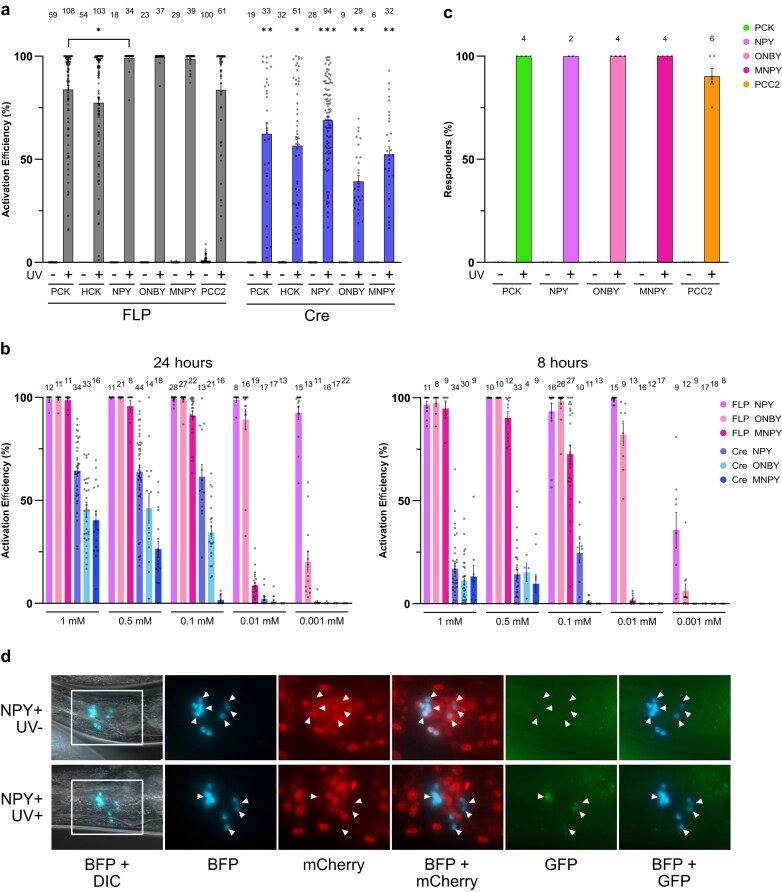 Figure 3
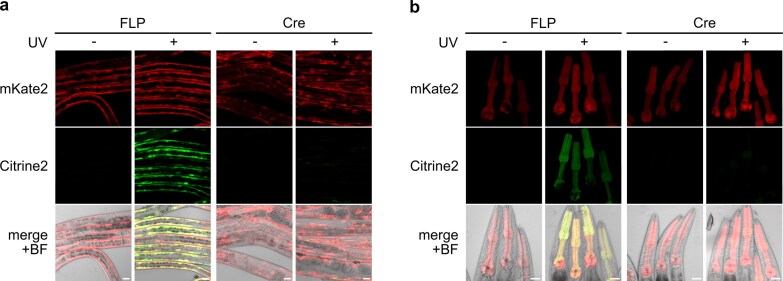 Figure 4
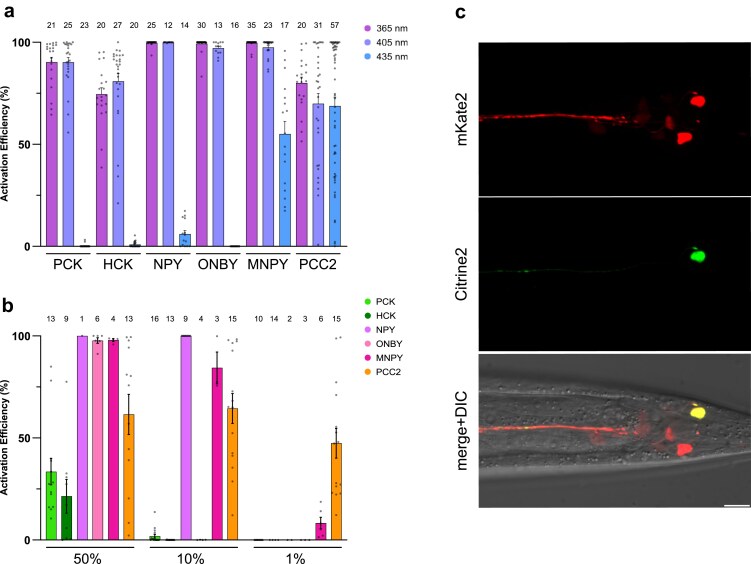 Figure 5
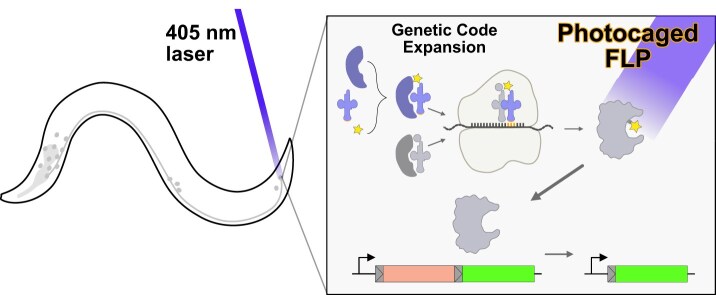 Figure 6
Peer Reviews
No public reviews on file for this paper yet. If you reviewed it on a platform where reviews are public (OpenReview, ICLR, NeurIPS, ICML), you can paste yours below so the community can read it here.
Videos
No videos yet. Explain this paper in a talk, walkthrough, or lecture? Add one.
Taxonomy
TopicsPhotochromic and Fluorescence Chemistry · Light effects on plants · Photoreceptor and optogenetics research