Second-line chemotherapy after gemcitabine plus nab-paclitaxel in metastatic pancreatic cancer: comparative outcomes and AI-guided treatment selection
Letizia Procaccio, Guido Giordano, Federico Nichetti, Michele Milella, Andrea Pretta, Donatella Iacono, Monica Niger, Simona Casalino, Caterina Vivaldi, Ferdinando De Vita, Valeria Pusceddu, Matteo Landriscina, Giacomo Di Paolo, Sara Sperotto, Mariachiara Masucci

TL;DR
This study compares second-line chemotherapy options for metastatic pancreatic cancer after gemcitabine+nab-paclitaxel and uses AI to guide treatment decisions.
Contribution
The study introduces interpretable AI methods to optimize treatment allocation for metastatic pancreatic cancer patients.
Findings
FOLFIRINOX showed the longest progression-free and overall survival among second-line regimens.
AI-derived treatment policies outperformed uniform strategies with a 2.5 percentage-point net benefit.
Nal-IRI+5FU/LV was recommended for specific patient subgroups based on tumor location and biomarkers.
Abstract
International guidelines recommend 5FU/LV, Nal-IRI + 5FU/LV, FOLFIRI, FOLFOX, or (m)FOLFIRINOX as second-line (2L) chemotherapy for patients with metastatic pancreatic ductal adenocarcinoma (mPDAC) after failure of gemcitabine+Nab-paclitaxel (GnP). However, a head-to-head comparison has not been performed. We conducted an observational cohort study of consecutive mPDAC patients treated with 2L chemotherapy after GnP failure at 41 Italian centers. Progression-free survival (PFS) and overall survival (OS) were compared using inverse probability of treatment weighting. Interpretable artificial intelligence methods were applied to optimize treatment allocation. A counterfactual Cox model was trained on baseline characteristics to estimate 12-month PFS under each regimen, and an Optimal Policy Tree (OPT) was derived to generate treatment recommendations, validated in a test set. Net-benefit…
Genes, proteins, chemicals, diseases, species, mutations and cell lines named across the full text — each resolved to its canonical identifier and authoritative record.
Click any figure to enlarge with its caption.
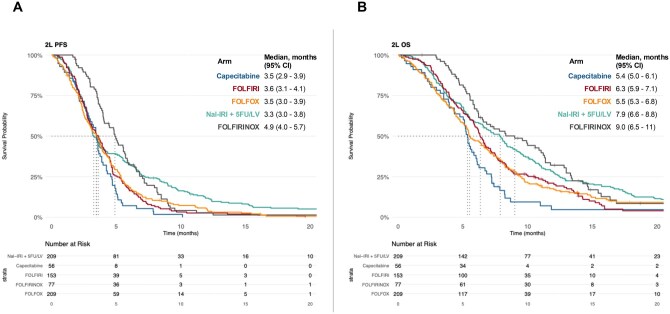 Figure 1
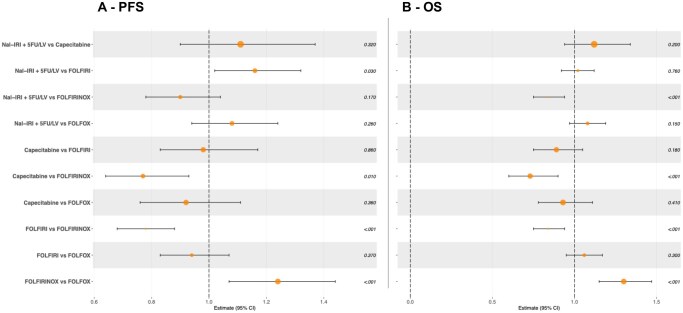 Figure 2
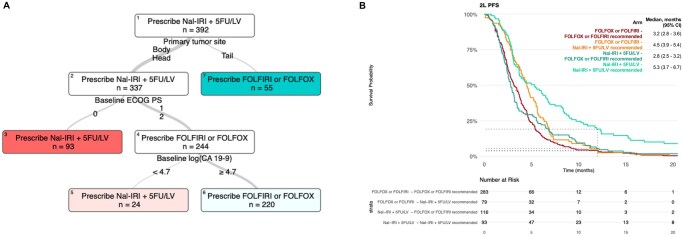 Figure 3
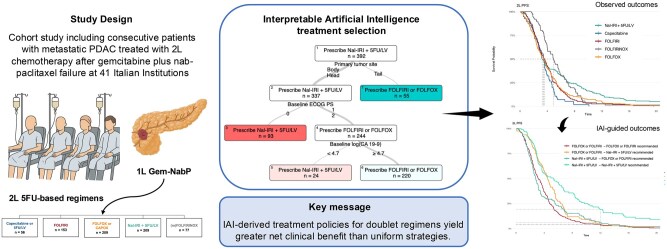 Figure 4
Peer Reviews
No public reviews on file for this paper yet. If you reviewed it on a platform where reviews are public (OpenReview, ICLR, NeurIPS, ICML), you can paste yours below so the community can read it here.
Videos
No videos yet. Explain this paper in a talk, walkthrough, or lecture? Add one.
Taxonomy
TopicsPancreatic and Hepatic Oncology Research · Renal cell carcinoma treatment · Artificial Intelligence in Healthcare and Education