CuCl-Promoted β‑Acylation of Cyclopropanols with Thioesters
Savva Ponomarev, Sandra W. Papińska, Michael Stier, Johannes Kästner, Ivana Fleischer

TL;DR
This paper introduces a new copper chloride-promoted chemical reaction that efficiently produces 1,4-dicarbonyl compounds from cyclopropanols and thioesters.
Contribution
The study presents a novel CuCl-promoted β-acylation method with high selectivity and yield for synthesizing 1,4-dicarbonyl compounds.
Findings
A variety of cyclopropanols and thioesters successfully underwent CuCl-promoted β-acylation.
The mechanism involves Cu(I)-homoenolate reacting with thioester via oxidative addition.
The method offers high chemoselectivity, regioselectivity, and good to excellent yields.
Abstract
CuCl-induced cyclopropyl alcohol ring-opening followed by β-acylation with thioester is reported. Cyclopropanols and thioesters with various substitution patterns were successfully subjected to the reaction, and a series of 1,4-dicarbonyl compounds were synthesized. The mechanistic investigation revealed the involvement of Cu(I)-homoenolate, which reacts with the thioester via oxidative addition. Both experimental and computational evidence were found. Operational simplicity, high chemo- and regioselectivity, and good to excellent yields are the core features of the presented approach.
Genes, proteins, chemicals, diseases, species, mutations and cell lines named across the full text — each resolved to its canonical identifier and authoritative record.
Click any figure to enlarge with its caption.
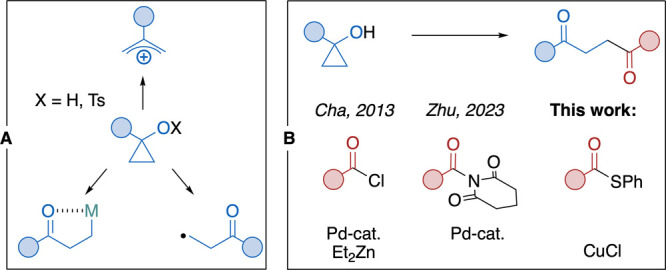 Figure 1
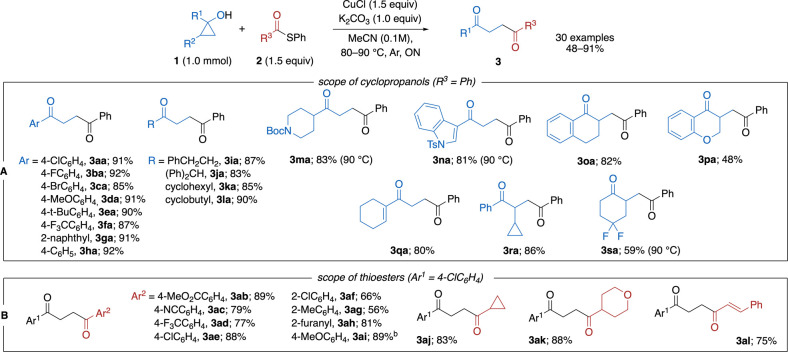 Figure 2
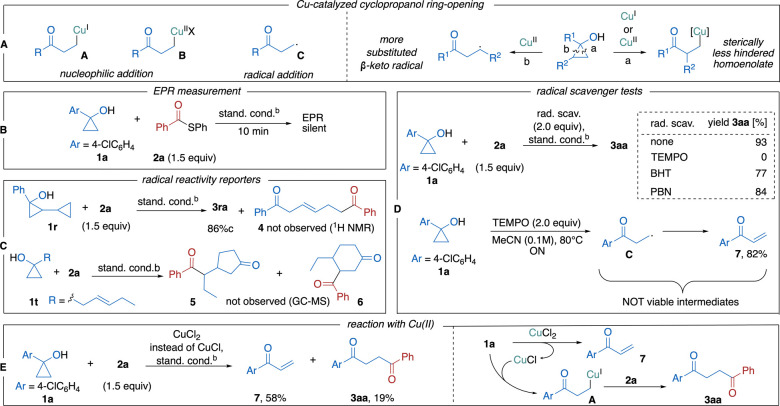 Figure 3
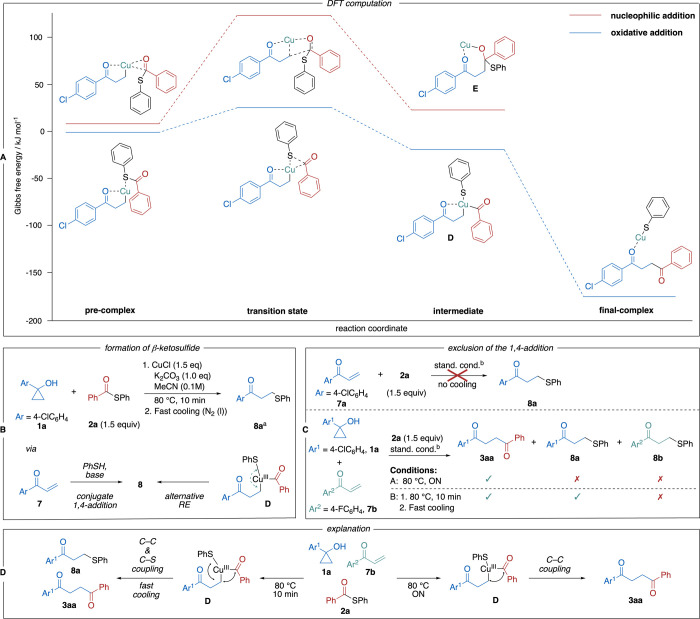 Figure 4
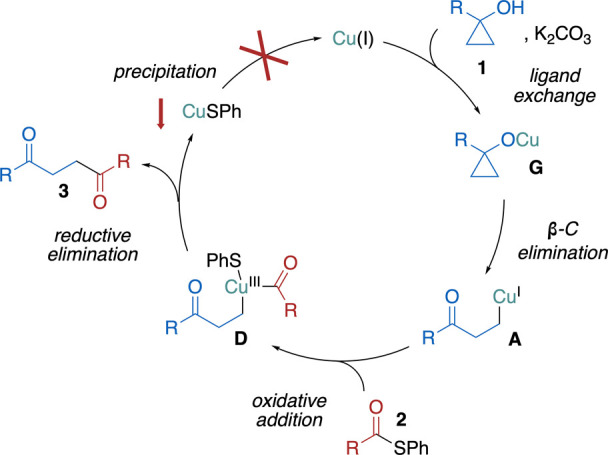 Figure 5
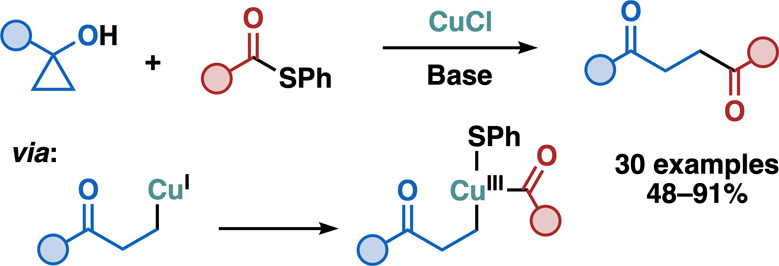 Figure 6
 Figure 7
Peer Reviews
No public reviews on file for this paper yet. If you reviewed it on a platform where reviews are public (OpenReview, ICLR, NeurIPS, ICML), you can paste yours below so the community can read it here.
Videos
No videos yet. Explain this paper in a talk, walkthrough, or lecture? Add one.
Taxonomy
TopicsCatalytic C–H Functionalization Methods · Sulfur-Based Synthesis Techniques · Cyclopropane Reaction Mechanisms