Precision percutaneous coronary intervention
Travis M. Wilson, Uzair Munaf, Nafhat Shaikh, Affan Rizwan, Riyan Siddiqui, Hafeez Ul Hassan Virk, Mahboob Alam, Umair Khalid, Muzamil Khawaja, Tanawat Attachaipanich, Larisa H. Cavallari, Tania Ahuja, Michael G. Nanna, Samin K. Sharma, Lloyd W. Klein, Gary S. Mintz

TL;DR
This paper discusses how precision-based PCI improves outcomes by using advanced strategies before, during, and after the procedure.
Contribution
The paper highlights the integration of precision strategies in PCI to enhance outcomes and reduce complications.
Findings
Precision PCI strategies reduce adverse events and improve procedural efficiency.
Artificial intelligence and pharmacogenomics may enhance personalization in PCI.
Clinical utility of AI and pharmacogenomics in PCI is still in early development.
Abstract
Precision-based percutaneous coronary intervention (PCI) integrates contemporary strategies across the pre-, intra-, and post-procedural phases to improve outcomes and minimize complications. Emerging evidence underscores the value of these strategies in reducing adverse events and improving procedural efficiency. While artificial intelligence and pharmacogenomics hold long-term promise for enhancing personalization, their clinical utility in PCI remains in the early stages of development.
Genes, proteins, chemicals, diseases, species, mutations and cell lines named across the full text — each resolved to its canonical identifier and authoritative record.
Click any figure to enlarge with its caption.
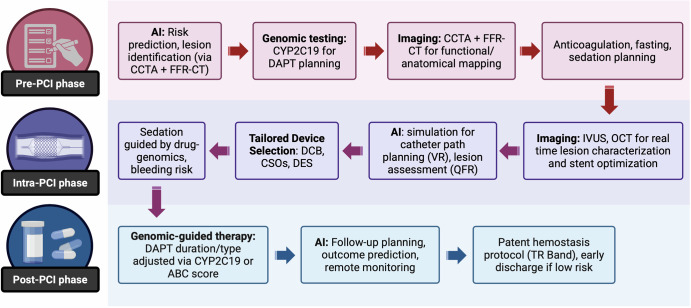 Figure 1
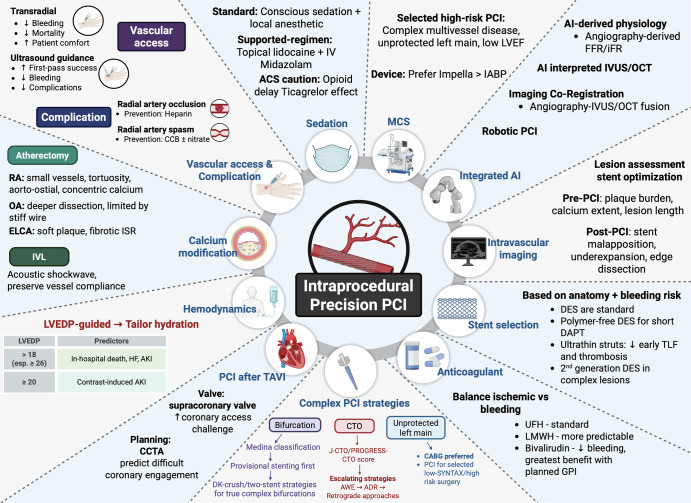 Figure 2
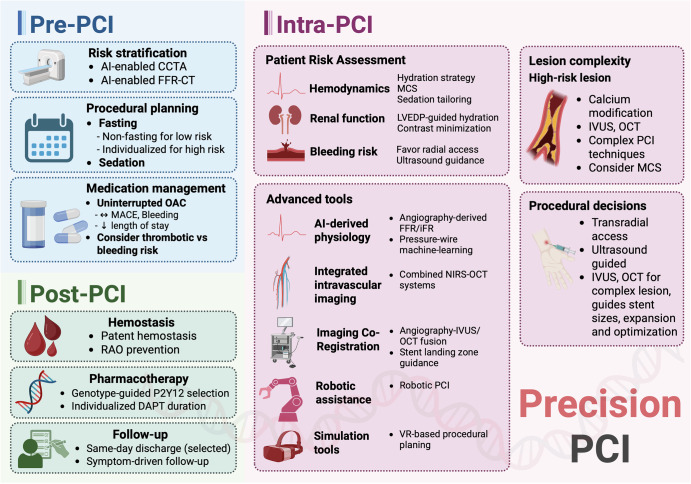 Figure 3
Peer Reviews
No public reviews on file for this paper yet. If you reviewed it on a platform where reviews are public (OpenReview, ICLR, NeurIPS, ICML), you can paste yours below so the community can read it here.
Videos
No videos yet. Explain this paper in a talk, walkthrough, or lecture? Add one.
Taxonomy
TopicsCoronary Interventions and Diagnostics · Antiplatelet Therapy and Cardiovascular Diseases · Cardiac and Coronary Surgery Techniques