Complete Genome Annotation of Mycobacteriophage Kremtemulon
Cole R. Jirsa, Bethany M. Wise, Kaylia Edwards, Jerusalem Mussie, Owen Tolbert, Danielle M. Heller

TL;DR
This paper presents the full genome analysis of a temperate phage called Kremtemulon, which infects Mycobacterium smegmatis.
Contribution
The study provides a complete genome annotation and classification of the mycobacteriophage Kremtemulon into Cluster A, Subcluster A4.
Findings
Kremtemulon has a 51,438 bp genome encoding 87 putative genes, 36 with predicted functions.
The phage is classified into Cluster A, Subcluster A4 based on gene content.
Kremtemulon is identified as a temperate phage due to its turbid plaques and presence of an immunity repressor and tyrosine integrase.
Abstract
Kremtemulon is a siphovirus isolated on the host bacterium Mycobacterium smegmatis mc 2 155 with a genome spanning 51,438 bp in length. Kremtemulon encodes 87 putative genes, 36 of which have predicted functions, and based on gene content, is assigned to Cluster A and Subcluster A4. Kremtemulon forms turbid plaques and encodes for both an immunity repressor and a tyrosine integrase, suggesting that Kremtemulon is a temperate phage.
Genes, proteins, chemicals, diseases, species, mutations and cell lines named across the full text — each resolved to its canonical identifier and authoritative record.
Click any figure to enlarge with its caption.
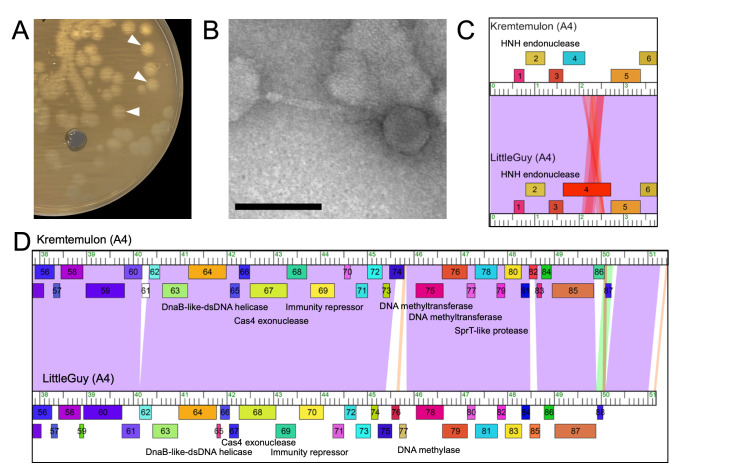 Figure 1
Peer Reviews
No public reviews on file for this paper yet. If you reviewed it on a platform where reviews are public (OpenReview, ICLR, NeurIPS, ICML), you can paste yours below so the community can read it here.
Videos
No videos yet. Explain this paper in a talk, walkthrough, or lecture? Add one.
Taxonomy
TopicsBacteriophages and microbial interactions · Genomics and Phylogenetic Studies · vaccines and immunoinformatics approaches
Description
Bacteriophages are critical components for understanding microbial ecology and offer promising alternatives to traditional antibiotics (Hatfull, 2020). Here, we report the isolation and characterization of Kremtemulon, a mycobacteriophage that infects Mycobacterium smegmatis mc²155.
Kremtemulon was isolated from a soil sample collected near a tranquil stream bank in Williamsburg, VA (GPS coordinates: 37.271102º N, 76.716221º W). After collection, the soil sample was resuspended in liquid medium (Middlebrook 7H9 broth supplemented with 145 mM NaCl, 5% Albumin fraction V, 2% dextrose, and 1 mM CaCl 2 ) and the suspension filtered (0.22-μm pore size). The filtrate was enriched for mycobacteriophages by inoculation with M. smegmatis mc²155 followed by incubation at 37 ºC with constant agitation for 48 h. The enriched sample was re-filtered and the filtrate plated with Middlebrook 7H9 top agar supplemented with 1 mM CaCl 2 and *M. smegmatis * mc ^2^ 155 to isolate plaques, which were then subjected to multiple rounds of plaque purification on similar top agar lawns. Plates with a high density of plaques were flooded with phage buffer (10 mM Tris pH 7.5, 10 mM MgSO 4 , 68 mM NaCl, 1 mM CaCl 2 ), and the collected liquid was filtered to generate a high-titer lysate. Kremtemulon forms large, turbid plaques, which is indicative of a temperate phage ( Figure 1A ). Transmission electron microscopy with negative staining (1% uranyl acetate) revealed that Kremtemulon is a siphovirus ( Figure 1B ), with an icosahedral head measuring 57 ± 1.0 nm in diameter (mean ± standard error, n =10 viral particles) and a non-contractile tail measuring 146 ± 4.8 nm in length (mean ± standard error, n =8 viral particles).
Kremtemulon genomic DNA was isolated from a high titer lysate using the Promega Wizard DNA Clean-Up Kit. Sequencing of Kremtemulon's genome was performed using an Illumina MiSeq platform (v3 reagents) at the Pittsburgh Bacteriophage Institute, with a library prepared using the NEBNext Ultra II FS DNA Library Prep Kit. This produced 557,541 150-base single-end reads resulting in ~1,534x coverage of the genome. Assembly of the raw reads was completed using Newbler v2.9 (Silva et al., 2013) , and assembly quality and completeness were confirmed with Consed v29 (Gordon & Green, 2013) using default parameters. The Kremtemulon genome is 51,438 base pairs in length with a GC content of 63.9%, similar to the 67.4% GC content of it its isolation host *M. smegmatis * mc ^2^ 155. The Kremtemulon genome contains 3′ single-stranded overhanging ends (5′-CGGCCGGTAA).
Annotation of the Kremtemulon genome was performed using the annotation platforms DNAMaster (http://cobamide2.bio.pitt.edu/) and PECAAN (v20240320; https://discover.kbrinsgd.org/). Open reading frames were first predicted using Glimmer v3.02 (Delcher et al., 2007) and GeneMark v4.28 (Besemer & Borodovsky, 2005), and then manually refined using the additional tools Starterator v558 for start site determination and Phamerator v3 (Cresawn et al., 2011) for comparative genomic visualization. Functional assignments were informed by BLASTp v2.13.0 (Altschul et al., 1990) against the NCBI non-redundant and Actinobacteriophage databases (v581), and by HHPred v3 (Söding et al., 2005) searches against the PDB_mmCIF70, Pfam-A v37, SCOPe v2.08, and NCBI Conserved Domain Database v3.20. All software was run using default parameters.
Kremtemulon was assigned to Cluster A and further sorted into Subcluster A4 based on gene content similarity of 35% or higher to other phages in the Actinobacteriophage database (Gauthier & Hatfull, 2023; Russell & Hatfull, 2016). A pairwise comparison between Kremtemulon and LittleGuy reveals 90.29% gene content similarity in these two A4 mycobacteriophages (Russell & Hatfull, 2016). Kremtemulon encodes for a serine integrase (gene 33 ) and a putative immunity repressor (gene 69 ), suggesting that it like many other Cluster A phages may be temperate (Hatfull, 2020; Mavrich & Hatfull, 2019), though the ability of Kremtemulon to form stable lysogens has not yet been experimentally demonstrated.
The Kremtemulon genome does exhibit some features that are distinctive from other cluster A4 mycobacteriophages. Most notably, between genes *74 * and *75, * Kremtemulon lacks two conserved genes of unknown function that are typically found near the immunity repressor region in other A4 genomes (e.g., LittleGuy genes 76 and 77 ), suggesting a potential gene deletion event. Additionally, gene
- 4* is truncated compared to homologous genes in other A4 phages due to a single base change that introduces an early stop codon, resulting in a gene product that is only 163 amino acids as opposed to the 357 amino acid homolog LittleGuy gene 4 . This gene product is annotated as a minor tail protein in many A4 genomes, and the truncation seen in Kremtemulon suggests that the full-length protein is likely not necessary for phage infection or virion assembly. Kremtemulon also contains two genes of unknown function that are uncommon in the Actinobacteriophage database. Gene 86 is uncommon within A4 mycobacteriophage genomes, with homologs found in only two other A4 phages, whereas gene 61 is an orphan gene with no homologous gene sequences identified in any other genomes currently in the Actinobacteriophage database. Altogether, these differences between closely related mycobacteriophage genomes underscore the complex, ongoing evolution of this population.
** Data Accesibility **
Kremtemulon is available on GenBank with the accession number PQ559668 , and the Sequence Read Archive (SRA) number SRX31207614 .
The reference list from the paper itself. Each links out to its DOI / PubMed record.
- 1Altschul Stephen F. Gish Warren Miller Webb Myers Eugene W. Lipman David J. 1990101 Basic local alignment search tool Journal of Molecular Biology 21530022-283640341010.1016/s 0022-2836(05)80360-22231712 · doi ↗ · pubmed ↗
- 2Besemer J. Borodovsky M. 200571 Gene Mark: web software for gene finding in prokaryotes, eukaryotes and viruses Nucleic Acids Research 33Web Server 0305-1048 W 451W 45410.1093/nar/gki 48715980510 PMC 1160247 · doi ↗ · pubmed ↗
- 3Cresawn Steven G Bogel Matt Day Nathan Jacobs-Sera Deborah Hendrix Roger W Hatfull Graham F 20111012 Phamerator: a bioinformatic tool for comparative bacteriophage genomics BMC Bioinformatics 1211471-210510.1186/1471-2105-12-395PMC 323361221991981 · doi ↗ · pubmed ↗
- 4Delcher Arthur L. Bratke Kirsten A. Powers Edwin C. Salzberg Steven L. 2007119 Identifying bacterial genes and endosymbiont DNA with Glimmer Bioinformatics 2361367-481167367910.1093/bioinformatics/btm 00917237039 PMC 2387122 · doi ↗ · pubmed ↗
- 5Gauthier Christian H. Hatfull Graham F. 20231026 Pham Clust: a phage genome clustering tool using proteomic equivalencem Systems 852379-507710.1128/msystems.00443-23PMC 1065410337791778 · doi ↗ · pubmed ↗
- 6Gordon David Green Phil 2013831 Consed: a graphical editor for next-generation sequencing Bioinformatics 29221367-48112936293710.1093/bioinformatics/btt 51523995391 PMC 3810858 · doi ↗ · pubmed ↗
- 7Hatfull Graham F. 2020929 Actinobacteriophages: Genomics, Dynamics, and Applications Annual Review of Virology 712327-056X 376110.1146/annurev-virology-122019-070009 PMC 801033232991269 · doi ↗ · pubmed ↗
- 8Mavrich Travis N. Hatfull Graham F. 2019625 Evolution of Superinfection Immunity in Cluster A Mycobacteriophagesm Bio 1032161-212910.1128/mbio.00971-19PMC 655052731164468 · doi ↗ · pubmed ↗