Exploring Feature Priorities and User Needs in Developing Virtual Study Assistants
Chi-shan Tsai, HyunHae Lee, Warren Szewczyk, Julia K Palmer, Sophie Putnam, Sean A Munson, Jaimee L Heffner, Alexi Vasbinder, Amandalynne Paullada, Weichao Yuwen, Kerryn W Reding

TL;DR
This study investigates what health science researchers want in an AI-based virtual study assistant and identifies eight key features and their importance.
Contribution
The paper introduces a set of prioritized features for virtual study assistants based on direct input from health science researchers.
Findings
Eight potential features for virtual study assistants were identified.
Researchers provided insights into the relative priorities of these features.
Abstract
This formative research explored health science researchers’ perspectives on the development of an artificial intelligence–based virtual study assistant and identified 8 potential features and their priorities.
Genes, proteins, chemicals, diseases, species, mutations and cell lines named across the full text — each resolved to its canonical identifier and authoritative record.
Click any figure to enlarge with its caption.
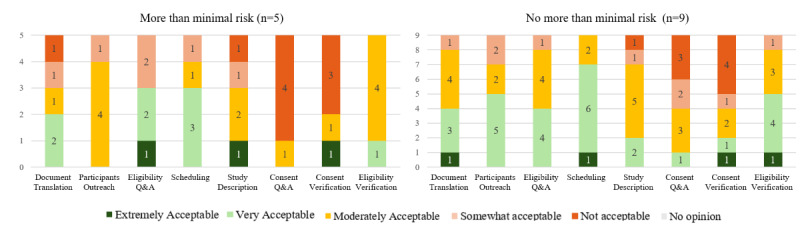 Figure 1
| Characteristics | Pre–focus group survey (n=14), n | Focus group (n=10), n | Follow-up survey (n=11), n | |
|
| ||||
|
| Female | 11 | 8 | 9 |
|
| Male | 2 | 1 | 1 |
|
| Nonbinary | 1 | 1 | 1 |
|
| ||||
|
| Asian | 2 | 1 | 2 |
|
| Black or African American | 1 | 1 | 0 |
|
| White | 9 | 7 | 7 |
|
| More than one racial group | 1 | 1 | 1 |
|
| Prefer not to answer | 1 | 0 | 1 |
|
| ||||
|
| Hispanic or Latino | 1 | 0 | 1 |
|
| Not Hispanic or Latino | 13 | 10 | 10 |
|
| ||||
|
| Research scientist/principal investigator | 8 | 5 | 5 |
|
| Interventionist | 1 | 1 | 1 |
|
| Research coordinator/assistant/consultant | 4 | 3 | 4 |
|
| Other | 1 | 1 | 1 |
|
| ||||
|
| Bachelor's degree or other 4-year college degree | 1 | 1 | 1 |
|
| Master’s degree | 6 | 5 | 6 |
|
| Doctoral degree | 7 | 4 | 4 |
|
| ||||
|
| 2-3 years | 3 | 2 | 3 |
|
| 5-6 years | 1 | 1 | 1 |
|
| 6-7 years | 1 | 1 | 0 |
|
| 7-8 years | 2 | 1 | 2 |
|
| 9-10 years | 3 | 1 | 3 |
|
| 10 years | 4 | 4 | 2 |
|
| ||||
|
| Interventional studies such as clinical trials | 9 | 6 | 8 |
|
| Dissemination and implementation trials | 5 | 4 | 4 |
|
| Observational studies with biospecimens or behavioral testing | 7 | 6 | 5 |
|
| Observational studies with surveys only | 9 | 5 | 7 |
|
| Qualitative studies | 12 | 8 | 10 |
|
| Secondary data analyses, electronic medical record studies, or similar | 4 | 3 | 2 |
|
| ||||
|
| Yes | 10 | 7 | 8 |
|
| No | 4 | 3 | 3 |
|
| ||||
|
| More than minimal risk (full institutional review board review) | —b | — | 5 |
|
| No more than minimal risk and exempt | — | — | 9 |
Peer Reviews
No public reviews on file for this paper yet. If you reviewed it on a platform where reviews are public (OpenReview, ICLR, NeurIPS, ICML), you can paste yours below so the community can read it here.
Videos
No videos yet. Explain this paper in a talk, walkthrough, or lecture? Add one.
Taxonomy
TopicsAI in Service Interactions · Usability and User Interface Design · Digital Accessibility for Disabilities
Introduction
With the proliferation of generative artificial intelligence (GenAI) tools in recent years, many research teams are exploring their potential applications in the health care field, including medical education, information provision, and disease diagnosis [1,2]. For example, GenAI tools have been used to support health care research training [3]. One underexplored application of GenAI is an AI-based virtual study assistant (VSA), which we define as a conversational and agentic technology capable of supporting participant-facing tasks in clinical research, such as screening, providing information, and facilitating consent. The purposes of this formative research were to (1) explore health science researchers’ perspectives on the development of an AI-based VSA and (2) identify potential features and their priorities for future AI-based VSA prototype development.
Methods
Study Design
Participants were recruited from the University of Washington (UW) and consisted of research investigators and study staff with at least 2 years of experience in human subjects research. A snowball approach was used for recruitment. The individuals first completed a questionnaire (Multimedia Appendix 1) collecting information on their research experience and prior experience with GenAI. One-hour focus groups were conducted to identify a list of potential features for AI-based VSA guided by semistructured questions (Multimedia Appendix 2) about key features and participants’ perceptions related to their use. In the final stage, participants completed follow-up surveys (Multimedia Appendix 3) to assess feature acceptability and preference across studies of varying risk levels.
Quantitative data were analyzed using Microsoft Excel. Descriptive statistics, including frequency and mean (SD), were calculated. Thematic analysis was used to identify potential features in the qualitative interview data [4]. Two researchers coded the transcripts and identified themes. The prioritization of preferred features was evaluated using Borda Count, a ranking-based scoring method.
Ethical Considerations
This study was deemed exempt by the University of Washington Institutional Review Board (#21197) since it involved only minimal risk interviews and surveys. Informed consent was obtained from all participants, and data were recorded without identifiable information. All participants received a 25 gift card for participating in the focus group.
Results
A total of 14 respondents completed the pre–focus group survey. Among them, 10 took part in focus groups (n=5 per group). The others could not attend due to scheduling conflicts. Following the focus groups, a follow-up survey was distributed to all pre–focus group survey respondents, and 11 completed it. Focus group participants mostly included faculty members (n=6) or student research assistants (n=3). Participant demographics and work experience are presented in Table 1.
Eight potential features for the AI-based VSA were identified from focus group responses, presented in order of most acceptable to least: (1) translating study documents into other languages, (2) contacting a potential participant to gauge their interest, (3) asking and answering questions about eligibility for the study, (4) scheduling participant interactions, (5) describing the study to participants, (6) answering participant questions about the consent form or study participation, (7) verifying participant understanding of consent, and (8) verifying eligibility. Most features were generally considered acceptable. However, those related to answering participant questions about the consent form or study participation, as well as consent verification, received lower levels of acceptance, particularly in studies involving more than minimal risk (Figure 1).
Acceptability of artificial intelligence–based virtual study assistant features among participants completing follow-up survey, by risk level of human subjects research. Q&A: questions and answers.
Discussion
Our findings reveal promising directions for the development of AI-based VSA for human subjects research. Among the potential features, translating study documents into other languages was rated as the most preferred. Features related to participant outreach and eligibility-related questions also ranked relatively high, indicating preferences for tools that reduce administrative burden and improve participant communication. One previous study [5] explored the use of GenAI for translating medical or public health–related documents in the health care sector. Specifically, postediting machine translation was on average 14% faster than translating from the beginning. Only a small proportion of outputs (11%-16%) required no human edits. Approximately half of the words needed to be edited [5]. These findings revealed both the potential and the limitations of such tools in this domain. Future research regarding VSA development could explore the linguistic and cultural considerations. There is limited research on using GenAI for participant outreach and scheduling; however, if such features were to be designed, considerations regarding data privacy and management would be necessary. Furthermore, these features entail agentic abilities beyond conversation, such as cross-checking participant and staff schedules and creating calendar appointments, which may involve greater potential for error than conversation alone. Some specific features such as consent verification or addressing questions regarding the consent form may require careful implementation and oversight, given the crucial ethical implications of informed consent. These options generated the highest rates of “not acceptable” responses, particularly among respondents conducting research in the “more than minimal risk” category.
This study identified potential features and offered preliminary observations regarding the development of a prototype. Limitations include the small, single institution sample, which may reduce the generalizability of findings, and the administration of a follow-up survey to all participants, that is, those who attended focus groups and those who did not, as responses from attendees may be biased by having attended a focus group. More formative work may be required to further validate and refine these findings, including engaging diverse potential participant populations and conducting iterative prototype development and usability assessments.
The reference list from the paper itself. Each links out to its DOI / PubMed record.
- 1Alowais SA Alghamdi SS Alsuhebany N Alqahtani T Alshaya AI Almohareb SN Aldairem A Alrashed M Bin Saleh K Badreldin HA Al Yami MS Al Harbi S Albekairy AM Revolutionizing healthcare: the role of artificial intelligence in clinical practice BMC Med Educ 20230922231689 10.1186/s 12909-023-04698-z 3774019110.1186/s 12909-023-04698-z 37740191 PMC 10517477 · doi ↗ · pubmed ↗
- 2Sun L Yin C Xu Q Zhao W Artificial intelligence for healthcare and medical education: a systematic review Am J Transl Res 202315748204828 3756024937560249 PMC 10408516 · pubmed ↗
- 3Mc Laughlin JE Ponte CD Lyons K Student perceptions of Gen AI as a virtual tutor to support collaborative research training for health professionals BMC Med Educ 20250701251895 10.1186/s 12909-025-07390-64059703610.1186/s 12909-025-07390-640597036 PMC 12210649 · doi ↗ · pubmed ↗
- 4Braun V Clarke V Using thematic analysis in psychology Qualitative Research in Psychology 20080721327710110.1191/1478088706 qp 063oa · doi ↗
- 5Martikainen M Smolander K Sanmark J Sanmark E Evaluation of generative artificial intelligence implementation impacts in social and health care language translation: mixed methods case study JMIR Form Res 202509179 e 73658 10.2196/7365840961386 v 9i 1e 7365840961386 PMC 12443352 · doi ↗ · pubmed ↗