Low-Dimensional Materials for Future Transistors
Shuohua Zhang, Zhihan Hong, Mingjun Ren, Limin Zhu, Jing Wang

TL;DR
This paper explores how low-dimensional materials could revolutionize future transistors as traditional scaling reaches its limits.
Contribution
The paper outlines a roadmap and three integration pathways for low-dimensional materials in future transistors.
Findings
Low-dimensional materials offer superior properties over bulk materials for transistor applications.
Three distinct pathways are proposed for integrating LDMs into transistors across different time horizons.
Key technological milestones for LDMs are identified to guide future development.
Abstract
The scaling of transistors is approaching its physical limits, making the future direction of transistor development a topic of global significance. Low-dimensional materials (LDMs), which exhibit superior properties compared to bulk materials, are emerging as a driving force for transformative advancements across various industries. What do LDMs signify for the future of transistors? Where do the challenges and opportunities lie? This perspective concludes with an overview of the transistor development roadmap, highlighting key technological milestones for LDMs, and proposes three pathways for integrating LDMs into future transistors across near-, mid-, and long-term horizons.
Genes, proteins, chemicals, diseases, species, mutations and cell lines named across the full text — each resolved to its canonical identifier and authoritative record.
Click any figure to enlarge with its caption.
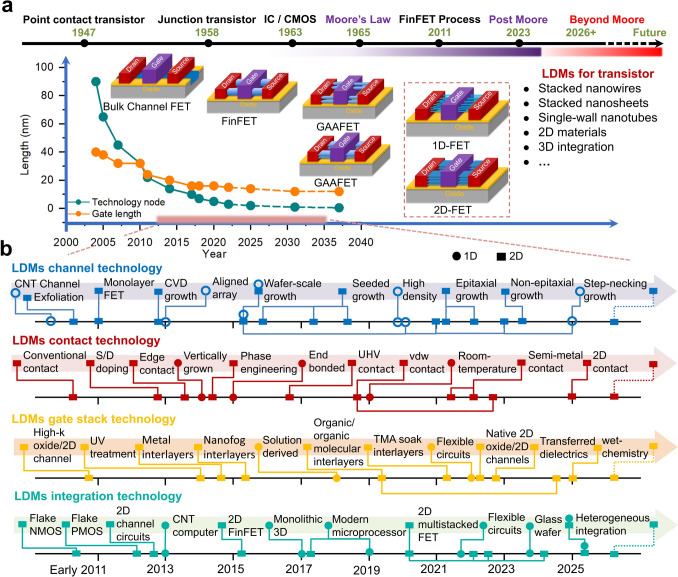 Figure 1
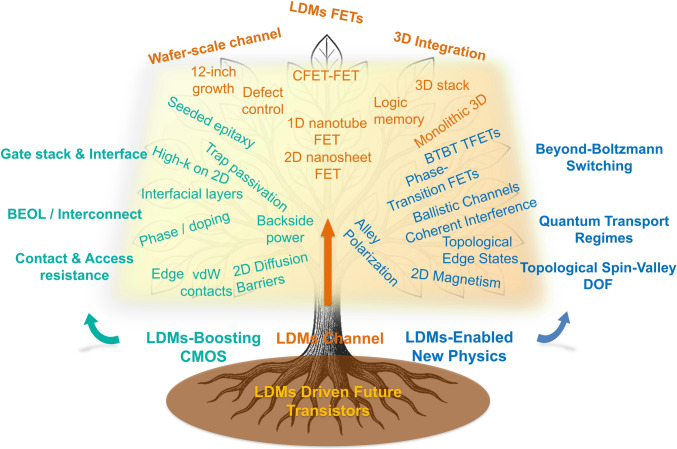 Figure 2
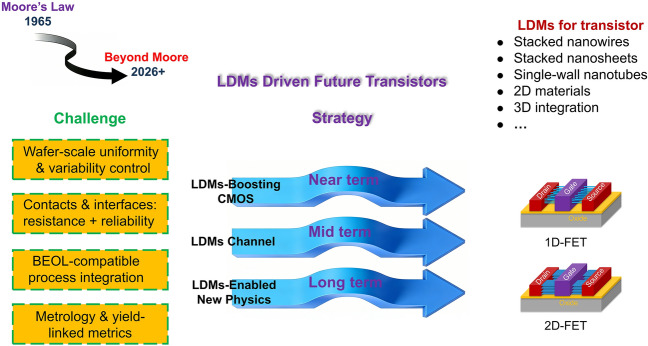 Figure 3
Peer Reviews
No public reviews on file for this paper yet. If you reviewed it on a platform where reviews are public (OpenReview, ICLR, NeurIPS, ICML), you can paste yours below so the community can read it here.
Videos
No videos yet. Explain this paper in a talk, walkthrough, or lecture? Add one.
Taxonomy
Topics2D Materials and Applications · MXene and MAX Phase Materials · Ga2O3 and related materials