Enabling Radiation Hardness in Solid-State NAND Storage Utilizing a Laminated Ferroelectric Stack
Lance Fernandes, Stuart Wodzro, Prasanna Venkatesan, Priyankka Ravikumar, Ming-Yen Lee, Minji Shon, Dyutimoy Chakraborty, Taeyoung Song, Sanghyun Kang, Salma Soliman, Mengkun Tian, Jason Yeager, Jackson Adler, Jiayi Chen, Zekai Wang, Douglas Wolfe, Shimeng Yu, Andrea Padovani

TL;DR
This paper introduces a new type of solid-state storage using ferroelectric transistors that can resist radiation damage, making it suitable for space and defense applications.
Contribution
The novel use of laminated ferroelectric stacks in vertical NAND transistors significantly improves radiation resilience compared to traditional charge-trap NAND.
Findings
Laminated FeFETs retain a full memory window and robust switching up to 10 Mrad (air) of total ionizing dose.
Erased states degrade by only ∼2 V at 10 Mrad (air), with negligible drift after 1 Mrad (air).
Laminated FeFETs show ∼30-fold lower threshold-voltage degradation per unit dose compared to charge-trap NAND.
Abstract
NAND flash forms the core of modern solid-state storage, which is critical for data-intensive AI applications, yet charge-trap NAND suffers rapid threshold-voltage (V th) degradation under ionizing radiation, causing reliability challenges for space and defense applications. Here we show that ferroelectric field-effect transistors (FeFETs) with laminated gate stacks offer a promising route to achieving radiation resilience in vertical NAND technology. We demonstrate that large-memory-window, vertical NAND-compatible laminated poly-silicon-channel FeFETs with an 8 nm Hf0.5Zr0.5O2/3 nm Al2O3/8 nm Hf0.5Zr0.5O2 stack retain a full memory window and robust switching up to 10 Mrad(air) of the total ionizing dose (TID). Programmed and erased states show negligible TID-induced drift after 1 Mrad(air), while only the erased state degrades by ∼2 V at 10 Mrad(air). Technology computer-aided…
Genes, proteins, chemicals, diseases, species, mutations and cell lines named across the full text — each resolved to its canonical identifier and authoritative record.
Click any figure to enlarge with its caption.
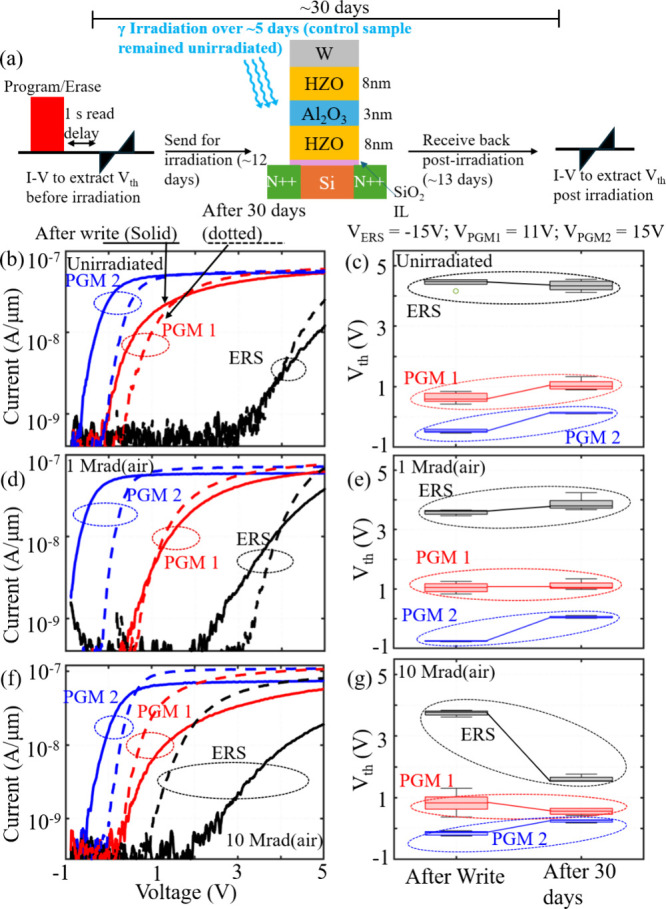 Figure 1
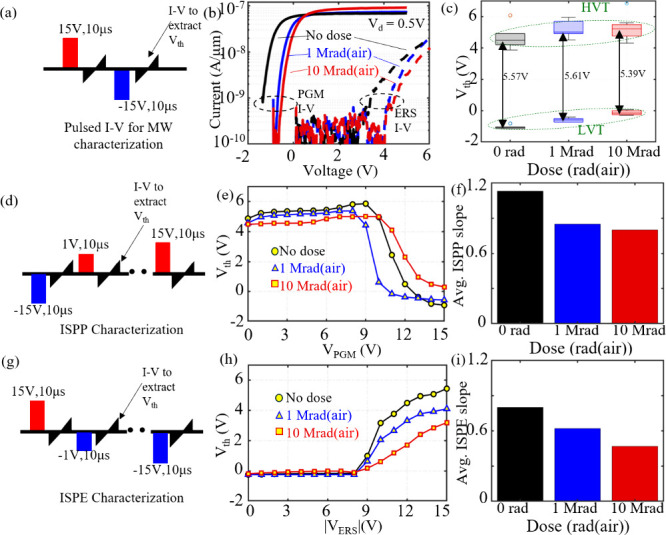 Figure 2
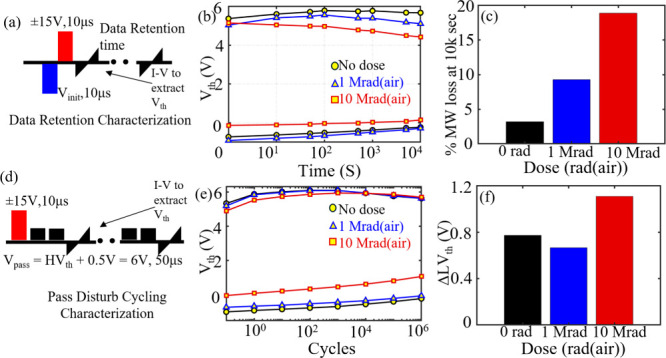 Figure 3
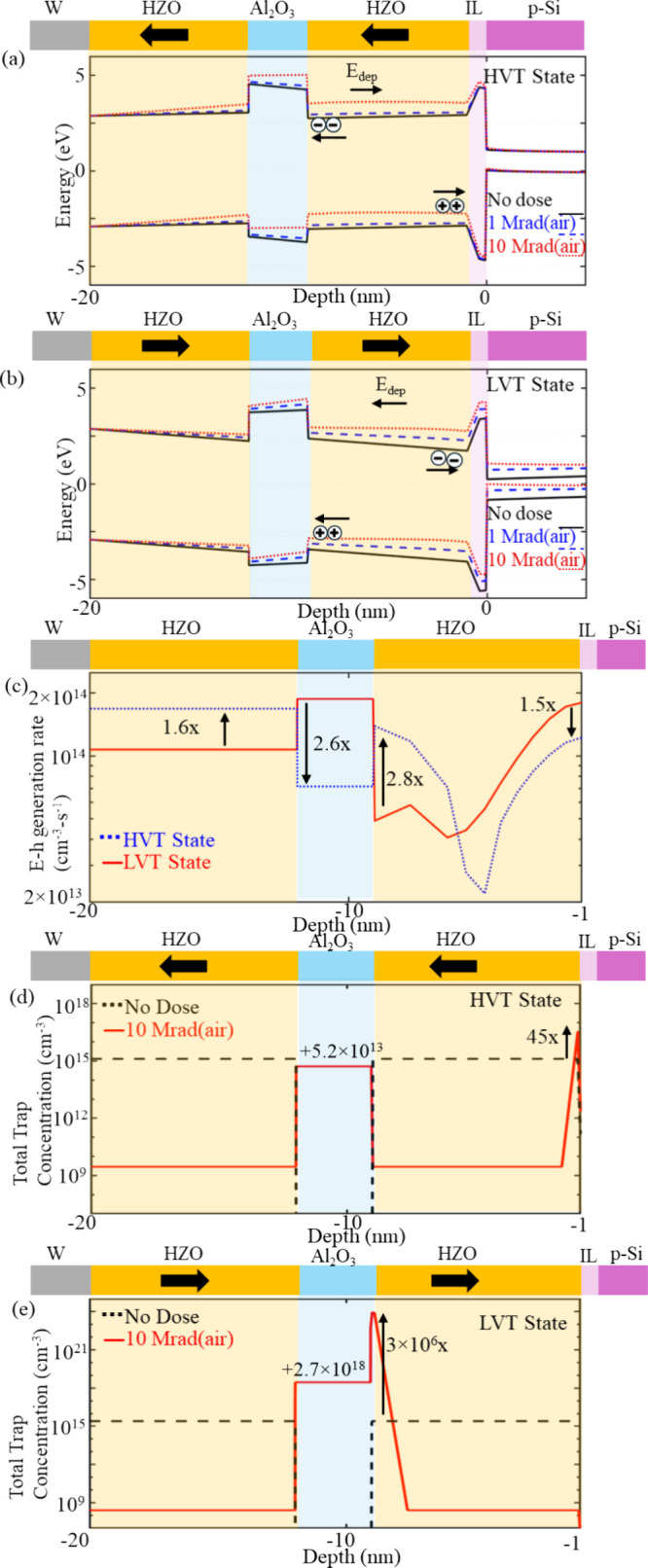 Figure 4
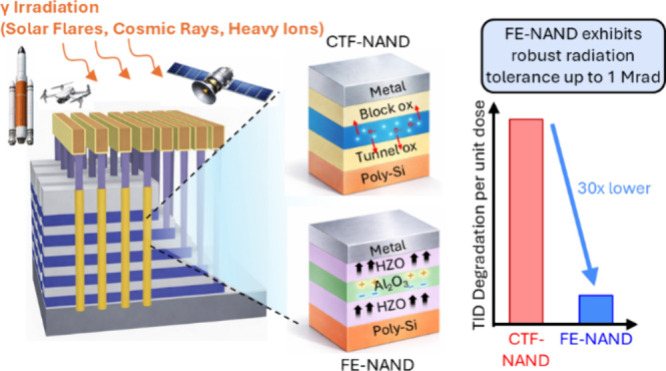 Figure 5
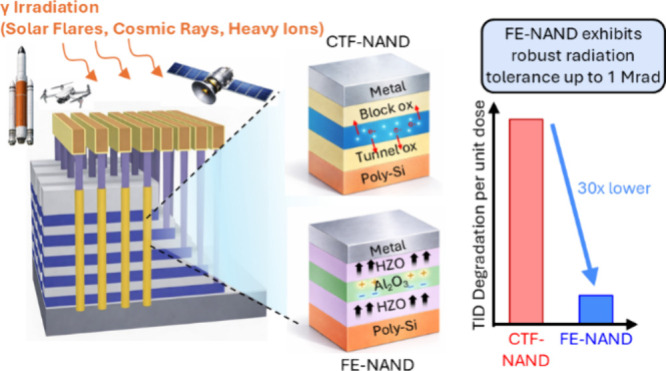 Figure 6
 Figure 7
Peer Reviews
No public reviews on file for this paper yet. If you reviewed it on a platform where reviews are public (OpenReview, ICLR, NeurIPS, ICML), you can paste yours below so the community can read it here.
Videos
No videos yet. Explain this paper in a talk, walkthrough, or lecture? Add one.
Taxonomy
TopicsAdvanced Data Storage Technologies · Radiation Effects in Electronics · Parallel Computing and Optimization Techniques