Non-medical use of exogenous testosterone and anabolic–androgenic substances in young men: health, psychological, and fertility consequences
Krzysztof Kowalik, Patryk Harasny, Laura Kaliczyńska, Konrad Reweda-Kwiatkowski, Dariusz Starzyński, Michał Pawlak, Arkadiusz Waloryszak, Magdalena Ptak, Andrzej Modrzejewski, Dagmara Lisman

TL;DR
Young men using testosterone and steroids for muscle gain face serious health risks, including fertility issues and hormonal imbalances.
Contribution
This review provides a comprehensive overview of the health, psychological, and fertility consequences of non-medical testosterone and steroid use in young men.
Findings
Non-medical use of testosterone and AAS suppresses the hypothalamic–pituitary–gonadal axis and impairs spermatogenesis.
AAS use is linked to long-term endocrine effects and fertility disturbances.
Psychological factors like muscle dysmorphia and social pressure contribute to AAS use and associated risks.
Abstract
The non-medical use of exogenous testosterone and other anabolic–androgenic steroids (AAS) has increased substantially in recent years, particularly among young men engaged in recreational strength training. Although often perceived as a means of enhancing muscle mass and physical performance, this practice represents a growing public-health concern due to its wide-ranging endocrine, reproductive, and multisystem adverse effects. This narrative review synthesizes current international evidence on the non-medical use of testosterone and AAS in non-professional athletic settings, with a primary focus on endocrine disruption and reproductive health. The review outlines the classification of commonly used anabolic–androgenic compounds, discusses their pharmacological mechanisms of action, and integrates clinical, experimental, and epidemiological data on associated adverse outcomes.…
Genes, proteins, chemicals, diseases, species, mutations and cell lines named across the full text — each resolved to its canonical identifier and authoritative record.
Click any figure to enlarge with its caption.
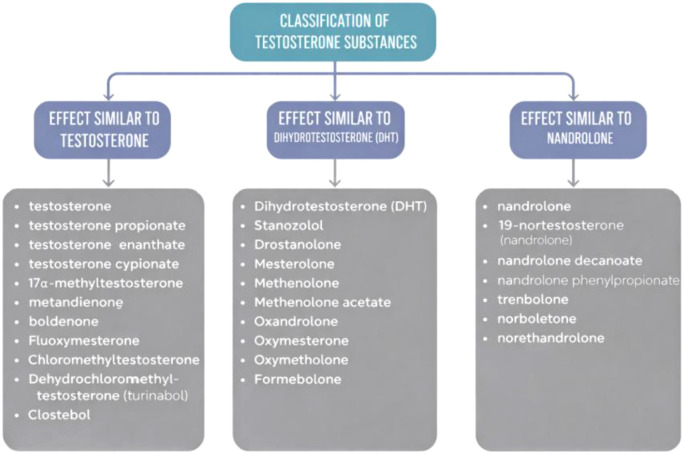 Figure 1
Peer Reviews
No public reviews on file for this paper yet. If you reviewed it on a platform where reviews are public (OpenReview, ICLR, NeurIPS, ICML), you can paste yours below so the community can read it here.
Videos
No videos yet. Explain this paper in a talk, walkthrough, or lecture? Add one.
Taxonomy
TopicsHormonal and reproductive studies · Evolutionary Psychology and Human Behavior · Sexual Differentiation and Disorders