Copper catalyzed synthesis of thiazole derivatives from enaminones, amines and CS₂
Amin Arman, Najmeh Nowrouzi, Mohammad Abbasi

TL;DR
A new copper-catalyzed method efficiently produces thiazole compounds using enaminones, amines, and carbon disulfide under simple conditions.
Contribution
A novel, ligand-free copper-catalyzed synthesis of thiazoles using CS₂ as a dual carbon and sulfur source.
Findings
The method achieves good to excellent yields of thiazole derivatives under mild conditions.
Carbon disulfide functions as both a sulfur and carbon source in the reaction.
The approach is tolerant to various functional groups and produces biologically relevant scaffolds.
Abstract
An efficient copper-catalyzed method for the synthesis of thiazoles from enaminones, amines, and carbon disulfide (CS₂) is described. This one-pot, ligand- and additive-free protocol proceeds under relatively simple reaction conditions, affording thiazole derivatives in good to excellent yields. Notably, CS₂ serves as a combined sulfur and carbon source, contributing to the synthetic practicality of the transformation. The method demonstrates good functional-group tolerance and provides a straightforward approach to biologically relevant thiazole scaffolds. The online version contains supplementary material available at 10.1038/s41598-026-40393-x.
Genes, proteins, chemicals, diseases, species, mutations and cell lines named across the full text — each resolved to its canonical identifier and authoritative record.
Click any figure to enlarge with its caption.
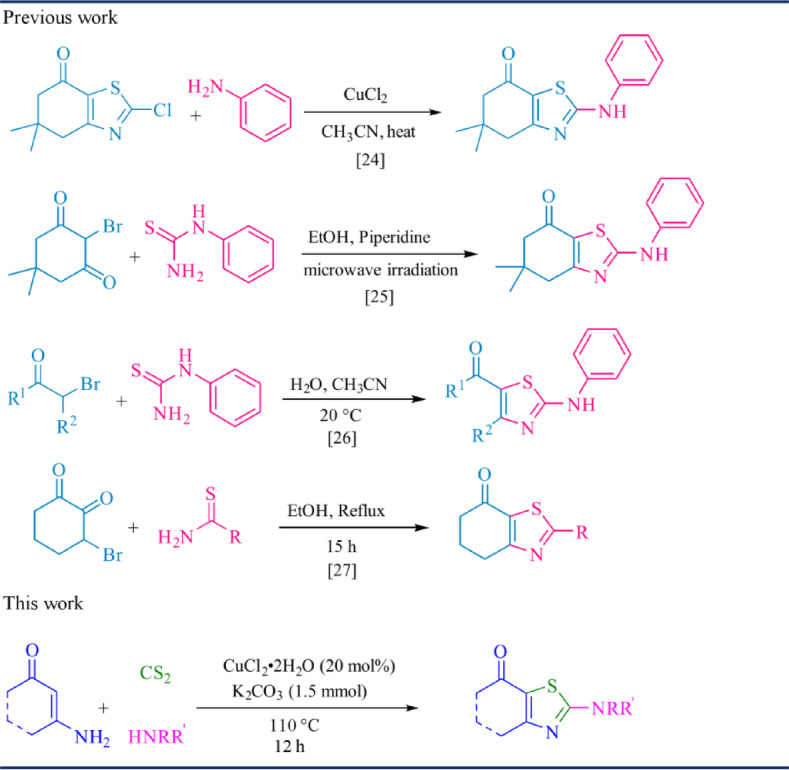 Figure 1
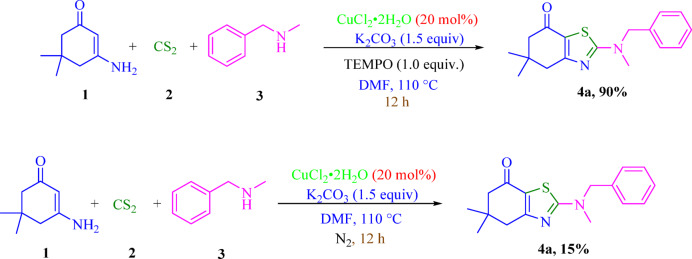 Figure 2
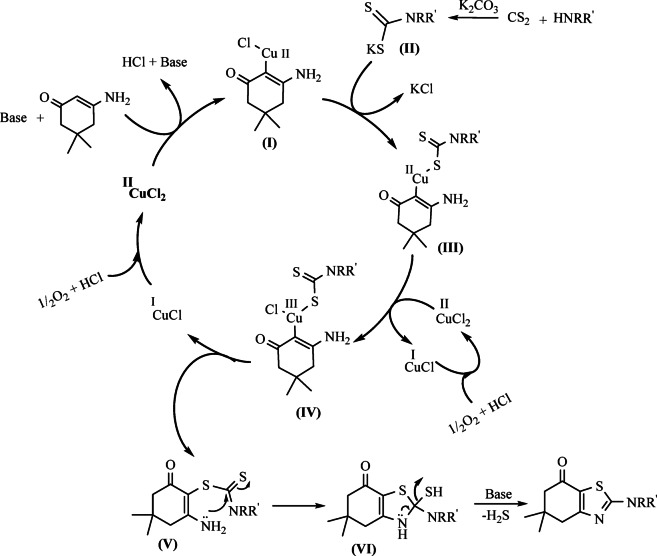 Figure 3
Peer Reviews
No public reviews on file for this paper yet. If you reviewed it on a platform where reviews are public (OpenReview, ICLR, NeurIPS, ICML), you can paste yours below so the community can read it here.
Videos
No videos yet. Explain this paper in a talk, walkthrough, or lecture? Add one.
Taxonomy
TopicsSulfur-Based Synthesis Techniques · Catalytic C–H Functionalization Methods · Catalytic Cross-Coupling Reactions
Introduction
The incorporation of both nitrogen and sulfur atoms into molecular frameworks often imparts unique chemical properties and diverse biological activities. Such nitrogen–sulfur heterocycles have attracted significant attention due to their versatile reactivity and their potential applications in pharmaceuticals, catalysis, and materials science^1^.Among these heterocycles, thiazole—a five-membered ring containing both sulfur and nitrogen—has emerged as a privileged scaffold, combining distinctive electronic properties with remarkable structural adaptability.
Thiazole derivatives exhibit a wide spectrum of bioactivities, including antimicrobial (antibacterial, antifungal, antimalarial), anti-inflammatory, analgesic, anticancer, cardiovascular, neurological, and antioxidant effects. This diverse pharmacological profile arises from the unique electronic configuration of the thiazole nucleus and its ability to mimic essential biological motifs in drug–target interactions^2–4^. In particular, 2-aminobenzothiazoles are important benzothiazole derivatives extensively studied in bioorganic and medicinal chemistry, finding applications in drug discovery and development for diseases such as AIDS, diabetes, epilepsy, and tuberculosis^5^. Furthermore, N-arylbenzo[d]thiazol-2-amines constitute key motifs in anticancer and antimicrobial agents^6^.
Given their remarkable properties, considerable efforts have been directed toward developing environmentally friendly and operationally simple synthetic strategies for thiazoles. Recent advances, including metal-free cyclization^7^ and photocatalytic C–H sulfuration^8^, have broadened access to novel thiazole frameworks with potential applications in OLEDs, conductive polymers, and organocatalysis^9–11^. Traditionally, thiazole and benzothiazole derivatives have been prepared through the condensation of 2-aminothiophenols with aryl ketones^12^, nitriles^13^, benzylamines^14^, benzyl chlorides^15^, or β-ketoesters^16^. Additionally, transition-metal-catalyzed C–H activation and subsequent functionalization with aryl halides have become well-established methods for constructing benzothiazole cores^17–19^.
Several practical protocols have also been developed to improve efficiency and selectivity. For example, Ding and co-workers reported a copper-catalyzed synthesis of 2-aminobenzothiazoles from 2-halobenzenamines and isothiocyanates^20^. The Wang group described the preparation of 2-aminophenyl benzothiazoles via the reaction of 2-aminobenzenethiol with isothiocyanates in the presence of Fe(NO_3_)3·9H_2_O^21^. More recently, Murthy Boddapati and colleagues introduced a convenient copper-catalyzed route using aryl isothioureas and aryl iodides^22^, while Zhang et al.. employed 2-iodoanilines and styrene, with elemental sulfur acting as both an oxidant and a one-carbon donor^23^. Despite these advances, most methods focus on benzothiazoles, and only a few protocols have been reported for the synthesis of thiazoles from enaminones^24–27^. Therefore, developing a straightforward and efficient strategy for constructing thiazoles based on enaminones remains highly desirable, offering a promising avenue for accessing structurally diverse thiazole derivatives with potential applications in medicinal chemistry and materials science.
Building on these advances, we have developed a direct and efficient method for the construction of thiazoles via simultaneous C–S and C–N bond formation from enaminones, amines, and CS_2_ under copper-catalyzed conditions (Scheme 1). Notably, this straightforward oxidative coupling and cyclization proceeds smoothly without the need for any additional ligands, additives, or external oxidants, highlighting its operational simplicity and practical applicability.
Scheme 1. Pathways for the synthesis of thiazoles.
Results and discussion
Our initial studies began with the addition of CS_2_ (0.75 mmol) to a mixture of N-methyl-1-phenylmethanamine (0.75 mmol), and K_2_CO_3_ as the base (1.0 mmol) in DMSO (1 mL) as the solvent. The mixture was kept under stirring at ambient temperature for 30 min. Then, enaminone (0.5 mmol), and CuCl₂·2 H₂O (0.1 mmol) were subsequently added to the reaction mixture, which was stirred at 100 °C for 12 h, affording the desired product in a moderate 65% yield (Table 1, entry 1). Switching the solvent to dimethylformamide (DMF) improved the yield to 76% under identical conditions (Table 1, entry 2), while alternative solvents such as 1,4-dioxane, ethanol, water, PEG-200, toluene, and acetonitrile led to only trace or low product formation (Table 1, entries 3–7). Temperature screening revealed that raising the reaction temperature to 110 °C resulted in a slight improvement in yield (Table 1, entry 8), whereas further raising it to 120 °C did not provide any significant benefit (Table 1, entry 9). Among the bases tested, K₂CO₃ proved to be the most effective (Table 1, entries 10–15), and increasing its amount from 1.0 mmol to 1.5 mmol further enhanced the yield to 90% (Table 1, entry 16). Additional increments in base loading did not significantly affect the outcome (Table 1, entry 17), whereas reducing the base to 0.5 mmol resulted in decreased conversion (Table 1, entry 18). As expected, no significant product formation was observed in the absence of a base (Table 1, entry 19). Furthermore, a range of transition-metal catalysts, including CuI, CuCl, Cu(OAc)₂, CoCl_2_, NiCl₂·6 H₂O, and MnCl₂, were evaluated, and CuCl₂·2 H₂O was identified as the most efficient, delivering the product in 90% yield (Table 1, entries 20–25). Reducing the catalyst loading led to a decline in yield, highlighting the importance of optimized conditions (Table 1, entry 26). On the other hand, increasing the amount of CuCl₂·2 H₂O up to 30 mol% did not have a significant enhancement on the yield (Table 1, entry 27).
Therefore, the optimal conditions for the synthesis of thiazoles were established as CuCl₂·2 H₂O (20 mol%) as the catalyst, K₂CO₃ (1.5 mmol) as the base, DMF as the solvent, and the reaction carried out at 110 °C for 12 h. Following the successful preparation of the desired product 4a, we turned our attention to the synthesis of a series of thiazole derivatives under these optimized conditions (Table 1, entry 16).
Table 1. Optimization the reaction conditions^a^.
EntryCatalyst [mol%]SolventBase [mmol]Temp [˚C]Yield [%]^a^1CuCl_2_·2H_2_O (20 mol%)DMSOK_2_CO_3_ (1.0 mmol)100652CuCl_2_·2H_2_O (20 mol%)DMFK_2_CO_3_ (1.0 mmol)100763CuCl_2_·2H_2_O (20 mol%)1,4-dioxaneK_2_CO_3_ (1.0 mmol)100224CuCl_2_·2H_2_O (20 mol%)EtOHK_2_CO_3_ (1.0 mmol)100Trace5CuCl_2_·2H_2_O (20 mol%)H_2_OK_2_CO_3_ (1.0 mmol)100Trace6CuCl_2_·2H_2_O (20 mol%)PEG-200K_2_CO_3_ (1.0 mmol)100Trace6CuCl_2_·2H_2_O (20 mol%)TolueneK_2_CO_3_ (1.0 mmol)100367CuCl_2_·2H_2_O (20 mol%)CH_3_CNK_2_CO_3_ (1.0 mmol)100158CuCl_2_·2H_2_O (20 mol%)DMFK_2_CO_3_ (1.0 mmol)110819CuCl_2_·2H_2_O (20 mol%)DMFK_2_CO_3_ (1.0 mmol)1208110CuCl_2_·2H_2_O (20 mol%)DMFNa_2_CO_3_ (1.0 mmol)1107711CuCl_2_·2H_2_O (20 mol%)DMFNaHCO_3_ (1.0 mmol)1207012CuCl_2_·2H_2_O (20 mol%)DMFNaOH (1.0 mmol)1106113CuCl_2_·2H_2_O (20 mol%)DMFKOH (1.0 mmol)1107514CuCl_2_·2H_2_O (20 mol%)DMFEt_3_N (1.0 mmol)1104315CuCl_2_·2H_2_O (20 mol%)DMFDABCO (1.0 mmol)11038 16
CuCl 2 ·2 H 2 O (20 mol%)
DMF K2CO3 (1.5 mmol) 110
90 17CuCl_2_·2H_2_O (20 mol%)DMFK_2_CO_3_ (2.0 mmol)1109018CuCl_2_·2H_2_O (20 mol%)DMFK_2_CO_3_ (0.5 mmol)1105419CuCl_2_·2H_2_O (20 mol%)DMF-110Trace20CuI (20 mol%)DMFK_2_CO_3_ (1.5 mmol)1104921CuCl (20 mol%)DMFK_2_CO_3_ (1.5 mmol)1105222Cu(OAc)2 (20 mol%)DMFK_2_CO_3_ (1.5 mmol)1103723CoCl_2_ (20 mol%)DMFK_2_CO_3_ (1.5 mmol)110Trace24NiCl_2_·6H_2_O (20 mol %)DMFK_2_CO_3_ (1.5 mmol)110Trace25 MnCl_2_ (20 mol%)DMFK_2_CO_3_ (1.5 mmol)1101926CuCl_2_·2H_2_O (10 mol%)DMFK_2_CO_3_ (1.5 mmol)1104727CuCl_2_·2H_2_O (30 mol%)DMFK_2_CO_3_ (1.5 mmol)11090^a^ Reaction conditions: First step: CS_2_ (0.75 mmol), N-methyl-1-phenylmethanamine (0.75 mmol), K_2_CO_3_ (1.5 mmol), Solvent (1 mL) at room temperature for 30 min; Second step: Enaminone (0.5 mmol), CuCl_2_·2H_2_O (20 mol%) at 110 °C for 12 h.
As illustrated in Table 2, we initially investigated the reaction of various secondary amines, such as N-methyl-1-phenylmethanamine, N-methylaniline, dibenzylamine, piperidine, pyrrolidine, diethylamine, dimethylamine, N-methylcyclohexanamine, and morpholine, with CS_2_ and enaminone. These reactions furnished the desired products 4a-4i in good to excellent yields. Subsequently, aniline and its derivatives, including 3,4-dimethylaniline, o-toluidine, 4-chloroaniline, and 4-bromoaniline, were also reacted under the same conditions to provide products 4j-4n in moderate yields. The results indicate that both the electronic nature and the position of substituents on the aniline rings have only a limited effect on this oxidative-coupling cyclization reaction. The successful synthesis of 4 L from o-toluidine demonstrates that arylamines bearing ortho-substituents indicate acceptable reactivity, proposing that steric factors on the aryl ring have minimal influence on the reaction outcome.
When butan-1-amine and phenylmethanamine were employed under the optimized conditions, the expected products 4o and 4p were obtained in acceptable yields. To further explore the substrate scope, 3-aminocyclohex-2-en-1-one was treated with both secondary and primary amines, affording products 4q-4t in good yields. A comparison between primary and secondary amines revealed that secondary aliphatic and aromatic amines generally exhibit higher reactivity, delivering the desired compounds in good to excellent yields, whereas primary aliphatic and aromatic amines provided slightly lower yields (Table 2).
Unfortunately, when 4-nitroaniline, pyridin-4-amine, and pyridin-2-amine were used as substrates, no corresponding products 4u–4w were observed. Further attempts to promote these reactions in DMSO in the presence of a strong base such as KOH also failed. This lack of reactivity can be attributed to strong electronic deactivation in the case of 4-nitroaniline and pyridine amines, which significantly reduces the electron density on the aniline nitrogen through both inductive and resonance effects. This electronic deficiency adversely affects the reactivity of the sulfur-containing species generated in situ, leading to a substantial reduction in its nucleophilicity. As a consequence, nucleophilic attack on the electrophilic reaction partner becomes unfavorable, and the reaction does not proceed further (Scheme 3). The reaction of (E)−4-aminopent-3-en-2-one, a linear enaminone, with aniline and CS_2_ under the optimized conditions was investigated; however, the desired product 4x was not formed. Probably, the low reactivity of linear enaminones originates from steric hindrance caused by their flexible conformations, which interferes with metal coordination and cyclization. To explore the scope of the reaction, the enaminone 6-amino-1,3-dimethylpyrimidine-2,4(1 H,3 H)-dione was reacted with N-methyl-1-phenylmethanamine and N-methylaniline, while 4-amino-2 H-chromen-2-one was treated with propan-1-amine under the optimized conditions. In all cases, the reactions proceeded efficiently and afforded the desired products (4y, 4z and 4aa) in excellent yields. These results indicate that the method is compatible with both aromatic and aliphatic amines, as well as with different enaminone frameworks.
Additional experimental details and characterization data are provided in Supplementary Table 2.
Table 2. Synthesis of thiazole derivativesa.
^a^Reaction conditions: First step: CS_2_ (0.75 mmol), Amines (0.75 mmol), K_2_CO_3_ (1.5 mmol), DMF (1 mL) at roomtemperature for 30 min; Second step: Enaminones (0.5 mmol), CuCl_2_·2H_2_O (20 mol%), at 110 °C for 12 h.
To gain further insight into the reaction pathway and to clarify the possible involvement of radical species, a series of control experiments were conducted under the optimized reaction conditions (Scheme 2).
First, the model reaction was performed in the presence of 2,2,6,6-tetramethylpiperidine-1-oxyl (TEMPO) as a well-known radical scavenger. Notably, the reaction proceeded smoothly, affording the desired thiazole product in comparable yield and within a similar reaction time to that observed under standard conditions. The negligible effect of TEMPO on both reaction efficiency and rate strongly suggests that a radical pathway is unlikely to be operative in this transformation.
In contrast, when the reaction was carried out under an inert nitrogen atmosphere, a significant decrease in product yield was observed. This result indicates that molecular oxygen plays a crucial role in the reaction process. Considering the reduced efficiency under oxygen-free conditions, it is reasonable to propose that oxygen is involved in the regeneration of the catalytically active copper species, most likely through the reoxidation of Cu(I) to Cu(II).
Scheme 2. Control experiments.
Based on the obtained results, control experiments, and previous literature reports on copper-catalyzed transformations of enaminones^28–33^, a plausible mechanism for the synthesis of thiazoles from enaminones, amines, and CS_2_ is proposed, as illustrated in Scheme 3.
The catalytic cycle is initiated by coordination of the enaminone to CuCl₂·2 H₂O through its α-carbon, forming activated complex I^28–33^, while the amine reacts with CS_2_ under basic conditions to produce the corresponding dithiocarbamate salt II^34–38^. Nucleophilic substitution of complex I with dithiocarbamate II affords intermediate III, which undergoes disproportionation of Cu(II) to Cu(III), generating species IV. Subsequent reductive elimination from IV provides intermediate V along with Cu(I). In V, the amino group intramolecularly attacks the electrophilic C = S unit to form the cyclized intermediate VI, which upon base-assisted elimination of hydrogen sulfide delivers the desired thiazole product. Finally, Cu(I) is reoxidized to Cu(II) by molecular oxygen in the presence of HCl, thereby regenerating the active catalyst and completing the catalytic cycle.
Scheme 3. Proposed mechanism for the synthesis of thiazoles.
Conclusion
In conclusion, a practical copper-catalyzed strategy for the synthesis of thiazoles from enaminones, amines, and CS₂ has been developed. The protocol operates under ligand- and additive-free conditions and shows good efficiency, particularly for secondary amines. this method provides a reliable and straightforward approach for accessing structurally diverse thiazole derivatives from readily available starting materials. This study expands the synthetic utility of enaminones in heterocycle construction.
Exprimental
All chemicals needed in this study were supplied by Merck or Fluka chemical companies. ^1^H-NMR and^13^C-NMR spectra were run on a Bruker Avance 400 MHz instrument in CDCl_3_. Melting points were measured as a Buchi B-545 apparatus in open capillary tubes.
Typical procedure for the synthesis of thiazoles
At first, a mixture of amine (0.75 mmol), CS_2_ (0.75 mmol), K₂CO₃ (1.5 mmol), and N, N-dimethylformamide (1 mL) was stirred at ambient temperature for 30 min. Next, after the addition of enaminone (0.5 mmol) and CuCl₂·2 H₂O (20 mol%), the resulting mixture was allowed to stir at 110 °C for 12 h. When the reaction was completed (monitored by TLC), the temperature was gradually decreased to room temperature, and the product was extracted with EtOAc (3 × 3 mL). After that, the solvent was eliminated under reduced pressure. Finally, the column chromatography was employed to purify the crude product using n-hexane/ethyl acetate (10:3) as the solvent to provide the desired product (Table 2).
Supplementary Information
Below is the link to the electronic supplementary material.
Supplementary Material 1
The reference list from the paper itself. Each links out to its DOI / PubMed record.
- 1Hou, J. & Kazemi, M. A comprehensive review on synthesis of oxazoles: research on magnetically recoverable catalysts. Research Chem. Intermediates. 50, 1845–1872 (2024).
- 2Bernini, R., Cacchi, S., Fabrizi, G., Filisti, E. & Sferrazza, A. 3-Aroylindoles via Copper-Catalyzed Cyclization of N-(2-Iodoaryl) enaminones. Synlett. 2009, 1480–1484 (2009).