Spatial alignment of chemoarchitecture and resting-state functional connectivity predicts short term weight restoration in anorexia nervosa
Arne Doose, Livio Tarchi, Maria Seidel, Joseph A. King, Fabio Bernardoni, Inger Hellerhoff, Daniel Geisler, Katrin Gramatke, Giovanni Castellini, Valdo Ricca, Veit Roessner, Paul M. Thompson, Stefan Ehrlich

TL;DR
This study explores how brain connectivity and neurotransmitter levels relate to weight recovery in anorexia nervosa patients.
Contribution
The study introduces spatial alignment of chemoarchitecture and functional connectivity as a predictor of weight restoration in anorexia nervosa.
Findings
Higher DC in brain regions with VAChT, DAT, and SERT was observed in acutely underweight anorexia patients.
Weight restoration was linked to normalization of DC in areas with higher DAT density.
Individual correlations between neurotransmitter densities and DC predicted early weight gain during treatment.
Abstract
Resting-state functional connectivity (rsFC) studies have revealed altered regional homogeneity (ReHo) and degree centrality (DC) in individuals with anorexia nervosa (AN) compared to healthy controls (HC), but the underlying mechanisms remain unclear. Here we explored the spatial alignment with neurotransmitter receptor and transporter densities (i.e., “chemoarchitecture”, based on “reference” PET studies) as a potential explanatory factor. We investigated rsFC alterations in acutely underweight patients with AN (n = 87) and age-matched HC (n = 87) cross-sectionally at admission and then again after successful weight-restoration treatment. Global ReHo and DC maps were associated with the spatial distribution of neurotransmitter receptors, transporters and/or metabolic glucose uptake. First, the correlation between rsFC alterations in AN and chemoarchitecture was evaluated at the…
Genes, proteins, chemicals, diseases, species, mutations and cell lines named across the full text — each resolved to its canonical identifier and authoritative record.
Click any figure to enlarge with its caption.
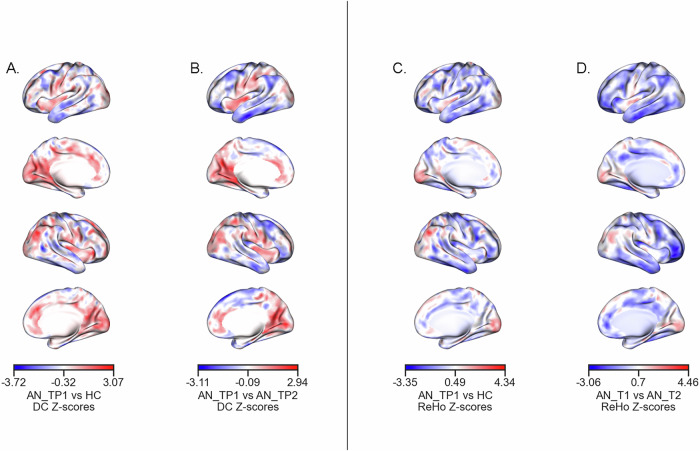 Figure 1
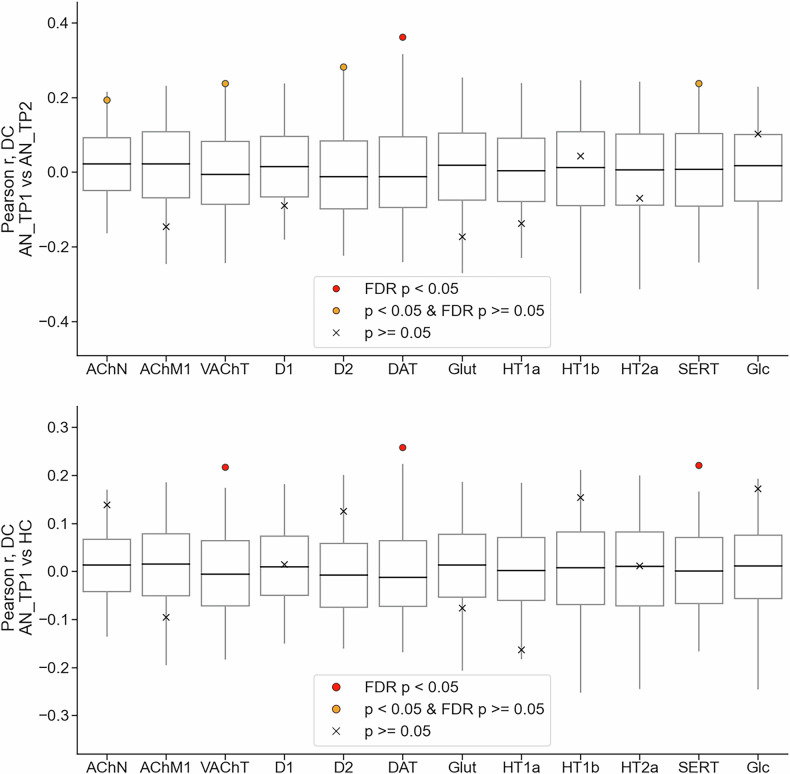 Figure 2
Peer Reviews
No public reviews on file for this paper yet. If you reviewed it on a platform where reviews are public (OpenReview, ICLR, NeurIPS, ICML), you can paste yours below so the community can read it here.
Videos
No videos yet. Explain this paper in a talk, walkthrough, or lecture? Add one.
Taxonomy
TopicsEating Disorders and Behaviors · Functional Brain Connectivity Studies · Mental Health Research Topics