Scalability Metrics and Effort Requirements for a Long-Acting Injectable Antiretroviral Treatment Program
Joshua P Havens, Jennifer O’Neill, Maureen Kubat, Shawnalyn W Sunagawa, Jennifer M Davis, Nada Fadul, Joshua Lechner, Sara H Bares

TL;DR
This paper examines the effort and resources needed to scale a long-acting injectable HIV treatment program, showing it is feasible despite high operational demands.
Contribution
The study quantifies the multidisciplinary effort required to scale an injectable antiretroviral treatment program in real-world settings.
Findings
Scaling to 113 patients required 2.25 full-time equivalents over 2.5 years.
Clinical outcomes were favorable despite high operational demands.
The program demonstrated real-world feasibility and scalability.
Abstract
Implementation of a long-acting injectable antiretroviral treatment program requires substantial multidisciplinary effort, particularly for program coordination, coverage/billing, and patient support/retention. As our program scaled to 113 patients over 2.5 years, a total of 2.25 full-time equivalents were required. Despite operational demands, clinical outcomes were favorable, supporting real-world feasibility and scalability.
Genes, proteins, chemicals, diseases, species, mutations and cell lines named across the full text — each resolved to its canonical identifier and authoritative record.
Click any figure to enlarge with its caption.
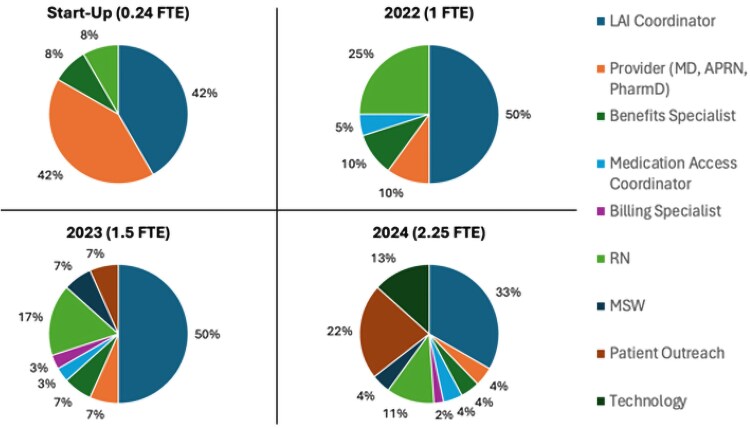 Figure 1
Peer Reviews
No public reviews on file for this paper yet. If you reviewed it on a platform where reviews are public (OpenReview, ICLR, NeurIPS, ICML), you can paste yours below so the community can read it here.
Videos
No videos yet. Explain this paper in a talk, walkthrough, or lecture? Add one.
Taxonomy
TopicsHIV/AIDS Research and Interventions · HIV/AIDS drug development and treatment · HIV-related health complications and treatments