Genomic insights highlight antimicrobial potential of Micromonospora sp. PTRAS2
Pankaj Mandal, Trisha Roy, Rittick Mondal, Arka Pratim Chakraborty, Priyambada Singh, Amit Ghati, Arnab Sen, Abdul Sadat, Amit Kumar Mandal

TL;DR
A soil bacterium from India has a genome rich in genes for making antimicrobial compounds, suggesting it could be a source of new antibiotics.
Contribution
The study identifies a new strain with multiple gene clusters for antimicrobial compound production through genome analysis.
Findings
Micromonospora sp. PTRAS2 has a 7.6 Mb genome with a high G + C content of 73.7%.
The genome contains multiple biosynthetic gene clusters for antimicrobial and bioactive compounds.
Abstract
Micromonospora sp. strain PTRAS2, a gram-positive actinobacterium isolated from mulberry rhizospheric soil in Raiganj, India, has a 7.6 Mb genome (G + C 73.7%). Genome analysis revealed multiple biosynthetic gene clusters for antimicrobial and bioactive compounds, indicating its potential as a source of novel natural products.
Genes, proteins, chemicals, diseases, species, mutations and cell lines named across the full text — each resolved to its canonical identifier and authoritative record.
Click any figure to enlarge with its caption.
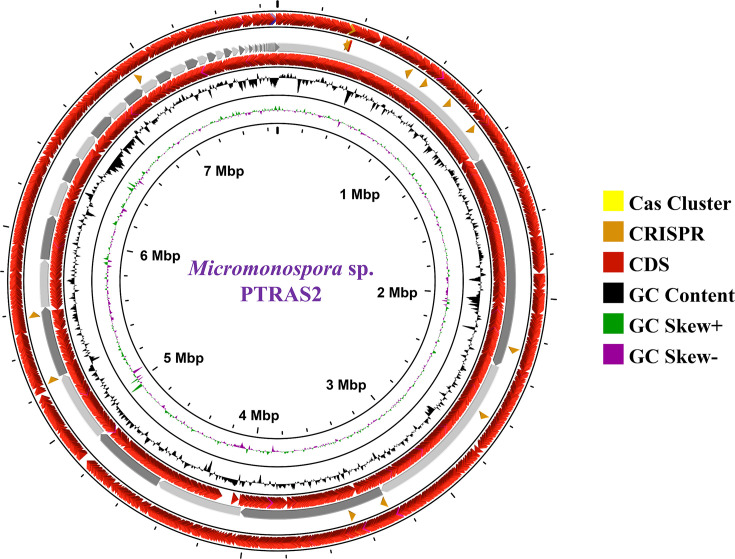 Figure 1
Peer Reviews
No public reviews on file for this paper yet. If you reviewed it on a platform where reviews are public (OpenReview, ICLR, NeurIPS, ICML), you can paste yours below so the community can read it here.
Videos
No videos yet. Explain this paper in a talk, walkthrough, or lecture? Add one.
Taxonomy
TopicsMicrobial Natural Products and Biosynthesis · Microbial Metabolism and Applications · Bioactive natural compounds