MiMiCPy-FM: A User-Friendly Force Matching Tool for Extending the Time Scale of QM/MM MD MiMiC Simulations
Sachin Shivakumar, Giorgia Frumenzio, Francesco Musiani, Fabio Affinito, Emiliano Ippoliti, Bharath Raghavan, Giulia Rossetti, Davide Mandelli, Paolo Carloni

TL;DR
MiMiCPy-FM is a tool that extends the time scale of QM/MM simulations by automatically generating force fields for classical MD simulations.
Contribution
MiMiCPy-FM introduces a user-friendly, automated force matching tool integrated with the MiMiC interface for QM/MM simulations.
Findings
MiMiCPy-FM supports systems with and without covalent QM/MM boundaries.
The tool generates updated topology files compatible with GROMACS for classical MD simulations.
An application to a Mg-based enzyme demonstrates its effectiveness in transitioning to long-time scale simulations.
Abstract
Force matching (FM) algorithms develop force fields to dramatically extend the time scales of quantum mechanical/molecular mechanics (QM/MM) molecular dynamics (MD) simulations. Here, we present MiMiCPy-FM, an implementation of the generalized QM/MM FM approach for the automated parametrization of biomolecular force fields. MiMiCPy-FM streamlines the optimization of force field parameters by using reference data generated by the recently developed, highly scalable QM/MM MD MiMiC interface. MiMiCPy-FM is fully integrated within the MiMiCPy framework, providing both a command-line interface for quick execution and a Python library for advanced, customizable workflows. The tool is able to treat systems with and without covalent QM/MM boundaries and produces updated topology files that can be directly used to perform classical MD simulations with GROMACS. An application to a complex…
Genes, proteins, chemicals, diseases, species, mutations and cell lines named across the full text — each resolved to its canonical identifier and authoritative record.
Click any figure to enlarge with its caption.
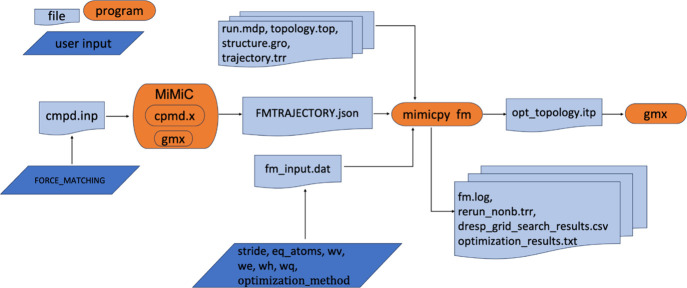 Figure 1
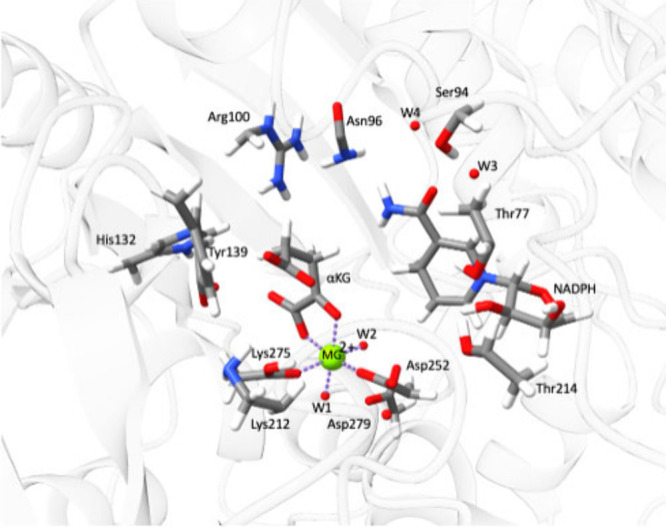 Figure 2
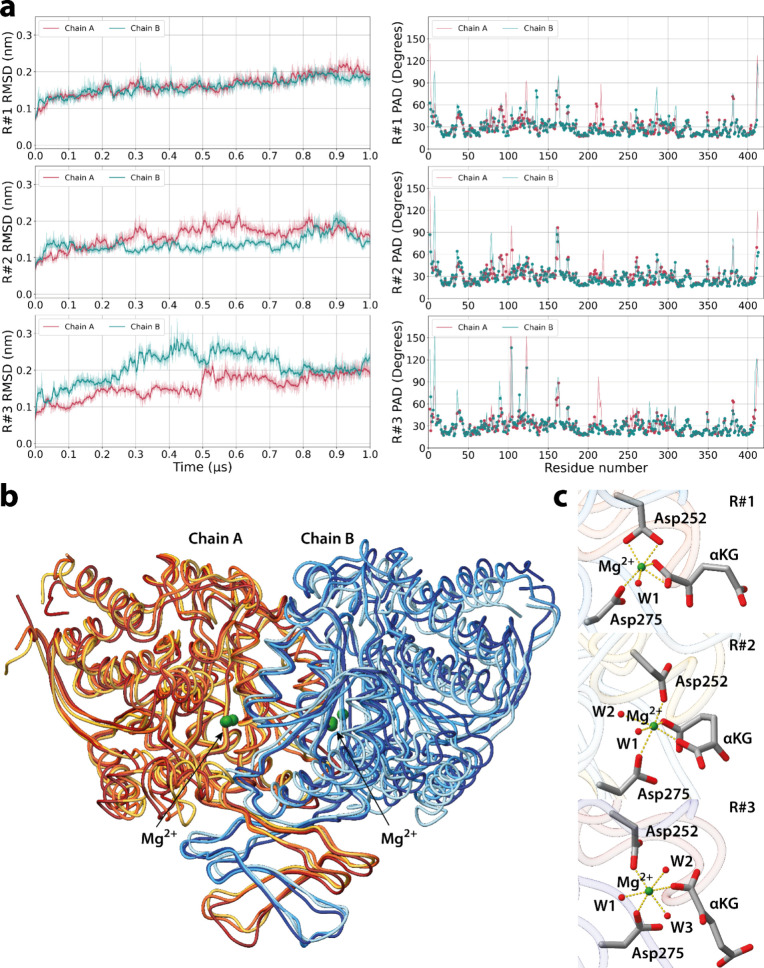 Figure 3
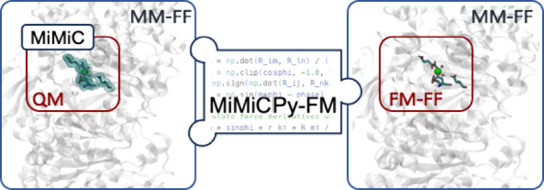 Figure 4
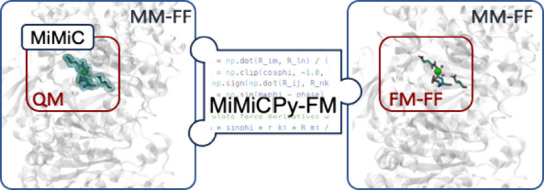 Figure 5
 Figure 6
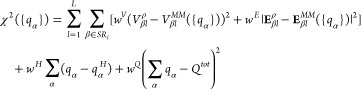 Figure 7
 Figure 8
Peer Reviews
No public reviews on file for this paper yet. If you reviewed it on a platform where reviews are public (OpenReview, ICLR, NeurIPS, ICML), you can paste yours below so the community can read it here.
Videos
No videos yet. Explain this paper in a talk, walkthrough, or lecture? Add one.
Taxonomy
TopicsProtein Structure and Dynamics · Force Microscopy Techniques and Applications · Crystallography and molecular interactions