Beyond the Lab: Cognitive Neuroscience in Real‐World Contexts
Stephan P. Kaufhold, Mia Borzello, Federico Rossano, David Kirsh

TL;DR
This paper argues that cognitive neuroscience should move beyond lab-based assumptions to better reflect real-world behavior and environments.
Contribution
The paper introduces a refined framework for ecological validity focusing on subject phenotype, task naturalness, and environmental fidelity.
Findings
Common assumptions about lab animals and digital twins may limit understanding of real-world cognition.
Natural settings offer behavioral flexibility and environmental variability that labs often exclude.
Methodological shifts like mobile neuroimaging and immersive environments can enhance ecological validity.
Abstract
Cognitive neuroscience has made remarkable advances by conducting rigorously controlled experiments inside the laboratory. However, the generalizability and real‐world relevance of these findings remain limited, in part due to fundamental, often unexamined, assumptions about how cognition operates across species and contexts. In this viewpoint, we critically evaluate three commonly held assumptions underlying current cognitive neuroscience practices: (1) laboratory animals serve as accurate representatives of their wild conspecifics; (2) animal models effectively mirror human cognitive processes; and (3) digital twins provide faithful, functionally equivalent representations of their real‐world analogs. We argue that these assumptions, if left unexamined, risk narrowing our understanding of cognition by excluding the behavioral flexibility, environmental variability, and agency that…
Genes, proteins, chemicals, diseases, species, mutations and cell lines named across the full text — each resolved to its canonical identifier and authoritative record.
Click any figure to enlarge with its caption.
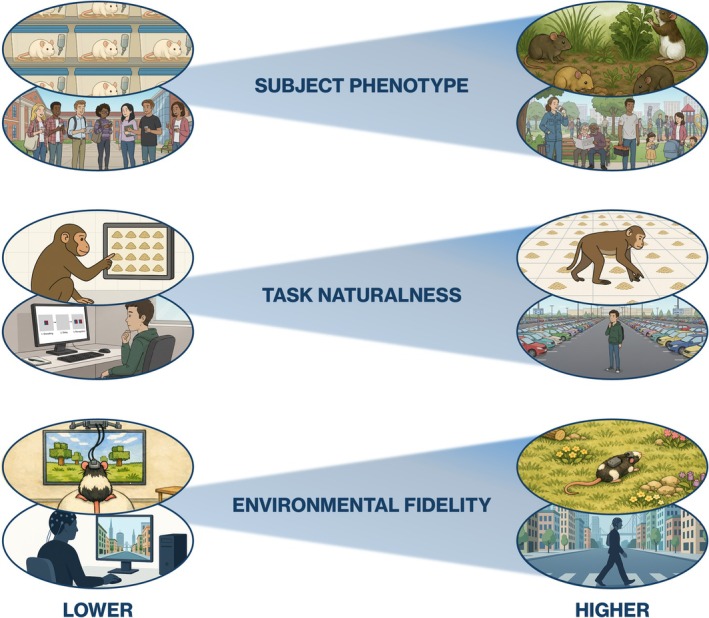 Figure 1
 Figure 2
Peer Reviews
No public reviews on file for this paper yet. If you reviewed it on a platform where reviews are public (OpenReview, ICLR, NeurIPS, ICML), you can paste yours below so the community can read it here.
Videos
No videos yet. Explain this paper in a talk, walkthrough, or lecture? Add one.
Taxonomy
TopicsAction Observation and Synchronization · Memory and Neural Mechanisms · Zebrafish Biomedical Research Applications