Upadacitinib for recalcitrant extraintestinal Crohn disease
Avery H. Seward, Jeffrey P. Callen

Abstract
Genes, proteins, chemicals, diseases, species, mutations and cell lines named across the full text — each resolved to its canonical identifier and authoritative record.
Click any figure to enlarge with its caption.
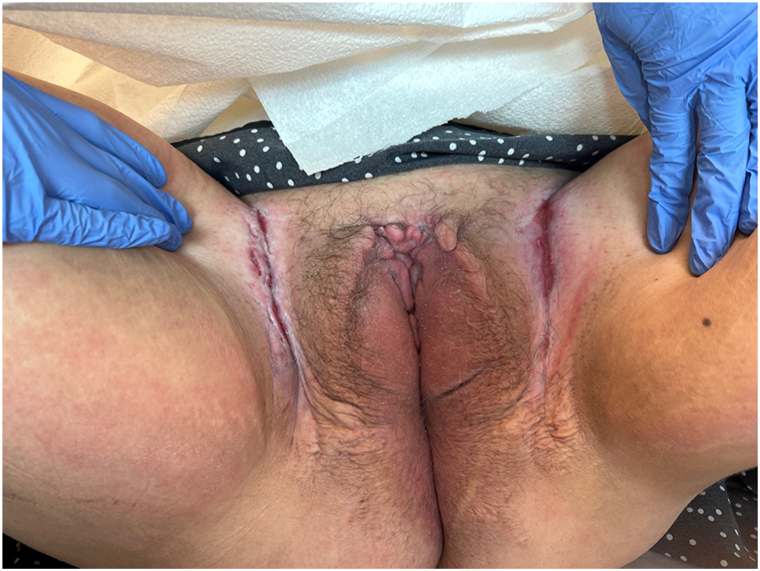 Figure 1
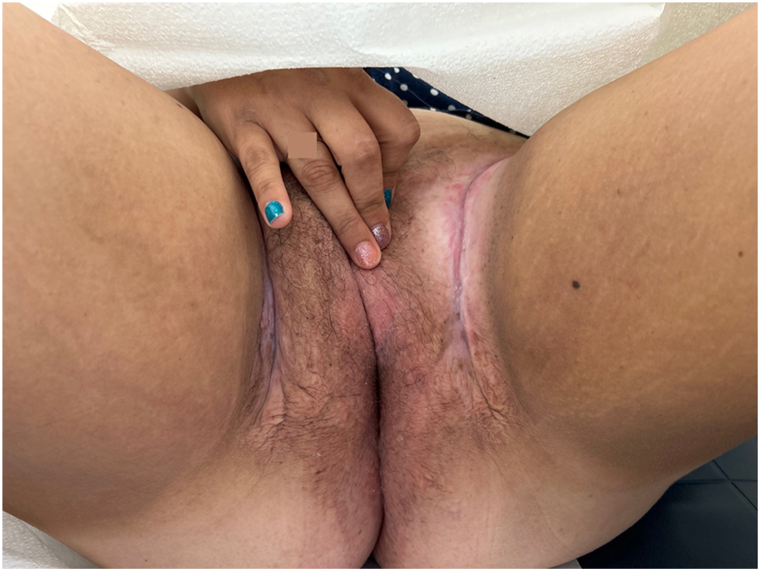 Figure 2
Peer Reviews
No public reviews on file for this paper yet. If you reviewed it on a platform where reviews are public (OpenReview, ICLR, NeurIPS, ICML), you can paste yours below so the community can read it here.
Videos
No videos yet. Explain this paper in a talk, walkthrough, or lecture? Add one.
Taxonomy
TopicsInflammatory Bowel Disease · Autoimmune and Inflammatory Disorders · Psoriasis: Treatment and Pathogenesis
Introduction
Crohn disease is a chronic inflammatory bowel disease that affects the gastrointestinal tract from the mouth to the anus. Extra-intestinal manifestations of Crohn disease are common, with the skin being the most commonly involved site.1 Cutaneous manifestations of Crohn include lesions that directly extend from the bowel to the skin, whereas extraintestinal Crohn disease involves sites that do not directly extend from the bowel.1 Extraintestinal Crohn disease is often resistant to treatments and often does not parallel the activity of the bowel disease.1 There have only been 3 documented cases of extraintestinal Crohn disease responding to upadacitinib.2^,^3 We describe a patient with recalcitrant extraintestinal Crohn disease who responded well to upadacitinib allowing her to cease prior therapies.
Case
A woman in her late 30s with a 29-year history of extraintestinal Crohn disease, with past medical history of an ileostomy pouch following a total colectomy, developed severe cutaneous Crohn disease affecting her perineum that included knife-like ulcerative lesions of her inguinal folds and hypertrophy of the vulva and clitoris (Fig 1). For the past 12 years as our patient, these manifestations have been resistant to multiple pharmacotherapies, including metronidazole, ustekinumab, mycophenolate mofetil, and methotrexate.Fig 1. Knife like ulcerative lesions of patient’s inguinal folds and hypertrophy of the vulva and clitoris prior to the introduction of upadacitinib.
Biopsy of gluteal and inguinal lesions revealed focal granulomatous infiltrate with background lymphoplasmacytic inflammation with small foci of granulomatous inflammation consisting of a few multinucleated histiocytes and a few mononuclear histiocytes. These findings were supportive of a diagnosis of extraintestinal Crohn disease.
Given the patient’s resistance to previous trialed pharmacotherapy, upadacitinib 45 mg, the recommended dosage for gastrointestinal Crohn disease, was initiated while her current regimen of oral metronidazole 500 mg twice daily, hydrocortisone ointment, silver sulfadiazine, and triamcinolone ointment were continued. Within 6 weeks, improvement was noted. The patient’s ulcerative slit-like lesions of the inguinal folds healed completely with only erythema remaining (Fig 2). Clitoral and vulvar hypertrophy have improved as well. No adverse effects or laboratory abnormalities from upadacitinib have been noted during treatment. We plan to taper the patient’s dose to 15-30 mg after 1 year of remission, based on clinical response.Fig 2. Six weeks of upadacitinib 45 mg daily demonstrated improvement of patient’s ulcerative slit-like lesions of the inguinal folds, with only mild erythema remaining.
Discussion
Extraintestinal Crohn disease is a rare manifestation of Crohn, presenting with cutaneous manifestations that are not contiguous with the gastrointestinal tract.4 The presentation of extraintestinal Crohn is variable and can include ulcerations, plaques, and nodules that are commonly found on the moist skin folds, genitals, and extremities.5, 6, 7 Our patient fulfills the criteria for diagnosis of extra-intestinal Crohn, as she has knifelike ulcerations of the inguinal skin, genital swelling, and a diagnosis of inflammatory bowel disease.8 The mechanism of extraintestinal Crohn’s disease remains unclear but is postulated to involve a Th1-mediated delayed hypersensitivity reaction.9 On biopsy, extraintestinal Crohn disease appears similar to intestinal Crohn, with characteristic findings of “noncaseating granulomas and epithelioid histiocytes” although this is not necessary for diagnosis.4 Extraintestinal Crohn disease is often refractory to treatment and causes significant morbidity and discomfort.
There is currently no standard for pharmaceutical management of extraintestinal cutaneous Crohn disease.4 Corticosteroids, antibiotics, immunosuppressants, tumor necrosis factor inhibitors, and interleukin 12 of 23 blockers are agents that have shown some efficacy,3^,^6 although many patients remain refractory to these treatments. Upadacitinib is an oral selective JAK1 inhibitor used to treat many chronic inflammatory conditions including rheumatoid arthritis, atopic dermatitis, psoriatic arthritis, Crohn disease, and ulcerative colitis.10 Prior to the initiation of upadacitinib, patients should receive a QuantiFERON-TB Gold test and pregnancy is contraindicated.
Upadacitinib has been used to resolve a case of extraintestinal Crohn presenting with a hand lesion,2 as well as 2 cases of extraintestinal Crohn involving the genital regions and inguinal folds.3 (Table I).Table IReported cases of extraintestinal manifestations of Crohn disease treated with upadacitinibPatientAge/sexSite of extraintestinal manifestationsDuration of lesionsUpadacitinib doseTime to complete healing/resolutionBurningham KM, et al.63-y-old manHand8 mo30 mg → 45 mg daily4 moEbriani J, et al.Woman in her 40sGenital region, inguinal folds5 y45 mg daily2 moEbriani J, et al.Woman in her 60sGenital region, inguinal folds2 y45 mg daily3 mo4 (current case)Woman in her late 30sGenital region, inguinal folds>12 y45 mg daily6 wks
Our patient demonstrated rapid resolution of skin lesions despite a longstanding disease course of over 12 years, suggesting that patients refractory to pharmacotherapy for extraintestinal Crohn disease may benefit from upadacitinib.
Conflicts of interest
None disclosed.
The reference list from the paper itself. Each links out to its DOI / PubMed record.
- 1Bernett C.N.Krishnamurthy K.Cutaneous Crohn disease Stat Pearls 2023 Stat Pearls Publishing
- 2Burningham K.M.Verma K.K.Patel A.B.Tyring S.K.Resolution of metastatic cutaneous Crohn's disease with upadacitinib monotherapy JAAD Case Rep 462024818410.1016/j.jdcr.2024.02.01738577495 PMC 10992270 · doi ↗ · pubmed ↗
- 3Ebriani J.Yoon J.Friedman S.Dalal R.French M.Charrow A.High-Dose upadacitinib therapy for refractory metastatic Crohn disease JAMA Dermatol 1607202478278310.1001/jamadermatol.2024.132138776111 · doi ↗ · pubmed ↗
- 4Aberumand B.Howard J.Howard J.Metastatic Crohn's disease: an approach to an uncommon but important cutaneous disorder Biomed Res Int 20172017819215010.1155/2017/8192150 PMC 523996628127561 · doi ↗ · pubmed ↗
- 5Antonelli E.Bassotti G.Tramontana M.Dermatological manifestations in inflammatory bowel diseases J Clin Med 102202136410.3390/jcm 1002036433477990 PMC 7835974 · doi ↗ · pubmed ↗
- 6Palamaras I.El-Jabbour J.Pietropaolo N.Metastatic Crohn's disease: a review J Eur Acad Dermatol Venereol 22920081033104310.1111/j.1468-3083.2008.02741.x 18573158 · doi ↗ · pubmed ↗
- 7Panackel C.John J.Krishnadas D.Vinayakumar K.R.Metastatic Crohn's disease of external genitalia Indian J Dermatol 533200814614810.4103/0019-5154.4320719882017 PMC 2763745 · doi ↗ · pubmed ↗
- 8Ebriani J.Santiago-Soltero K.Anshelevich E.E.Delphi panel for the development of diagnostic criteria for metastatic cutaneous Crohn disease: a consensus statement JAMA Dermatol 1616202564264710.1001/jamadermatol.2025.111540332924 · doi ↗ · pubmed ↗