Navigating the landscape of academic prose: A corpus-driven inquiry into rhetorical preferences and their pedagogical implications for advanced L2 writers
Yang Yu, Yingying Xu, Yongkang Wu

TL;DR
This study explores how advanced non-native English writers use general nouns in academic writing, revealing cultural differences and suggesting teaching strategies to improve their rhetorical skills.
Contribution
The study introduces a pedagogical model based on corpus analysis to help L2 writers understand and adopt Anglophone rhetorical conventions.
Findings
Chinese writers prefer 'Research-group' and 'Result-group' nouns with temporal and subjective collocations.
Anglophone writers favor 'Example-group' and 'Discussion-group' nouns with objectifying collocations.
The study proposes a teaching model to enhance rhetorical awareness and academic writing skills in L2 learners.
Abstract
This study presents a pedagogically motivated inquiry into the cross-cultural rhetorical patterns of academic writing, focusing on the use of general nouns (GNs). The research was initiated in response to persistent difficulties observed among advanced L2 writers, who struggle to use GNs with appropriate nuance to establish an authoritative stance. Employing a corpus-driven methodology, the study analyzes two purpose-built corpora: the Chinese Academic Written English Corpus (CAWEC) and the Inner-Circle Affiliated Written English Corpus (ICAWEC). The findings reveal divergent rhetorical tendencies. Writers in the CAWEC show a statistically significant preference for “Research-group” (e.g., study, research) and “Result-group” nouns (e.g., difference, results). Their collocational patterns, marked by temporality (current study) and subjectivity (our study), are consistent with a…
Genes, proteins, chemicals, diseases, species, mutations and cell lines named across the full text — each resolved to its canonical identifier and authoritative record.
Click any figure to enlarge with its caption.
 Figure 1
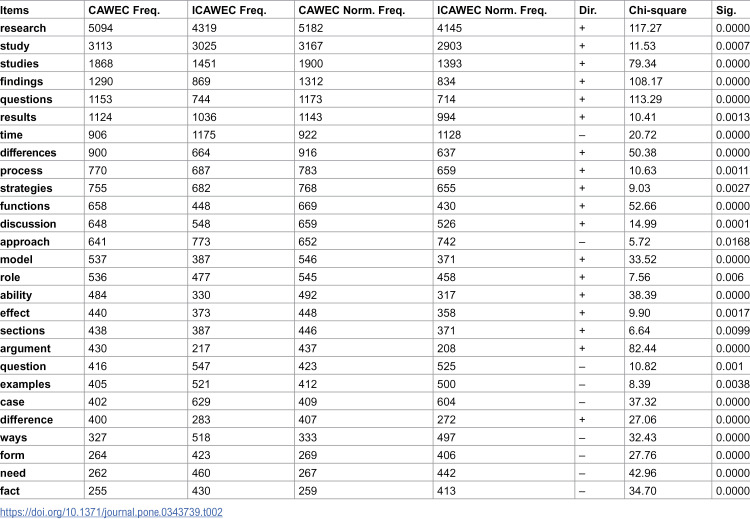 Figure 2
 Figure 3
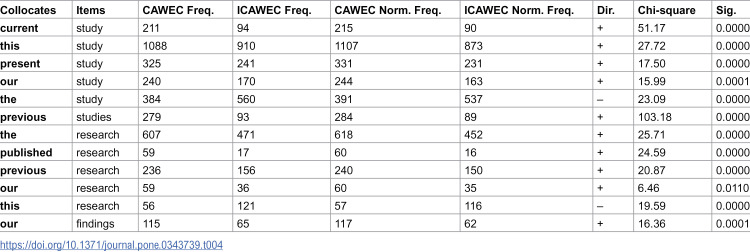 Figure 4
 Figure 5
 Figure 6
 Figure 7
Peer Reviews
No public reviews on file for this paper yet. If you reviewed it on a platform where reviews are public (OpenReview, ICLR, NeurIPS, ICML), you can paste yours below so the community can read it here.
Videos
No videos yet. Explain this paper in a talk, walkthrough, or lecture? Add one.
Taxonomy
TopicsDiscourse Analysis in Language Studies · Second Language Acquisition and Learning · Language, Metaphor, and Cognition