Beyond life cycle thinking: A perspective
Hannes Geist, Frank Balle

TL;DR
This paper questions if life cycle thinking alone is enough for today's sustainability challenges and suggests moving toward holistic systems thinking.
Contribution
It introduces a non-expert perspective on the limitations of life cycle thinking and proposes a shift toward systems thinking.
Findings
Life cycle thinking has four key limitations tied to its definition.
Non-experts outnumber experts in using life cycle thinking methodologies.
Holistic systems thinking is suggested as a complementary approach.
Abstract
Life cycle thinking is a fundamental concept of sustainability endeavors in most disciplines. The share of non-expert users applying life cycle thinking-based methodologies and tools is nowadays already significantly larger than the respective expert community. This perspective discusses life cycle thinking with a focus on its implications, limitations, and potential ways to overcome them from this non-expert perspective. While building on a long history and bringing undoubted advantages, we raise the question of whether thinking in life cycles alone is sufficient in light of today’s sustainability challenges. Four key limitations are found in the literature, all directly related to the definition of the concept itself. Solution attempts and sensitivity for these issues exist in the expert community only. We raise the discussion about going beyond the often-eponymous focus on life cycle…
Genes, proteins, chemicals, diseases, species, mutations and cell lines named across the full text — each resolved to its canonical identifier and authoritative record.
Click any figure to enlarge with its caption.
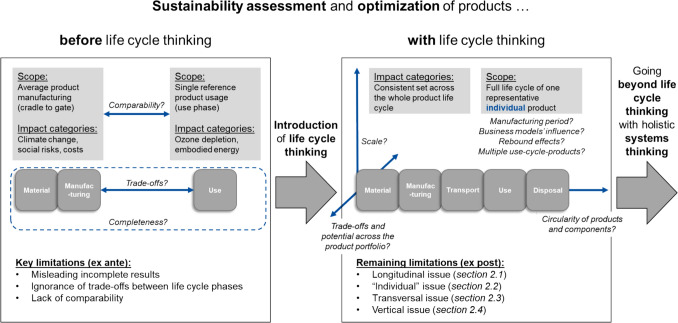 Figure 1
Peer Reviews
No public reviews on file for this paper yet. If you reviewed it on a platform where reviews are public (OpenReview, ICLR, NeurIPS, ICML), you can paste yours below so the community can read it here.
Videos
No videos yet. Explain this paper in a talk, walkthrough, or lecture? Add one.
Taxonomy
TopicsSustainability in Higher Education · Environmental Impact and Sustainability · Sustainable Development and Environmental Policy