Salmonella Stanley ST29 carrying IncHI2/ST3-blaNDM-5 plasmid emerged in a 4-month-old infant with diarrhea
Yu-Man Bai, Xiao-Juan Gao, Chao Yue, Zhong-Peng Cai, Guo-Long Gao, Lu-Chao Lv, Yi-Hua Cai, Hong-Mei Mo, Jian-Hua Liu

TL;DR
A 4-month-old infant's Salmonella infection revealed a rare carbapenem-resistant plasmid and insights into its spread in the community.
Contribution
The study identifies a novel plasmid-mediated blaNDM-5 carbapenem resistance in Salmonella Stanley ST29 and its potential community spread.
Findings
Two clonal ST29 isolates showed Tn7051-mediated excision of blaNDM-5 from an IncHI2/ST3 plasmid.
Phylogenomic analysis linked the isolate to strains from a healthy carrier and food sources in the same region.
Findings highlight the need for One-Health surveillance to track emerging Salmonella Stanley ST29.
Abstract
Salmonella serovar Stanley ST29 is an emerging foodborne pathogen with community spread potential, while its carbapenem resistance remains uncommon. In a longitudinal pediatric case with diarrhea, two clonal ST29 isolates sampled 2 months apart revealed within-host evolutionary dynamics: Tn7051-mediated excision of blaNDM-5 from an IncHI2/ST3 plasmid. Moreover, phylogenomics connected the case isolate to strains from a healthy carrier and from food-chain-associated sources in the same region (17–18 SNPs), underscoring community dissemination and the need for One-Health surveillance.
Genes, proteins, chemicals, diseases, species, mutations and cell lines named across the full text — each resolved to its canonical identifier and authoritative record.
Click any figure to enlarge with its caption.
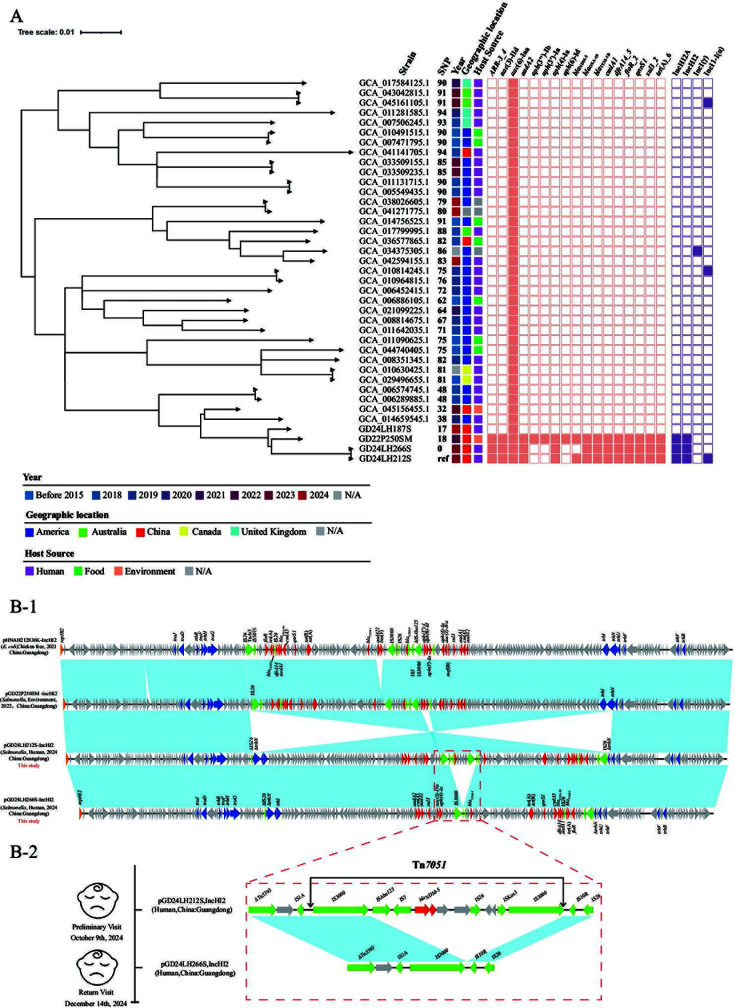 Fig 1
Fig 1| Isolate | MLST | Serotype | Plasmid type (pDLST) | Resistance genes | Antimicrobial profile (MIC, μg/mL) | Antimicrobial (KB, mm) |
|---|---|---|---|---|---|---|
| GD24LH212S | ST29 | Stanley | Resistant: CAZ (≥64), CRO (≥64), CSL (≥64), FEP (16), AMC (≥32), TZP (≥128), LVX (2), SXT (≥16/304), ETP (≥64), IPM (≥64) | Resistant: PEN (6), CZO (6) | ||
| GD24LH266S | ST29 | Stanley |
| Resistant: SXT (≥16/304) | Resistant: PEN (6) |
- —National Key Research and Development Program of China
- —National Natural Science Foundation of China
Peer Reviews
No public reviews on file for this paper yet. If you reviewed it on a platform where reviews are public (OpenReview, ICLR, NeurIPS, ICML), you can paste yours below so the community can read it here.
Videos
No videos yet. Explain this paper in a talk, walkthrough, or lecture? Add one.
Taxonomy
TopicsSalmonella and Campylobacter epidemiology · Escherichia coli research studies · Antibiotic Resistance in Bacteria
INTRODUCTION
Salmonella is a major foodborne pathogen of global concern, causing an estimated 93.8 million gastroenteritis cases and over 150,000 deaths annually, with infants and the elderly particularly vulnerable (1, 2). Antimicrobial therapy remains the cornerstone of treatment, yet resistance is rising, and carbapenem-resistant Salmonella has shown an increasing trend in recent years (3, 4). Within the broader emergence of carbapenem-resistant Salmonella, S. Stanley has become increasingly noteworthy (5, 6), with sporadic reports of carbapenemase genes since the first identification of blaNDM-1 (7), raising clinical concern despite the limited number of cases.
On 9 October 2024, a 4-month-old infant was admitted with diarrhea lasting 8 days, characterized by ≥5 watery stools per day and a single febrile episode at onset. The patient was diagnosed with diarrhea and intestinal dysbiosis and received probiotics with supportive care. On 14 December, the infant was re-admitted for persistent diarrhea and nasopharyngitis. Laboratory tests showed a reduced neutrophil ratio (33.7%, normal: 50%–70%), elevated lymphocyte ratio (53.7%, normal: 20%–40%), and elevated monocyte ratio (8.9%, normal: 1%–8%). Fecal examination showed watery, yellowish-brown stools. Treatment included a 3-day course of oral antibiotics, montmorillonite, and nasal irrigation. During history taking, caregivers reported that feeding bottles were not always promptly cleaned or disinfected, suggesting potential household hygiene lapses. Fecal samples were collected for sentinel testing.
Two strains of S. Stanley ST29, designated GD24LH212S and GD24LH266S, respectively, were isolated from fecal samples of the infant patient on 9 October and 14 December 2024, respectively. Antimicrobial susceptibility testing revealed that GD24LH212S was resistant to cephalosporins (ceftazidime, ceftriaxone, cefoperazone/sulbactam, cefepime), β-lactam/β-lactamase inhibitor combinations (amoxicillin-clavulanate, piperacillin-tazobactam), and carbapenems (ertapenem, imipenem), while GD24LH266S exhibited restored susceptibility to cephalosporins and carbapenems, but retained resistance to trimethoprim-sulfamethoxazole and penicillin (Table 1). To investigate the clonal relationship of these two isolates, we generated complete genomic data using the 2 × 150 PE Illumina HiSeq platform (200× coverage) (Illumina, San Diego, CA, USA) and QitanTech nanopore platform (QitanTech, China) and assembled the genomes with Unicycler v0.4.7 (8). Both isolates were identified as the emerging S. Stanley ST29 lineage, carrying highly similar plasmids and resistance genes. GD24LH212S carried IncHI2/ST3 and IncI1 plasmids, as well as multiple resistance genes across different antibiotic classes, including blaNDM-5, consistent with a multidrug-resistant profile (Table 1). The blaNDM-5 gene was located on the IncHI2/ST3 plasmid which was over 260 kb in size with a GC content of 46.3%, and also carried 14 other antimicrobial resistance genes (Table 1). GD24LH266S shared an almost identical resistance gene and plasmid profile, except for the absence of blaNDM-5 and IncI1 plasmid (Table 1). To our knowledge, this represents a rare observation of blaNDM-5 in S. Stanley from a pediatric diarrhea case, highlighting the public health concern posed by foodborne S. Stanley carrying this resistance gene.
Phylogenetic analysis of core genomes, using GD24LH212S as the reference, revealed that GD24LH266S shared an identical core genome (0 SNP differences) and clustered closely with global ST29 S. Stanley strains (17–94 SNP differences relative to the reference) publicly available sequences in GenBank as well as additional Salmonella genomes sequenced in our laboratory, including isolates from human, food, and environment across China and other regions (Fig. 1A). Notably, GD22P250SM (GCA_037164745.1, Guangzhou, 2022), an ST29 S. Stanley strain from a swine slaughterhouse in our previous study, carried a blaNDM-5-bearing IncHI2/ST3 plasmid (9) and differed from GD24LH212S by only 18 SNPs. Similarly, GD24LH187S (Shenzhen, 2024, laboratory collection), obtained from the feces of a healthy individual, differed by 17 SNPs but lacked the blaNDM-5-bearing plasmid. Taken together, these findings indicate the potential for cross-host transmission and community spread of NDM-producing ST29 S. Stanley in Guangdong province of China.
(A) Phylogenetic tree and heatmap of Salmonella ST29 isolates. (B-1) Comparison of blaNDM-5-IncHI2/ST3 plasmids with similar plasmids. (B-2) Schematic illustration of isolates from the pediatric case at initial (GD24LH212S) and follow-up (GD24LH266S) visits. Orange, red, green, and blue arrows represent plasmid replication genes, antimicrobial resistance genes, mobile element genes, and conjugative transfer genes, respectively. Light blue shading denotes regions of shared 99% homology among the different plasmids.
A linear comparison of pHNGD24LH212S from GD24LH212S and pHNGD24LH266S from GD24LH266S with IncHI2/ST3 plasmids deposited in GenBank and plasmids obtained in our lab revealed that pHNGD24LH212S and pHNGD24LH266S were highly similar to pHNAH212836K (CP104628.1, China, chicken feces, 2021) (10) and pHNGD22P250SM (GCA_037164745.1, China, environmental sample, 2022) (9), with an average sequence identity of 99% and coverage of 98% (Fig. 1B-1). In contrast, the variable regions of pHNGD24LH212S and pHNGD24LH266S exhibited inversions compared with pHN22P250SM, likely driven by the insertion and transposition of IS elements such as IS26. Conjugation was performed with GD24LH212S (donor) and Escherichia coli J53 (recipient) at 25°C and 30°C. Donor and recipient cells were co-incubated in antibiotic-free broth for 10 h, and mixtures were plated onto meropenem and sodium azide supplemented selective agar. No transconjugants were recovered under either condition. Conjugation assays further demonstrated that both plasmids had lost transferability, which may be attributable to IS26-mediated truncation of trhN (Fig. 1B-1).pHNGD24LH212S and pHNGD24LH266S are highly similar, with differences only observed in the variable regions. pHNGD24LH266S, compared to pHNGD24LH212S, lacks Tn7051 (IS3000-ΔISAba125-IS5-blaNDM-5-bleMBL-trpF-dsbC-IS26-umuD-∆ISKox3-IS3000), and this observation may be associated with recombination of the two copies of IS3000 in the same orientation, possibly leading to the insertion or loss of resistance modules (Fig. 1B-2). Competitive assays further showed that GD24LH212S carrying Tn7051 had only a slight fitness advantage over GD24LH266S under antibiotic-free conditions (Fig. S1). This finding, together with the absence of antimicrobial treatment before 14 December, suggests that Tn7051 loss may have been facilitated by selective pressure.
Previous epidemiological surveillances identified S. Stanley as a persistent pathogen disproportionately affecting pediatric (0–5 years) and geriatric (>60 years) populations, with recurrent isolation from commercial aquatic products and food matrices across multiple regions (11–13). Our previous detection of NDM-5-producing S. Stanley in slaughterhouse environments points to potential transmission nodes within the food chain. Phylogenetic analysis further demonstrates that this pathogen can undergo cross-host transmission through food chain pathways, facilitating its spread in human populations. Of particular concern, this case was epidemiologically linked to inadequate domestic food handling practices, specifically delayed cleaning of feeding bottles, establishing a direct connection between hygiene behaviors and clinical outcomes. In addition, our findings show that S. Stanley ST29 can persist in the infant gut for over 2 months, causing prolonged diarrhea likely due to the lack of timely diagnosis and targeted antimicrobial therapy. Interestingly, in the absence of antibiotic pressure, the blaNDM-5-carrying plasmid underwent Tn7051-mediated loss. Competition assays indicated that the Tn7051-blaNDM-5 module imposed only a minor fitness cost on the host strain, consistent with previous reports (14). This suggests that other factors may also drive the instability of blaNDM-5, which warrants further investigation. As carbapenem-resistant Salmonella represents a particular threat to infant health, improved household hygiene is vital to prevent foodborne infections in this population.
In summary, this study documents the first isolation of blaNDM-5-IncHI2/ST3 plasmid-harboring S. Stanley ST29 strain from an infant diarrheal case. Our findings revealed two urgent threats: mobile genetic elements spreading resistance genes through bacterial populations, while weaknesses in food safety systems allow contaminated food to reach vulnerable groups. They underscore the need for integrated One-Health surveillance and targeted interventions, particularly food-handler education, to disrupt transmission of high-risk-resistant clones.
The reference list from the paper itself. Each links out to its DOI / PubMed record.
- 1Majowicz SE, Musto J, Scallan E, Angulo FJ, Kirk M, O’Brien SJ, Jones TF, Fazil A, Hoekstra RM International Collaboration on Enteric Disease “Burden of Illness” Studies 2010. The global burden of nontyphoidal Salmonella gastroenteritis. Clin Infect Dis 50:882–889. doi:10.1086/65073320158401 · doi ↗ · pubmed ↗
- 2Popa GL, Papa MI. 2021. Salmonella spp. infection - a continuous threat worldwide. Germs 11:88–96. doi:10.18683/germs.2021.124433898345 PMC 8057844 · doi ↗ · pubmed ↗
- 3Song H, Zou S, Wang Y, Chen Z, Sun Z, Jian C. 2025. Emergence of carbapenem-resistant Salmonella Mbandaka through IS 26-driven bla NDM-1 mobilization and chromosomal structural variation. Microbiol Spectr:e 00967–25. doi:10.1128/spectrum.00967-2540815228 PMC 12502706 · doi ↗ · pubmed ↗
- 4Liao Y-S, Chen B-H, Hong Y-P, Teng R-H, Wang Y-W, Liang S-Y, Liu Y-Y, Tu Y-H, Chen Y-S, Chang J-H, Tsao C-S, Chiou C-S. 2019. Emergence of multidrug-resistant Salmonella enterica serovar goldcoast strains in taiwan and international spread of the ST 358 clone. Antimicrob Agents Chemother 63:01122–19. doi:10.1128/AAC.01122-19PMC 676150231383653 · doi ↗ · pubmed ↗
- 5Li P, Yuan Y, Yan Y, Jia M, Gao L, Liu X, Sun Y, Zhu G, Chen Z. 2025. Characterization of bla NDM–5-carrying plasmids in two clinical Salmonella isolates from Jiaxing city, China. Front Microbiol 16:2025. doi:10.3389/fmicb.2025.1620907 PMC 1224092640641878 · doi ↗ · pubmed ↗
- 6World Health Organization. 2024. WHO Bacterial Priority Pathogens List, 2024: bacterial pathogens of public health importance to guide research, development and strategies to prevent and control antimicrobial resistance. Available from: https://www.who.int/publications/i/item/9789240093461
- 7Huang J, Wang M, Ding H, Ye M, Hu F, Guo Q, Xu X, Wang M. 2013. New Delhi metallo-β-lactamase-1 in carbapenem-resistant Salmonella strain, China. Emerg Infect Dis 19:2049–2051. doi:10.3201/eid 1912.13005124274898 PMC 3840890 · doi ↗ · pubmed ↗
- 8Wick RR, Judd LM, Gorrie CL, Holt KE. 2017. Unicycler: resolving bacterial genome assemblies from short and long sequencing reads. PLOS Comput Biol 13:e 1005595. doi:10.1371/journal.pcbi.100559528594827 PMC 5481147 · doi ↗ · pubmed ↗