The first complete chloroplast genome sequence and phylogenetic analysis of Actinidia trichogyna
Sen Meng, Zheng Jiang, Jingwen Huang, Xiaohong Yao

TL;DR
This paper presents the first complete chloroplast genome of Actinidia trichogyna and explores its evolutionary relationships.
Contribution
The study provides the first complete chloroplast genome sequence of Actinidia trichogyna and its phylogenetic analysis.
Findings
The chloroplast genome is 156,507 bp long with 131 annotated genes.
Phylogenetic analysis shows Actinidia trichogyna forms an independent evolutionary branch.
The findings offer new genomic resources for kiwifruit research.
Abstract
Actinidia trichogyna is primarily distributed in the high-altitude regions of southwest China and its genomic data resources are still lacking. In this study, we assembled and annotated its complete chloroplast genome, which spanned 156,507 bp and consisted of a large single-copy region of 88,295 bp, a small single-copy region of 20,610 bp and two inverted repeat regions of 23,801 bp. The genome contained 131 genes, including 84 protein-coding genes, 8 ribosomal RNA genes, and 39 transfer RNA genes. Phylogenetic analysis revealed that it formed an independent branch to other species in the Sect. Maculatae, suggesting its unique evolutionary history. This study provides valuable data resources for kiwifruit evolutionary and functional genomic studies.
Genes, proteins, chemicals, diseases, species, mutations and cell lines named across the full text — each resolved to its canonical identifier and authoritative record.
Click any figure to enlarge with its caption.
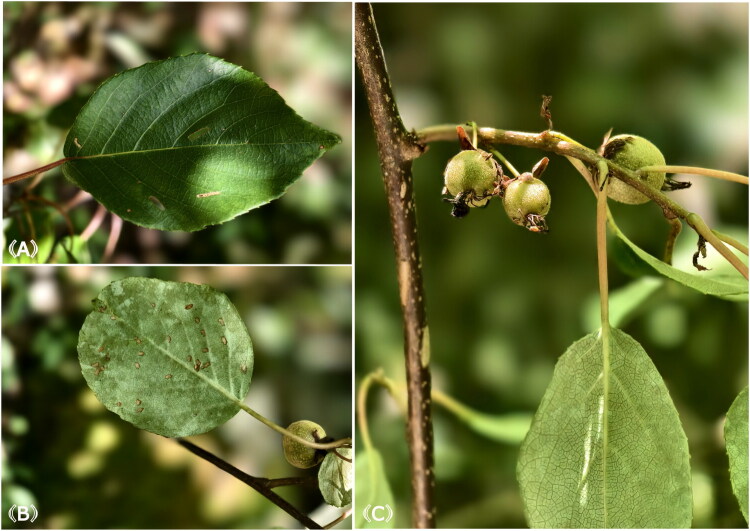 Figure 1
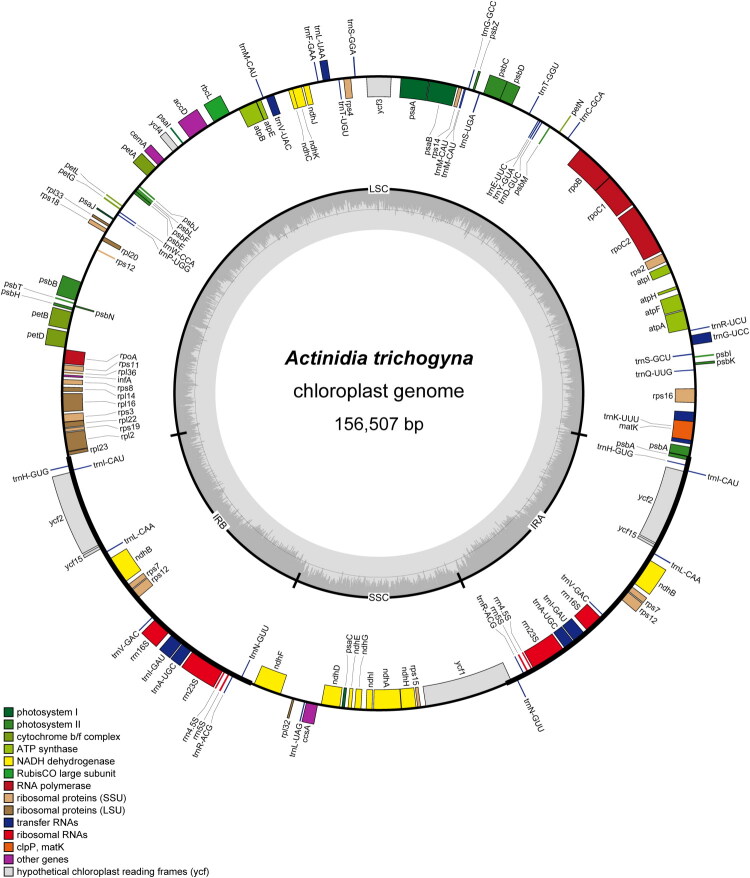 Figure 2
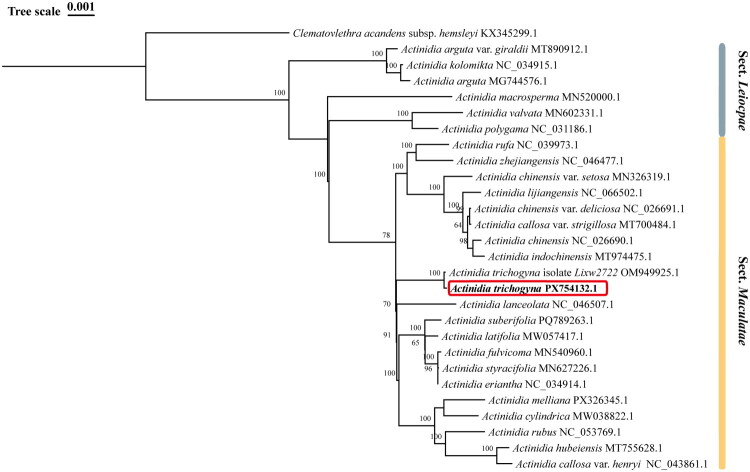 Figure 3
- —Zhejiang Provincial Forestry Special Project
Peer Reviews
No public reviews on file for this paper yet. If you reviewed it on a platform where reviews are public (OpenReview, ICLR, NeurIPS, ICML), you can paste yours below so the community can read it here.
Videos
No videos yet. Explain this paper in a talk, walkthrough, or lecture? Add one.
Taxonomy
TopicsGenomics and Phylogenetic Studies · Photosynthetic Processes and Mechanisms · Biological and pharmacological studies of plants
Introduction
The genus Actinidia is one of the most important fruit trees, gathering significant attention due to its rich nutritional value, particularly its high vitamin C content (Liang et al. 2020). According to the latest taxonomic revision, Actinidia currently comprises 75 species or variants, nearly all of which are endemic to China, except for A. strigose and A. hypoleuca (Huang et al. 2013). The abundant Actinidia germplasm resources in China lay a solid foundation for future insights into the speciation, evolution, and subsequent breeding of kiwifruit.
Actinidia trichogyna Franch. (1894) is primarily distributed in the high-altitude regions of southwest China, such as Chongqing municipality, Sichuan province, and Hubei province (Li et al. 2007). The reference images of A. trichogyna are presented in Figure 1. According to the latest taxonomic revision, it is classified within the Sect. Maculatae and shares similar morphological characteristics with A. chrysantha, A. glaucocallosa and A. indochinensis. However, the phylogenetic relationships of A. trichogyna are still uncertain owing to lacking of genomic data resources, so it is crucial to fill the gap within Actinidia. The chloroplast genome is a key component of the plant plastid genetic system and contains relatively independent genetic information (Daniell et al. 2016). Due to its small genome size, relative conservation and low nucleotide substitution rates, it has been widely used in studying molecular evolution and phylogeographical history (Jansen et al. 2007). Moreover, a complete chloroplast genome serves as a crucial resource for studying the phylogenetic relationships and taxonomy within the genus Actinidia. Therefore, it is essential to explore the complete chloroplast genome sequence of A. trichogyna.
Morphological characteristics of A. trichogyna. Photographs were taken by Jingwen Huang in Wuxi County, Chongqing municipality, on August 1, 2024. (A) The adaxial leaf surface. Green and glabrous, midvein and lateral veins subconspicuous abaxially, lateral veins 6 or 7 pairs. (B) The abaxial leaf surface. Glaucous and glabrous, base usually truncate, margin finely serrulate, apex acute to acuminate. (C) The fruits and stem. Fruits subglobose, with lenticels, glabrescent at maturity. Stems dark brown, glabrous, with conspicuous lenticels.
In this study, we sequenced, assembled, and annotated the complete chloroplast genome of A. trichogyna. Comparative analyses were conducted with other published chloroplast genomes in the NCBI database to explore the phylogenetic relationships of A. trichogyna. Our study provides valuable genomic information for the species classification, conservation, and molecular breeding of kiwifruit.
Materials and methods
Plant sampling, DNA extraction and sequencing
2.1.
The leaves of A. trichogyna for this study were collected from the Wuxi County, Chongqing municipality (109.88°E, 31.47°N, altitude. 1592 m), in August 2024. The fresh leaves were collected and preserved in silica gel. The voucher specimen (voucher: HIB0258940; contact person: Guangwan Hu, [email protected]) was identified and deposited at the Herbarium of Wuhan Botanical Garden, Chinese Academy of Sciences on September 12, 2025.
Paired-end sequencing libraries were constructed following the manufacturer’s protocol on the DNBSEQ-T7 platform by Novogene (Beijing, China), with insert sizes of approximately 150 bp. Low-quality reads and adapter sequences were removed from the raw sequencing data using fastp v0.23.2 (Chen et al. 2018).
Assembly and annotation of the chloroplast genome
2.2.
Approximately 7 GB of clean reads of A. trichogyna were produced and further evaluated using FastQC v0.11.9 (Brown et al. 2017). The de novo plastome assembly was performed by GetOrganelle v1.7.5 with parameter ‘-R 15 -t 20 -k 21,45,65,85,105 -F embplant_ pt’ (Jin et al. 2020). The genome sequence was annotated by using PGA 2.0 (Zhang et al. 2025) and CPGAVAS2(Shi et al. 2019) and then manually merged and modified, with Actinidia chinensis Planch. (GenBank Accession no. NC_026690) as the reference genome. The assembled chloroplast genome map was generated using OGDRAW v1.3.1 (Greiner et al. 2019).
Phylogenetic analysis
2.3.
We downloaded 26 cp genome sequences of other Actinidia species from the NCBI database, and Clematoclethra scandens subsp*. hemsleyi* (Actinidiaceae) was selected as the outgroup. All the cp genome sequences were aligned using MAFFT v.7 (Nakamura et al. 2018), and the poorly aligned regions were then removed using trimAl v1.2 (Capella-Gutierrez et al. 2009). The Maximum-likelihood (ML) tree was reconstructed in IQ-TREE v2.0.3 (Bui et al. 2020) with rapid 1000 bootstrap replicates. The phylogenic tree was then visualized by the online website Chiplot (Xie et al. 2023).
Results
Characteristics of chloroplast genome
3.1.
The average coverage depth of the assembled genome was 11091.8× (Figure S1). The complete cp genome of A. trichogyna was 156,507 bp in length and showed a typical quadripartite structure, consisting of a large single-copy (LSC) region of 88,295 bp, a small single-copy (SSC) region of 20,610 bp and a pair of inverted repeat (IRs) regions of 23,801 bp (Figure 2). The genome had an overall GC content of 37.2%, with higher GC content observed in the IR regions (43.2%) compared to the LSC (35.4%) and SSC (31.1%) regions. The annotation identified a total of 131 genes, including 84 protein-coding genes (PCGs), 8 ribosomal RNA genes (rRNAs), and 39 transfer RNA genes (tRNAs). Among them, 12 genes (rps16, atpF, rpoC1, ycf3, petB, petD, rpl16, rpl2, ndhB, ndhA, ycf1, and ndhB) were cis-splicing genes (Figure S2), and rps12 was a trans-splicing gene with three unique exons (Figure S3). The newly completed annotation of the A. trichogyna chloroplast genome has been deposited to GenBank under the accession number PX754132.
The circular chloroplast map of A. trichogyna. The distribution of genes are shown on the outermost track. The genes categories are shown in the bottom left corner. The inner circle represents a typical quadripartite structure with a large single-copy (LSC) region, a pair of inverted repeats (IRa and IRb) regions and a small single-copy (SSC) region.
Phylogenetic relationship
3.2.
Phylogenetic reconstruction using Maximum Likelihood (ML) methods robustly revealed the position of A. trichogyna within the genus based on 28 whole chloroplast genome sequences of Actinidia and the outgroup (Figure 3). In the phylogenetic tree, 26 Actinidia species clustered into two main clades with high bootstrap support, closely consistent with the latest taxonomic revision. In the first main clade, one branch contained A. arguta, A. arguta var. giraldii and A. kolomikta, and another one contained A. macrosperma, A. polygama, A. valvata, which corresponded to the Ser. Lamellatae and Ser. Solidae of Sect. Leiocarpae, respectively. The rest species clustered into another main clade, which were in correspondence with the Sect. Maculatae. Phylogenetic analysis indicated that A. trichogyna did not cluster with other species, suggesting its distinct evolutionary history. Besides that, A. chinensis, A. chinensis var. deliciosa, A. lijiangensis, A. chinensis var. setosa, A. indochinensis and A. callosa var. strigillosa clustered together, whereas A. zhejiangensis and A. rufa formed another independent cluster*. A. suberifolia*, A. latifolia, A. eriantha, A. styracifolia and A. fulvicoma clurested together, while A. melliana, A. cylindrica, A. rubus, A. callosa var. henryi and A. hubeiensis showed closely phylogenetic relationships in another branch.
The maximum-likelihood tree based on the chloroplast gene sequences of A. trichogyna and other 25 species of Actinidia. The number next to the nodes indicates the bootstrap values. The scale bar in the top left corner of the figure represents the phylogenetic distance of 0.001 nucleotide substitutions per site. The following sequences are used: A. arguta MG744576.1 (Lin et al. 2018), A. arguta var. giraldii MT890912.1 (Ding et al. 2021), A. callosa var. henryi NC_043861.1 (Wu et al. 2019), A. callosa var. strigillosa MT700484.1 (Liu et al. 2020), A. chinensis NC_026690.1 (Yao et al. 2015), A. chinensis var. deliciosa NC_026691.1 (Yao et al. 2015), A. chinensis var. setosa MN326319.1 (Lin et al. 2019), A. cylindrica MW038822.1 (Ma and Liu 2019), A. eriantha NC_034914.1 (Tang et al. 2019), A. fulvicoma MN540960.1 (Zhang et al. 2019), A. hubeiensis MT755628.1, A. indochinensis MT974475.1, A. kolomikta NC_034915.1 (Lan et al. 2018), A. lanceolata NC_046507.1 (Zhang and Liu 2019), A. latifolia MW057417.1 (Yang et al. 2021), A.lijiangensis NC_066502.1 (Lin et al. 2025), A. macrosperma MN520000.1 (Chen et al. 2019), A. melliana PX326345.1, A. polygama NC_031186.1 (Wang et al. 2016), A. rubus NC_053769.1 (Xu et al. 2020), A. rufa NC_039973.1 (Kim et al. 2018), A. styracifolia MN627226.1 (Yang et al. 2019), A. suberifolia PQ789263 (Zhang et al. 2025), A. trichogyna PX754132, A. trichogyna isolate Lixw2722 OM949925.1, A. valvata MN602331.1 (Chen et al. 2020), A. zhejiangensis NC_046477,1 (Ai and Liu 2019), Clematoclethra scandens subsp. hemsleyi KX345299.1 (Wang et al. 2016).
Discussion and conclusion
This study reported the complete chloroplast genome of A. trichogyna and analyzed its structural features and gene content, which was similar to other previously reported species of Actinidia. The genome showed a typical quadripartite structure spanning 156,507 bp, which consisted of two inverted repeats (IRs) of 23,801 bp separated by a large single-copy (LSC) and a SSC of 88,295 bp and 20,610 bp. The phylogenetic analysis based on 25 whole chloroplast genome sequences revealed the phylogenetic position of A. trichogyna within the genus, which displayed consistent topology with the previous reports (Liu et al. 2017; Wang et al. 2022). The two chloroplast genome sequences of A. trichogyna (Accessions: PX754132.1 and OM949925,1) clustered together with a 100% bootstrap value in the phylogenetic analysis, which confirmed the accuracy of our assembly and the sequence conservation of the species’ plastome. The phylogenetic results indicated that A. trichogyna formed an independent lineage parallel to other species in the Sect. Maculatae. Based on morphological characteristics, A. trichogyna was close to A. indochinensis but not supported by the phylogenetic analysis (Figure 3). Therefore, further studies are needed to resolve the phylogenetic relationships within the genus Actinidia.
The complete chloroplast genome and phylogenetic analysis of A. trichogyna provided valuable perspectives for clarifying the evolutionary relationships within the genus Actinidia. Future investigations should combine more extensive species sampling and nuclear data, which will enhance our comprehension of molecular evolution and species conservation for this economically important genus.
Supplementary Material
supplementary material.docx
The reference list from the paper itself. Each links out to its DOI / PubMed record.
- 1Ai F, Liu H. 2019. The complete chloroplast genome sequence of Actinidia zhejiangensis. Mitochondrial DNA Part B. 4(1):690–691. 10.1080/23802359.2019.1573117 · doi ↗
- 2Brown J, Pirrung M, Mc Cue LA. 2017. FQC Dashboard: integrates Fast QC results into a web-based, interactive, and extensible FASTQ quality control tool. Bioinformatics. 33(19):3137–3139. 10.1093/bioinformatics/btx 37328605449 PMC 5870778 · doi ↗ · pubmed ↗
- 3Bui QM et al. 2020. IQ-TREE 2: new models and efficient methods for phylogenetic inference in the genomic era. Mol Biol Evol. 37(5):1530–1534. 10.1093/molbev/msaa 01532011700 PMC 7182206 · doi ↗ · pubmed ↗
- 4Capella-Gutierrez S, Silla-Martinez JM, Gabaldón T. 2009. trim Al: a tool for automated alignment trimming in large-scale phylogenetic analyses. Bioinformatics. 25(15):1972–1973. 10.1093/bioinformatics/btp 34819505945 PMC 2712344 · doi ↗ · pubmed ↗
- 5Chen S, Zhou Y, Chen Y, Gu J. 2018. fastp: an ultra-fast all-in-one FASTQ preprocessor. Bioinformatics. 34(17):i 884–i 890. 10.1093/bioinformatics/bty 56030423086 PMC 6129281 · doi ↗ · pubmed ↗
- 6Chen Y et al. 2019. The complete chloroplast genome of Actinidia macrosperma. Mitochondrial DNA B Resour. 4(2):4188–4189. 10.1080/23802359.2019.169273333366376 PMC 7707781 · doi ↗ · pubmed ↗
- 7Chen Y et al. 2020. The complete chloroplast genome sequence of Actinidia valvata. Mitochondrial DNA B Resour. 5(3):2072–2073. 10.1080/23802359.20201764402.33457746 PMC 7782910 · doi ↗ · pubmed ↗
- 8Daniell H, Lin C, Yu M, Chang W. 2016. Chloroplast genomes: diversity, evolution, and applications in genetic engineering. Genome Biol. 17(1):134. 10.1186/s 13059-016-1004-227339192 PMC 4918201 · doi ↗ · pubmed ↗