Point-of-Care EEG for Non-Convulsive Seizure and Status Epilepticus: Advances, Limitations, and Future Directions
Ana Leticia Fornari Caprara, Jamir Pitton Rissardo, Hana Rababeh, April Pivonka, Priya Shah, Kaitlyn Piotrowski, Matthew George Petruncio, Anusha Keshireddy, Zehra Jaffri, Arthur Gribachov, Ruchika Moturi, Haashim Khurram, Manisha Koneru, Evren Burakgazi-Dalkilic

TL;DR
Point-of-care EEG is a promising tool for quickly detecting non-convulsive seizures and improving neurological care in emergency settings.
Contribution
This review highlights recent advances, limitations, and future directions of POC-EEG in detecting seizures and related conditions.
Findings
POC-EEG enables earlier seizure detection and faster treatment decisions in acute neurological care.
Recent improvements in portability and AI-assisted interpretation have increased accessibility for non-specialists.
Automated detection algorithms show high accuracy but require further validation for focal or low-burden seizure activity.
Abstract
Point-of-care electroencephalography (POC-EEG) has emerged as a practical tool for the rapid detection of non-convulsive seizures (NCS) and non-convulsive status epilepticus (NCSE) in acute neurological settings where access to conventional EEG is often delayed. This narrative review synthesizes current evidence on the clinical applications, tech-no-logical evolution, and limitations of POC-EEG systems across adult and pediatric populations. Available data suggest that POC-EEG is associated with earlier seizure identification, more timely antiseizure treatment decisions, and reduced dependence on inter-facility transfers in selected healthcare settings. Beyond seizure detection, POC-EEG has shown potential utility in the assessment of acute encephalopathy due to conditions such as stroke, traumatic brain injury, delirium, and post-cardiac arrest states. Recent advances in device…
Genes, proteins, chemicals, diseases, species, mutations and cell lines named across the full text — each resolved to its canonical identifier and authoritative record.
Click any figure to enlarge with its caption.
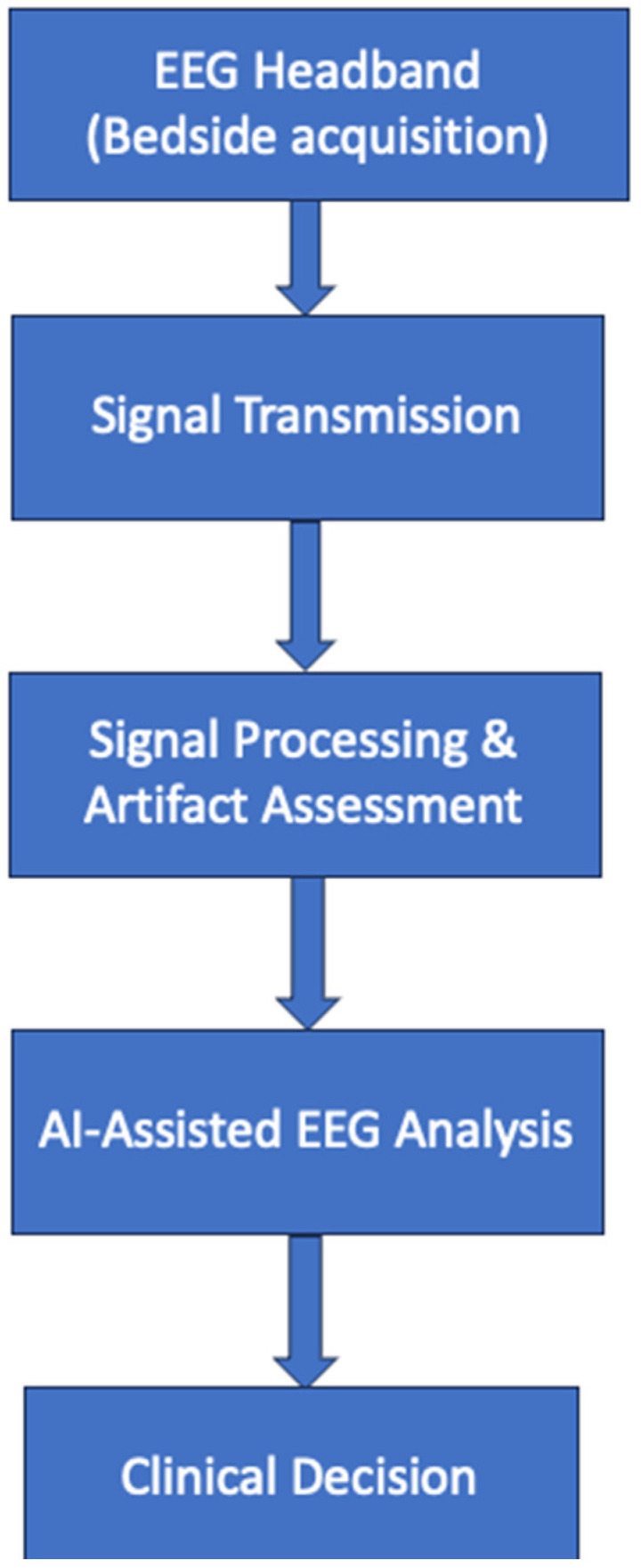 Figure 1
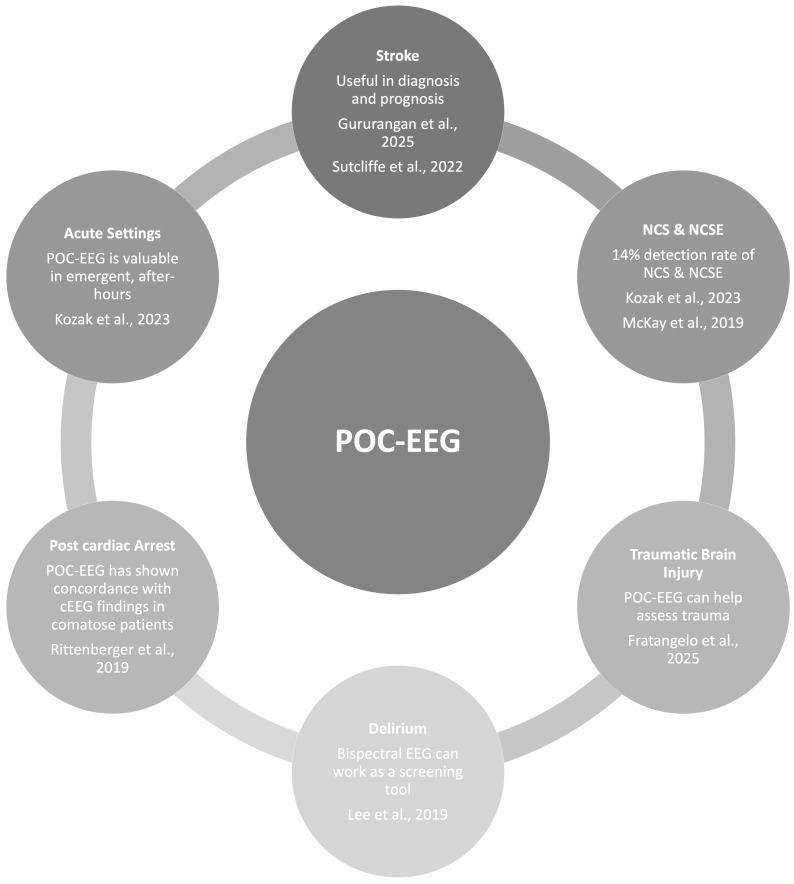 Figure 2
Peer Reviews
No public reviews on file for this paper yet. If you reviewed it on a platform where reviews are public (OpenReview, ICLR, NeurIPS, ICML), you can paste yours below so the community can read it here.
Videos
No videos yet. Explain this paper in a talk, walkthrough, or lecture? Add one.
Taxonomy
TopicsEEG and Brain-Computer Interfaces · Epilepsy research and treatment · Neonatal and fetal brain pathology