Intersecting Sex Work and Substance Use Risk Among Sexual and Gender Minoritized Individuals Recruited Online in San Francisco, California: Survey Results
Sean Arayasirikul, Jarett Maycott, Angela Olivares

TL;DR
This study explores the link between sex work and substance use among sexual and gender minoritized individuals in San Francisco.
Contribution
It identifies a higher likelihood of substance use and domestic violence among individuals with a history of sex work.
Findings
A history of sex work was prevalent in the study sample.
Individuals with a history of sex work were more likely to use controlled substances recently.
Sex workers were more likely to experience domestic violence.
Abstract
This research letter examines sex work and substance use associations in a sample of sexual and gender minoritized individuals recruited online in San Francisco, California. This study found that a history of sex work was prevalent and that people with a history of sex work were more likely to recently report using controlled substances and experience domestic violence.
Genes, proteins, chemicals, diseases, species, mutations and cell lines named across the full text — each resolved to its canonical identifier and authoritative record.
Click any figure to enlarge with its caption.
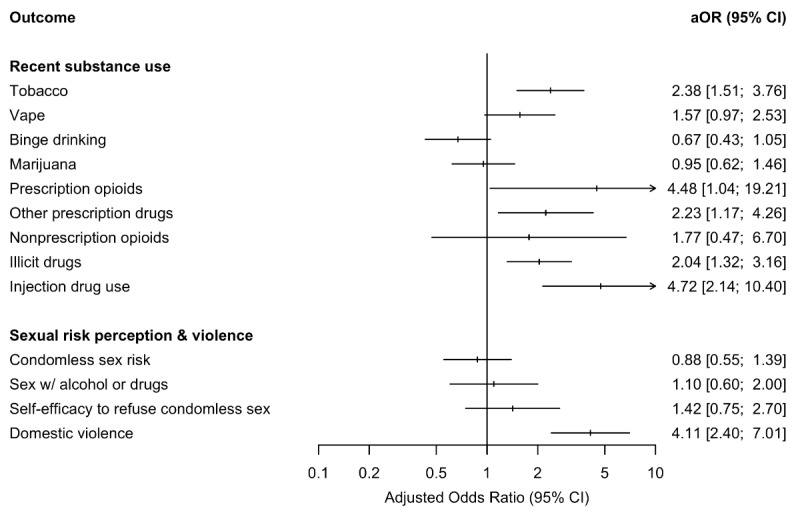 Figure 1
|
| Overall (N=409), n (%) | Sex work status | ||||||
|
|
| Yes (n=168), n (%) | No (n=241), n (%) | |||||
|
| ||||||||
|
|
| |||||||
|
|
| 18-29 | 103 (25.18) | 31 (18.45) | 72 (29.88) | |||
|
|
| 30-39 | 112 (27.38) | 54 (32.14) | 58 (24.07) | |||
|
|
| 40-49 | 77 (18.83) | 34 (20.24) | 43 (17.84) | |||
|
|
| 50+ | 117 (28.61) | 49 (29.17) | 68 (28.22) | |||
|
|
| |||||||
|
|
| White | 169 (41.32) | 71 (42.26) | 98 (40.66) | |||
|
|
| Latino/a/x/e | 113 (27.63) | 51 (30.36) | 62 (25.73) | |||
|
|
| Asian, Pacific Islander, and Native Hawaiian | 50 (12.22) | 13 (7.74) | 37 (15.35) | |||
|
|
| Black | 38 (9.29) | 16 (9.52) | 22 (9.13) | |||
|
|
| More than one or other | 39 (9.54) | 17 (10.12) | 22 (9.13) | |||
|
|
| |||||||
|
|
| Cisgender man | 327 (79.95) | 123 (73.21) | 204 (84.65) | |||
|
|
| Transgender woman or gender expansive | 82 (20.05) | 45 (26.79) | 37 (15.35) | |||
|
|
| |||||||
|
|
| Bisexual | 47 (11.49) | 22 (13.10) | 25 (10.37) | |||
|
|
| Gay/lesbian | 282 (68.95) | 105 (62.50) | 177 (73.44) | |||
|
|
| Other | 48 (11.74) | 22 (13.10) | 26 (10.79) | |||
|
|
| Straight/heterosexual | 32 (7.82) | 19 (11.31) | 13 (5.39) | |||
|
|
| |||||||
|
|
| Not a person with HIV | 278 (67.97) | 96 (57.14) | 182 (75.52) | |||
|
|
| Person with HIV | 131 (32.03) | 72 (42.86) | 59 (24.48) | |||
|
|
| |||||||
|
|
| Stable | 337 (82.40) | 123 (73.21) | 214 (88.80) | |||
|
|
| Unstable | 72 (17.60) | 45 (26.79) | 27 (11.20) | |||
|
|
| |||||||
|
|
| Above federal poverty line | 338 (82.64) | 124 (73.81) | 214 (88.80) | |||
|
|
| Below federal poverty line | 71 (17.36) | 44 (26.19) | 27 (11.20) | |||
|
| ||||||||
|
|
| |||||||
|
|
| No | 254 (62.10) | 81 (48.21) | 173 (71.78) | |||
|
|
| Yes | 155 (37.90) | 87 (51.79) | 68 (28.22) | |||
|
|
| |||||||
|
|
| No | 288 (70.42) | 109 (64.88) | 179 (74.27) | |||
|
|
| Yes | 121 (29.58) | 59 (35.12) | 62 (25.73) | |||
|
|
| |||||||
|
|
| No | 249 (60.88) | 116 (69.05) | 133 (55.19) | |||
|
|
| Yes | 160 (39.12) | 52 (30.95) | 108 (44.81) | |||
|
|
| |||||||
|
|
| No | 189 (46.21) | 77 (45.83) | 112 (46.47) | |||
|
|
| Yes | 220 (53.79) | 91 (54.17) | 129 (53.53) | |||
|
|
| |||||||
|
|
| No | 398 (97.31) | 160 (95.24) | 238 (98.76) | |||
|
|
| Yes | 11 (2.69) | 8 (4.76) | 3 (1.24) | |||
|
|
| |||||||
|
|
| No | 396 (96.82) | 159 (94.64) | 237 (98.34) | |||
|
|
| Yes | 13 (3.18) | 9 (5.36) | 4 (1.66) | |||
|
|
| |||||||
|
|
| No | 361 (88.26) | 141 (83.93) | 220 (91.29) | |||
|
|
| Yes | 48 (11.74) | 27 (16.07) | 21 (8.71) | |||
|
|
| |||||||
|
|
| No | 182 (44.50) | 56 (33.33) | 126 (52.28) | |||
|
|
| Yes | 227 (55.50) | 112 (66.67) | 115 (47.72) | |||
|
|
| |||||||
|
|
| No | 366 (89.49) | 135 (80.36) | 231 (95.85) | |||
|
|
| Yes | 43 (10.51) | 33 (19.64) | 10 (4.15) | |||
|
| ||||||||
|
|
| |||||||
|
|
| High risk | 287 (70.17) | 122 (72.62) | 165 (68.46) | |||
|
|
| Low risk | 122 (29.83) | 46 (27.38) | 76 (31.54) | |||
|
|
| |||||||
|
|
| High risk | 349 (85.33) | 142 (84.52) | 207 (85.89) | |||
|
|
| Low risk | 60 (14.67) | 26 (15.48) | 34 (14.11) | |||
|
|
| |||||||
|
|
| Disagree | 48 (11.74) | 25 (14.88) | 23 (9.54) | |||
|
|
| Agree | 361 (88.26) | 143 (8.12) | 218 (90.46) | |||
|
| ||||||||
|
|
| No | 315 (77.02) | 102 (60.71) | 213 (88.38) | |||
|
|
| Yes | 94 (22.98) | 66 (39.29) | 28 (11.62) | |||
Peer Reviews
No public reviews on file for this paper yet. If you reviewed it on a platform where reviews are public (OpenReview, ICLR, NeurIPS, ICML), you can paste yours below so the community can read it here.
Videos
No videos yet. Explain this paper in a talk, walkthrough, or lecture? Add one.
Taxonomy
TopicsSex work and related issues · Sexuality, Behavior, and Technology · Sexual Assault and Victimization Studies
Introduction
Sexual and gender minoritized (SGM) communities experience victimization because of structural oppression [1]. The confluence of social exclusion, economic hardship, and the internet supports the formation of a sex work economy [2,3]. People in sex work experience health inequities due to their unique occupational health exposures [4]. Yet there is little research on online help-seeking SGM populations [5]. We address this gap and characterize the prevalence of sex work history among SGM individuals seeking help online and their sexual and substance use–related prevention and treatment needs.
Methods
Ethical Considerations
The study was approved by the University of California, San Francisco institutional review board (20-33169). Participants provided informed consent, could opt out anytime, and received US $30. Data were deidentified to protect participants’ privacy and confidentiality.
Study Design and Recruitment
This is a cross-sectional analysis of 409 people recruited online in San Francisco by using social medial advertisements on Facebook, Instagram, and Grindr in 2022-2024. Advertisements sought out potential participants seeking help for substance use, mental health, and HIV. Once they clicked on the advertisement and were directed to a study interest website, they were contacted by staff to screen for eligibility, informed consent was obtained electronically, and they completed a baseline assessment. Eligibility criteria included aged 18 years or older, seeking help for substance use prevention/treatment or related health topics (eg, HIV, mental health), live in San Francisco, identify as a man who had sex with men or a trans woman, and had smartphone access.
Measures and Analysis
We analyzed the following demographics: age, race/ethnicity, gender identity, sexual orientation, HIV status, housing stability, and socioeconomic status. Recent substance use was measured by asking how many days in the last 30 days, if any, did they use each of the following substances: tobacco, vaping products, binge drinking (having 5 or more alcoholic beverages at the same time or within a couple of hours of each other for people assigned male sex at birth), marijuana, prescription opioids, nonprescription opioids, other prescription drugs, illicit drugs (crack/cocaine, amphetamine/methamphetamine, hallucinogens, inhalants), and injection drug use [6]. Responses were recoded dichotomously for any recent use (yes/no). We measured participants’ history of sex work if they had ever had sex with someone in exchange for money, drugs, or shelter (yes/no) [6]. We assessed participants’ risk perception of harm when engaging in condomless sex and sex while using drugs or alcohol. Responses were dichotomized into low risk (no risk, slight risk, unknown risk) and high risk (moderate risk, great risk). Self-efficacy to refuse condomless sex was assessed by participants’ agreement with the statement, “I could refuse if someone wanted to have sex without a condom or dental dam” [6]. Responses were dichotomized into agree (strongly agree, agree) and disagree (disagree, strongly disagree). Domestic violence was measured by asking participants if anyone with whom they had an intimate relationship had emotionally, physically, or sexually abused them in the last 3 months (yes/no) [6]. STATA version 17 was used to create logistic regression models to test associations between history of sex work and recent substance use and sexual risk outcomes, adjusted for age, gender identity, race/ethnicity, socioeconomic status, and housing stability.
Results
Many participants (168/409, 41.08%) reported a history of sex work. The most frequently reported in the last 30 days was illicit drugs (227/409, 55.50%) followed by marijuana (220/409, 53.79%), binge drinking (160/409, 39.12%), and tobacco (155/409, 37.90%). A majority of participants perceived condomless sex (287/409, 70.17%) and sex while using drugs or alcohol (349/409, 85.33%) as high risk and could refuse condomless sex (361/409, 88.26%). Almost 22.98% (94/409) had experienced domestic violence in the last 3 months (Table 1).
Adjusting for potential confounders, people with a history of sex work (Figure 1) were more likely to report using tobacco (adjusted odds ratio [aOR] 2.38, 95% CI 1.51-3.76), prescription opioid drugs (aOR 4.48, 95% CI 1.04-19.21), other prescription drugs (aOR 2.23, 95% CI 1.17-4.26), illicit drugs (aOR 2.04, 95% CI 1.32-3.16), and have injected drugs (aOR 4.72, 95% CI 2.14-10.40) compared to people with no sex work history. People with a history of sex work had 4.11 times the odds of experiencing domestic violence recently compared to counterparts with no sex work history (95% CI 2.40-7.01). No statistically significant association was observed between history of sex work and self-efficacy to refuse condomless sex.
Associations between history of sex work and recent substance use and between sexual risk perception and violence among sexual and gender minoritized people recruited online in San Francisco, California, 2022-2024 (N=409). aOR: adjusted odds ratio.
Discussion
We found that SGM participants with a history of sex work were more likely to report recent use of controlled substances. Although no statistically significant associations exist between history of sex work and sexual risk perception level and self-efficacy to refuse condom use, our findings indicate that domestic violence may be heightened for SGM people with a history of sex work. SGM populations report similar or greater rates of domestic or intimate partner violence compared to their non-SGM counterparts [7], and intimate partner violence is a common experience among people who engage in sex work [8]. Relationship dynamics among SGM partnerships can vary in composition with relationship to sexual and gender roles, power, and how violence is enacted and experienced. A recent systematic literature review found that bidirectional violence was the most common among SGM intimate partners compared to non-SGM partners [9]. The interplay between substance use, violence, and trauma are complex and must be explored in future [10]. This study has limited generalizability because of its design and possible sampling bias toward people seeking help online who may be experiencing heightened risk. Despite this, these findings reinforce the need for substance use prevention efforts to serve people with a history of sex work and address domestic violence as a unique violence exposure. Although stigma remains a significant barrier for people engaged in sex work and those using substances, addressing domestic violence may offer a whole-person alternative to intervene on the material impacts of violence and substance use behaviors that may be both enabling and coping mechanisms of violence. Public health interventions that cross-train substance use providers about domestic violence and sex work literacy, and conversely, are needed to better facilitate screening, referral, and treatment.
The reference list from the paper itself. Each links out to its DOI / PubMed record.
- 1Hoskin RA"Femininity? it's the aesthetic of subordination": examining femmephobia, the gender binary, and experiences of oppression among sexual and gender minorities Arch Sex Behav 2020104972319233910.1007/s 10508-020-01641-x 3219855310.1007/s 10508-020-01641-x 32198553 · doi ↗ · pubmed ↗
- 2Aggarwal NK Consavage KE Dhanuka I Clement KW Bouey JH Health and health care access barriers among transgender women engaged in sex work: a synthesis of U.S.-based studies published 2005-2019 LGBT Health 20210181112510.1089/lgbt.2019.02433329783433297834 · doi ↗ · pubmed ↗
- 3Jackson KJ Santos G Advertising patterns of internet-based male sex workers who have sex with men (MSMSW): the association between LGBTQIA+ events and advertising for work during the 2022 pride season Am J Mens Health 202317515579883231205984 10.1177/155798832312059843782209437822094 PMC 10571702 · doi ↗ · pubmed ↗
- 4Bernier T Shah A Ross LE Logie CH Seto E The use of information and communication technologies by sex workers to manage occupational health and safety: scoping review J Med Internet Res 20210624236 e 26085 10.2196/2608534185001 v 23i 6e 2608534185001 PMC 8277340 · doi ↗ · pubmed ↗
- 5Mc Dermott E Asking for help online: lesbian, gay, bisexual and trans youth, self-harm and articulating the 'failed' self Health (London)2015111965617710.1177/136345931455796725413341136345931455796725413341 · doi ↗ · pubmed ↗
- 6SAMHSA National Survey on Drug Use and Health: Summary of Methodological Studies, 1971-2014201411 Rockville, MD Substance Use and Mental Health Services Administration 30199189 · pubmed ↗
- 7Kurbatfinski S Letourneau N Marshall S Mc Bride D Novick J Griggs K Perrotta A Daye M Mc Manus C Nixon K Myths and misconceptions of intimate partner violence among sexual and gender minorities: a qualitative exploration Front Sociol 202491466984 10.3389/fsoc.2024.14669843975818939758189 PMC 11695346 · doi ↗ · pubmed ↗
- 8Zemlak JL Alexander KA Wilson D Singer R Williams JS Sherman SG Sex workers' experiences of screening for intimate partner violence J Obstet Gynecol Neonatal Nurs 20240753439740510.1016/j.jogn.2024.02.00538490264 S 0884-2175(24)00034-0PMC 1124680638490264 · doi ↗ · pubmed ↗