Neospora caninum Infection in Marine Mammals Stranding in Northeastern Pacific Ocean Region
Stephen A. Raverty, Pádraig Duignan, Dyanna M. Lambourn, Paul Cottrell, Verena A. Gill, Pamela Tuomi, Lorraine Barbosa, Brendan Cottrell, Spencer L. Magargal, Amanda K. Gibson, Elizabeth R. Zhang, Michael E. Grigg

TL;DR
This study found Neospora caninum, a parasite, in marine mammals in the northeastern Pacific Ocean, showing it can spread from land to sea.
Contribution
The study expands the known host range of Neospora caninum to include marine mammals.
Findings
Neospora caninum was identified in six marine mammal species using immunohistochemistry and PCR.
The parasite was found in stranded animals, including two pups, in the northeastern Pacific Ocean.
The findings suggest terrestrial pathogens can affect marine ecosystems.
Abstract
We used immunohistochemistry and PCR to identify Neospora caninum in 6 infected marine mammal species, including 2 pups, that stranded in the northeastern Pacific Ocean. Our findings suggest the expansion of this parasite’s host range to marine mammals, underscoring the effect of terrestrial pathogens that flow from land to sea.
Genes, proteins, chemicals, diseases, species, mutations and cell lines named across the full text — each resolved to its canonical identifier and authoritative record.
Click any figure to enlarge with its caption.
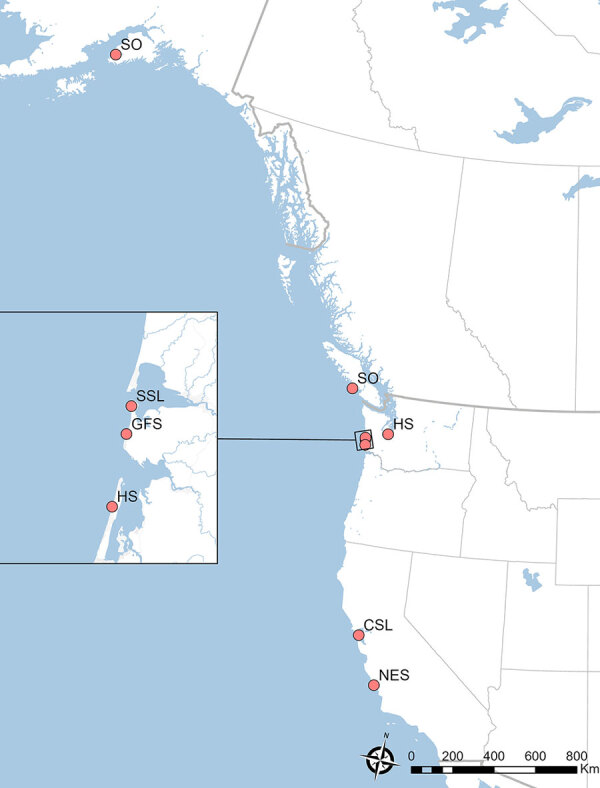 Figure 1
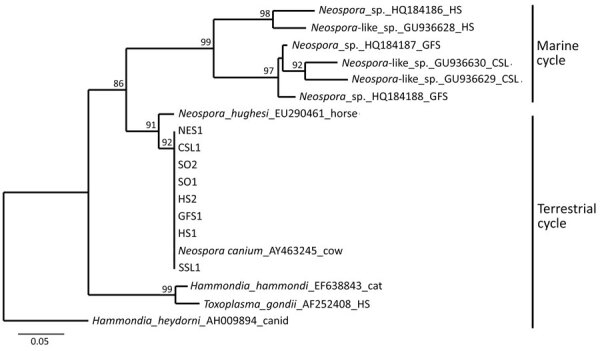 Figure 2
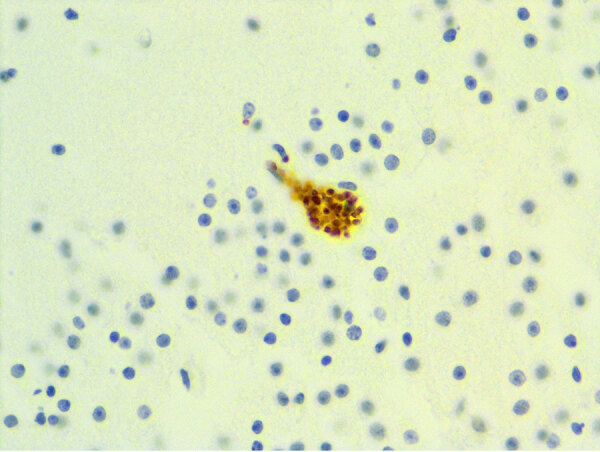 Figure 3
Peer Reviews
No public reviews on file for this paper yet. If you reviewed it on a platform where reviews are public (OpenReview, ICLR, NeurIPS, ICML), you can paste yours below so the community can read it here.
Videos
No videos yet. Explain this paper in a talk, walkthrough, or lecture? Add one.
Taxonomy
TopicsToxoplasma gondii Research Studies · Parasitic Infections and Diagnostics · Parasitic infections in humans and animals
Researchers using immunohistochemistry and PCR-DNA sequencing analyses have confirmed high infection rates of the protozoan parasites Toxoplasma gondii and Sarcocystis neurona, often as mixed infections, in a range of stranded pinniped, cetacean, and mustelid species (1,2). Parasite transmission is closely linked to land-to-sea pathogen flow (3,4). We identified Neospora caninum, a protozoan pathogen known to affect reproductive fitness in livestock, in 6 different species of marine mammals stranded in the northeastern Pacific Ocean region. The emergence of N. caninum illustrates a third terrestrially sourced parasite (also referred to as a pollutagen) flowing from land to sea to infect marine mammals in this region. This parasite is distinct from previously reported N. caninum–like parasites that circulate between pinnipeds in a marine cycle (5).
In cattle, N. caninum is considered among the most efficient pathogens to be transmitted transplacentally (6). This pathogen is a major contributor of reproductive loss in the dairy industry worldwide. Dogs and wild canids, including foxes, wolves, and coyotes, are among the recognized hosts, both definitive and intermediate, for this parasite. Unlike most coccidian parasites that have a limited host range, N. caninum is increasingly detected in a wide array of terrestrial and avian species (7). Although reports have identified antibodies to N. caninum in prior serosurveys of marine mammals in Australia, Japan, and the United States (8–10), those assays were not validated for wildlife. Cross-reactivity with related coccidian parasites that commonly circulate between marine mammals in a marine cycle may have confounded interpretation of the results (11). We report 8 confirmed cases of N. caninum infection in 6 marine mammal species, including 2 pups and a pregnant female.
The Study
Throughout the northeastern Pacific region, local and regional marine mammal stranding networks respond to live stranded and dead marine mammals. In this case series, wildlife officials delivered a California sea lion (Zalophus californianus) for rehabilitation. Despite supportive care, the animal declined and was euthanized. We identified a solitary N. caninum infection using PCR, observing no discernible parasites by histopathology. As a result of that finding, we conducted a retrospective database analysis on 410 stranded marine mammals previously screened by PCR-DNA sequencing at the internal transcribed spacer (ITS) 1 marker. We identified 7 additional cases of N. caninum infection in another 5 species of marine mammals. The geographic range of the N. caninum–infected animals (Figure 1) suggested multiple points, rather than a single point source, of parasite exposure.
Stranding locations and animal species in study of Neospora caninum infection in marine mammals stranding in the northeastern Pacific Ocean region. NES, northern elephant seal (Mirounga angustirostris); CSL, California sea lion (Zalophus californianus); HS, harbor seal (Phoca vitulina); GFS, Guadalupe fur seal (Arctocephalus townsendi); SSL, Steller sea lion (Eumetopias jubatus); SO, sea otter (Enhydra lutris).
We documented the stranding location, recorded signalment, compiled morphometrics, and performed a necropsy for all 8 cases (Appendix Table). We also harvested representative tissues for histopathology and immunohistochemistry and froze samples for ancillary diagnostic studies. We conducted PCR-DNA sequencing using pan-Apicomplexan primers that amplify across the ITS1 region for speciation. We carried out immunohistochemistry for N. caninum, T. gondii, and S. neurona on available tissues from 4 PCR-positive animals, following previously reported protocols (1,12).
Phylogenetic analysis at the ITS1 locus established unequivocally that all 8 animals were infected with an identical sequence type that resolved as N. caninum (GenBank accession nos. PX529932–8) (Figure 2). For comparison, we included in the tree sequences recovered from other pinnipeds infected by N. caninum–like parasites that commonly circulate within a marine transmission cycle (5). We conducted PCR testing, determining 7 of the 8 N. caninum–infected animals had polyparasite infections with 1 or 2 other terrestrially sourced coccidian agents (T. gondii, S. neurona) in their tissues. Infected animals were 2 sea otters (Enhydra lutris), 2 harbor seals (Phoca vitulina), 1 northern elephant seal (Mirounga angustirostris), 1 Guadelupe fur seal (Arctocephalus townsendi), and 1 Steller sea lion (Eumetopias jubatus) (Appendix Table).
Phylogenetic relationships among Neospora caninum–like species that circulate in a marine cycle compared with terrestrial-sourced species from study of N. caninum infection in marine mammals stranding in the northeastern Pacific Ocean region. Neighbor-joining consensus tree shows marine strains that commonly infect pinnipeds and terrestrial strains (GenBank accession numbers PX529932–8) that transferred from land to sea to infect 5 species of pinnipeds. Evolutionary distances computed using the Tamura-Nei genetic distance model at the complete internal transcribed spacer 1 locus. Tree inferred using the outgroup sequence from Hammondia heydorni to root the tree; 1,000 bootstrap values listed at supported nodes. NES, northern elephant seal (Mirounga angustirostris); CSL, California sea lion (Zalophus californianus); HS, harbor seal (Phoca vitulina); GFS, Guadalupe fur seal (Arctocephalus townsendi); SSL, Steller sea lion (Eumetopias jubatus); SO, sea otter (Enhydra lutris).
We diagnosed nonsuppurative and necrotizing encephalitis (n = 2), meningoencephalomyelitis (n = 1), and meningoencephalitis (n = 1) by histology of the brain for 4 of 6 cases, including the pup and subadult harbor seals, adult Steller sea lion, and yearling California sea lion. We conducted immunohistochemistry in 4 encephalitic cases, observing N. caninum antigen in brain samples from the harbor seal pup and T. gondii and S. neurona (one or both) antigens in the other 3 animals (Figure 3). We found no pathognomonic lesions in this case series directly attributed to N. caninum infection. The cause of death for all 8 animals was independent of N. caninum infection (Appendix Table).
Immunohistochemistry of a harbor seal pup with Neospora caninum antigen localized within a neuron from study of N. caninum infection in marine mammals stranding in the northeastern Pacific Ocean region. Original magnification ×600.
Conclusion
We identified 8 animals from 6 marine mammal species unequivocally infected with N. caninum. Infection by this parasite alone was confirmed in 1 animal, a yearling California sea lion, and the infection represents another example of land-to-sea flow of a pollutagen of parasite origin. The contribution of this pathogen to marine mammal health is unknown. All infected animals we studied were from species with varying degrees of philopatry, with either short natal dispersal distances or extended oceanic to pelagic migrations. Seasonal haul out associated with pupping and breeding, coupled with accounts of wild canids scavenging at rookeries (13), provide insights into potential parasite introduction, persistence, and dissemination. For sea otters, bioaccumulation of parasites by invertebrate prey species may be inferred from observations of transmission dynamics with T. gondii (4). On the basis of gross and microscopic findings, we determined N. caninum infection to be unrelated to the proximate cause of death in the examined animals. Nevertheless, detection of N. caninum in a pregnant Steller sea lion, as well as in a harbor seal pup and northern elephant seal pup (weanling), is concerning. Recrudescence of latent infection during pregnancy contributes to parasite reactivation that results in vertical transmission in cattle and dogs (6), and we propose this phenomenon might be occurring sporadically in marine mammals.
Documented reports have confirmed land-to-sea transmission of protozoan parasites, and serosurveys for N. caninum have detected titers in marine mammal species. A recent review documents the global extent of land-to-sea pathogen flow (14). Seals and sea lions are monophyletic, members of the order Carnivora, and share a common ancestry with terrestrial canids. This evolutionary relationship may predispose these marine mammals to pollutagens defecated by canids. Cross reactivity with previously described nonpathogenic N. caninum–like parasites that circulate among pinnipeds in a marine transmission cycle, including coccidia types A and B (with California sea lions as definitive hosts) (5), may have contributed to false-positive results in prior serosurveys. The contribution of these *N. caninum–*like parasites to immune protection of hosts against N. caninum is unknown. In this limited series, we confirmed N. caninum infection in 2 sea otters, 2 harbor seals, 1 California sea lion, 1 northern elephant seal, 1 Steller sea lion, and 1 Guadelupe fur seal, none of which had been infected with previously described N. caninum–like parasites. Those findings extend the host range and ecologic niche for N. caninum. Infections were predominantly mixed with T. gondii, S. neurona, or both. Climate change, ecologic marine regime shifts, rural and urban development, weather events, and other environmental perturbations may lead to incursion of previously recognized land-based pathogens into the marine environment.
In conclusion, our results indicate that further investigations to characterize the life history of N. caninum in the marine environment, the role of polyparasitism in disease manifestation, and the potential pathogenicity in susceptible host species are warranted. Whereas we cannot definitively attribute N. caninum as the cause of illness or death for the animals described here, future investigations of similar unexpected deaths, particularly those involving abortion storms among coastal breeding marine mammals in the northeastern Pacific, should consider molecular screening for this pathogen.
AppendixAdditional information for Neospora caninum in marine mammals stranding in northeastern Pacific Ocean region.
The reference list from the paper itself. Each links out to its DOI / PubMed record.
- 1Gibson AK, Raverty S, Lambourn DM, Huggins J, Magargal SL, Grigg ME. Polyparasitism is associated with increased disease severity in Toxoplasma gondii-infected marine sentinel species. P Lo S Negl Trop Dis. 2011;5:e 1142. 10.1371/journal.pntd.000114221629726 PMC 3101184 · doi ↗ · pubmed ↗
- 2Miller MA, Shapiro K, Murray MJ, Haulena M, Raverty SA. Protozoan parasites of marine mammals. In: Gulland FMD, Dierauf LA, Whitman KL, editors. CRC handbook of marine mammal medicine, 3rd edition. Oxford: CRC Press; 2018;chap 20:p. 1-46.
- 3Burgess TL, Tinker MT, Miller MA, Smith WA, Bodkin JL, Murray MJ, et al. Spatial epidemiological patterns suggest mechanisms of land-sea transmission for Sarcocystis neurona in a coastal marine mammal. Sci Rep. 2020;10:3683. 10.1038/s 41598-020-60254-532111856 PMC 7048795 · doi ↗ · pubmed ↗
- 4Conrad PA, Miller MA, Kreuder C, James ER, Mazet J, Dabritz H, et al. Transmission of Toxoplasma: clues from the study of sea otters as sentinels of Toxoplasma gondii flow into the marine environment. Int J Parasitol. 2005;35:1155–68. 10.1016/j.ijpara.2005.07.00216157341 · doi ↗ · pubmed ↗
- 5Carlson-Bremer D, Johnson CK, Miller RH, Gulland FM, Conrad PA, Wasmuth JD, et al. Identification of two novel coccidian species shed by California sea lions (Zalophus californianus). J Parasitol. 2012;98:347–54. 10.1645/GE-2752.122091999 PMC 4907794 · doi ↗ · pubmed ↗
- 6Dubey JP, Schares G, Ortega-Mora LM. Epidemiology and control of neosporosis and Neospora caninum. Clin Microbiol Rev. 2007;20:323–67. 10.1128/CMR.00031-0617428888 PMC 1865591 · doi ↗ · pubmed ↗
- 7Almería S. Neospora caninum and Wildlife. ISRN Parasitol. 2013;2013:947347. 10.5402/2013/94734727335866 PMC 4890850 · doi ↗ · pubmed ↗
- 8Dubey JP, Zarnke R, Thomas NJ, Wong SK, Van Bonn W, Briggs M, et al. Toxoplasma gondii, Neospora caninum, Sarcocystis neurona, and Sarcocystis canis-like infections in marine mammals. Vet Parasitol. 2003;116:275–96. 10.1016/S 0304-4017(03)00263-214580799 · doi ↗ · pubmed ↗