Assessing Prokaryotic Benthic Communities in the Red Sea
Christopher A. Hempel, Larissa Frühe, Sofia Frappi, Elisa Laiolo, Kah Kheng Lim, Diego E. Rivera Rosas, Amal A. Bajaffer, Wajitha J. R. M. Sait, Alexandra Steckbauer, Taiba Alamoudi, Jacqueline V. Alva García, Shannon G. Klein, Anieka J. Parry, Mohammad A. Qurban

TL;DR
This study explores how prokaryotic communities in Red Sea sediments vary with depth, latitude, and oxygen levels, revealing distinct patterns and adaptations in extreme environments.
Contribution
The study provides a baseline for understanding prokaryotic benthic community distribution and environmental drivers in the unique Red Sea environment.
Findings
Bathybenthic communities showed low OTU richness due to uniform environmental conditions at depth.
Southern Red Sea shallower communities had higher OTU richness and different bacterial abundances compared to northern regions.
Extreme environments like the Atlantis II brine pool supported specialized microbial communities adapted to hypersalinity.
Abstract
Marine sediments host diverse benthic prokaryotic communities that are integral to global biogeochemical cycles. However, the spatial distribution and environmental drivers of these communities, particularly in unique environments like the Red Sea, remain largely underexplored. In this study, we examine benthic prokaryotic communities sampled during the Red Sea Decade Expedition (RSDE) using 16S rRNA gene sequencing across five major regions along the Red Sea's latitudinal gradient and three depth strata. Our findings reveal distinct biogeographical patterns shaped by depth, latitude, and oxygen availability, with clear shifts in microbial community composition across the epibenthic, mesobenthic and bathybenthic zones. Bathybenthic communities exhibited consistently low levels of OTU richness throughout the Red Sea, likely due to uniform niche environmental conditions at depth, while…
Genes, proteins, chemicals, diseases, species, mutations and cell lines named across the full text — each resolved to its canonical identifier and authoritative record.
Click any figure to enlarge with its caption.
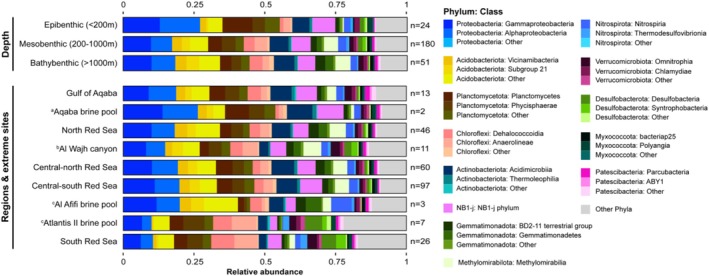 Figure 1
 Figure 2
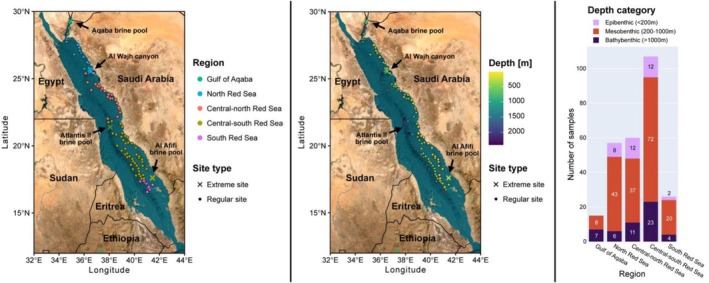 Figure 3
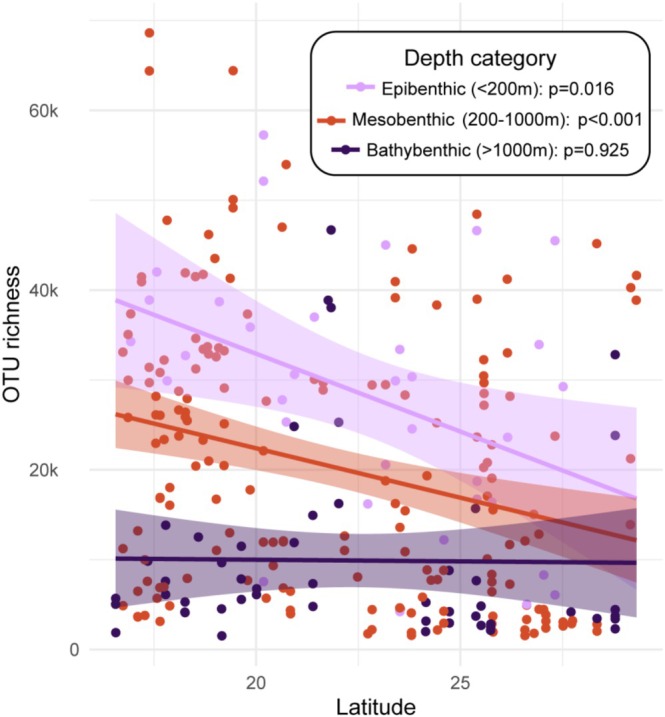 Figure 4
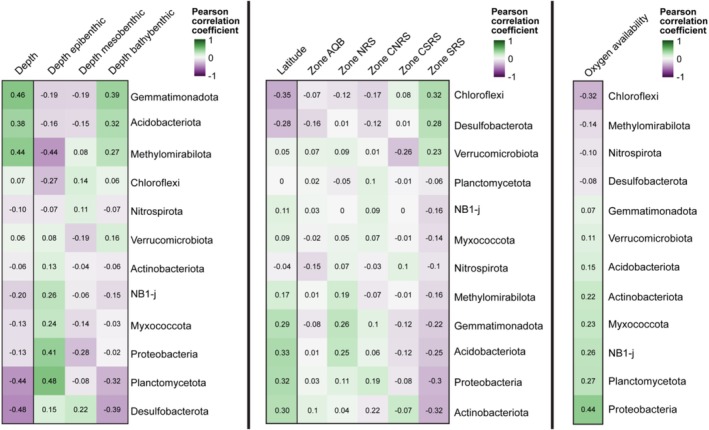 Figure 5
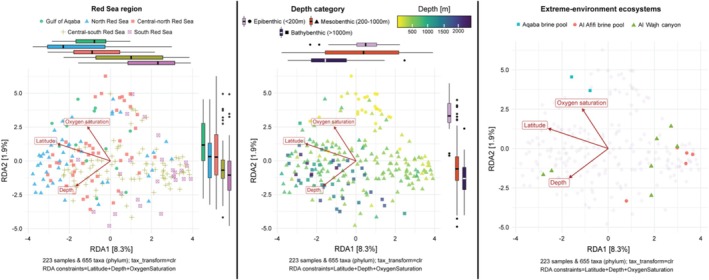 Figure 6
Peer Reviews
No public reviews on file for this paper yet. If you reviewed it on a platform where reviews are public (OpenReview, ICLR, NeurIPS, ICML), you can paste yours below so the community can read it here.
Videos
No videos yet. Explain this paper in a talk, walkthrough, or lecture? Add one.
Taxonomy
TopicsMicrobial Community Ecology and Physiology · Marine and coastal ecosystems · Protist diversity and phylogeny