Cultural differences in the production of emotional facial expressions: a review
Adèle Gallant, Marie-Pier Mazerolle, Annalie Pelot, Annie Roy-Charland

TL;DR
This review explores how cultural differences affect the way people produce emotional facial expressions, both spontaneously and when posed.
Contribution
The paper systematically reviews and categorizes cultural influences on the production of emotional expressions across age groups.
Findings
Emotional facial expression production is largely universal but shows cultural nuances.
Spontaneous and posed expressions reveal different cultural patterns.
Findings are categorized into four themes based on age and expression type.
Abstract
Whereas cross-cultural differences in recognition of emotional facial expressions are widely established, less information exists regarding differences in their production. The current systematic review was conducted to summarize and clarify the role of culture in the production of emotional facial expressions. Following a two-step process, 21 peer-reviewed articles were included within the current review, from which four categories were generated exploring findings from child/infant and adult studies separately: (1) production of spontaneous expressions, (2) production of posed expressions, (3) comparison of spontaneous and posed expressions, and (4) others. Whereas the production of emotional facial expressions is shown to be largely universal, culturally variable nuances exist but vary according to spontaneous versus posed expressions.
Click any figure to enlarge with its caption.
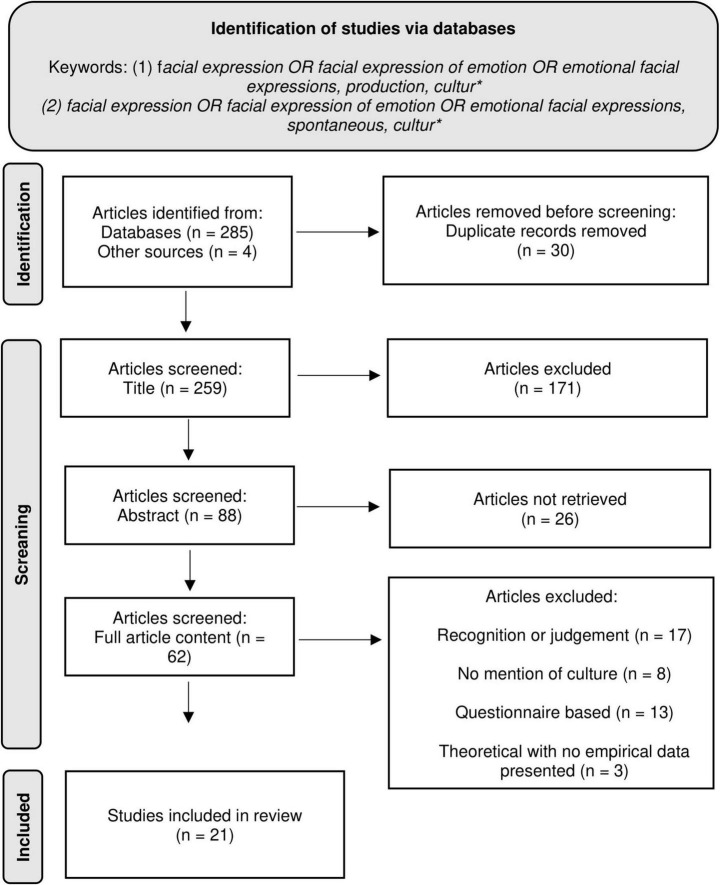 Figure 1
Peer Reviews
No public reviews on file for this paper yet. If you reviewed it on a platform where reviews are public (OpenReview, ICLR, NeurIPS, ICML), you can paste yours below so the community can read it here.
Videos
No videos yet. Explain this paper in a talk, walkthrough, or lecture? Add one.
Taxonomy
TopicsFace Recognition and Perception · Emotion and Mood Recognition · Child and Animal Learning Development