Complete genome sequence of Bacillus subtilis SNUY1, a novel strain enhancing antifungal activity in edible coatings
Gwon Mo Yang, Na Yun Kim, Yohan Song, Donghwa Chung, Hyo Jin Kim

TL;DR
A new strain of Bacillus subtilis, isolated from Korean fermented food, shows strong antifungal properties and could be used as a natural food additive to prevent mold.
Contribution
The complete genome sequence of Bacillus subtilis SNUY1 is reported, revealing antifungal-related genes and potential for food preservation.
Findings
Bacillus subtilis SNUY1 inhibits Botrytis cinerea, a common mold.
The genome contains 33 antifungal-related genes and no plasmids.
The strain is a potential natural additive for controlling mold on perishable foods.
Abstract
Bacillus subtilis SNUY1, isolated from Korean fermented food, strongly inhibits Botrytis cinerea. Its 4.19 Mb genome comprises 4,164 protein-coding genes and 108 pseudogenes (4,272 CDSs) without plasmids and includes 33 antifungal-related genes. These genetic traits highlight its potential as a natural food additive to control mold growth on perishable produce.
Genes, proteins, chemicals, diseases, species, mutations and cell lines named across the full text — each resolved to its canonical identifier and authoritative record.
Click any figure to enlarge with its caption.
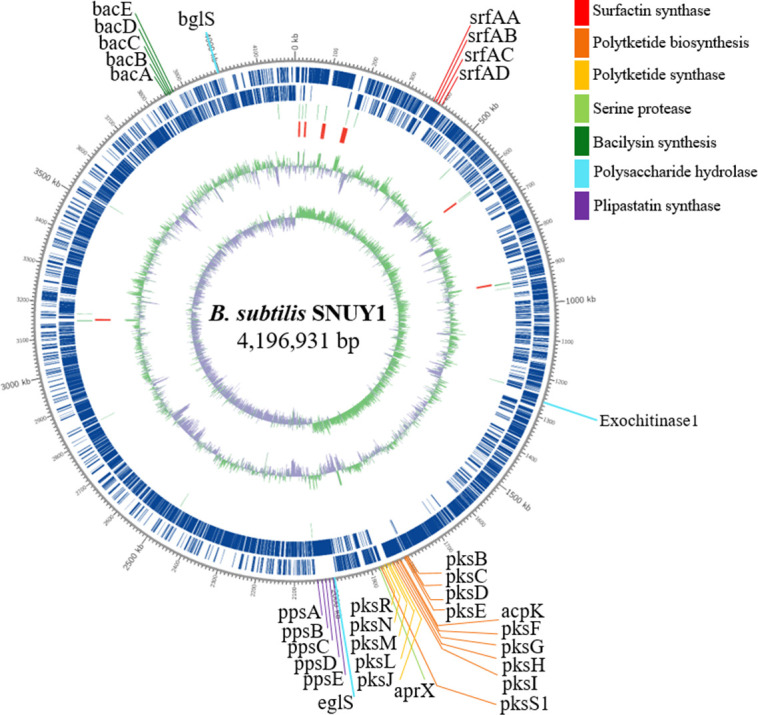 Figure 1
Peer Reviews
No public reviews on file for this paper yet. If you reviewed it on a platform where reviews are public (OpenReview, ICLR, NeurIPS, ICML), you can paste yours below so the community can read it here.
Videos
No videos yet. Explain this paper in a talk, walkthrough, or lecture? Add one.
Taxonomy
TopicsAntimicrobial agents and applications · Nanocomposite Films for Food Packaging · Marine Biology and Environmental Chemistry