Toward a “green” brain health agenda: establishing short- and long-term goals for the field of neurology in a changing climate
Esme D. Trahair, Trisha Dalapati, Danelle Levinson, Alexandra R. Linares, Aaron Reuben, Richard Bedlack

TL;DR
This paper proposes a 'green' brain health agenda to address how climate change impacts neurological health and suggests goals for the field of neurology.
Contribution
The paper introduces a structured agenda for neurology to address environmental determinants of brain health.
Findings
Climate-related factors contribute to neurological and mental health conditions.
Five domains for action are proposed: clinical practice, communication, education, research, and policy.
A commitment to environmental determinants is critical for global neurologic well-being.
Abstract
The global burden of neurological disease is rising amid an aging population and accelerating climate change, yet environmental determinants of brain health remain underrecognized within neurology. Climate-related factors—including air pollution, extreme heat, environmental contaminants, and ecological disruptions—can contribute to neuroinflammation, cerebrovascular disease, neurodegenerative disorders, and mental health conditions. Development of climate-relevant short- and long-term goals within the field of neurology is in line with the discipline’s increasing interest in improving population brain health. This commentary categorizes “green” brain health priorities into five domains: (1) clinical practice, (2) public communication, (3) education and training, (4) research, and (5) policy. The recommendations put forth constitute an agenda that is relevant to many stakeholders,…
Genes, proteins, chemicals, diseases, species, mutations and cell lines named across the full text — each resolved to its canonical identifier and authoritative record.
Click any figure to enlarge with its caption.
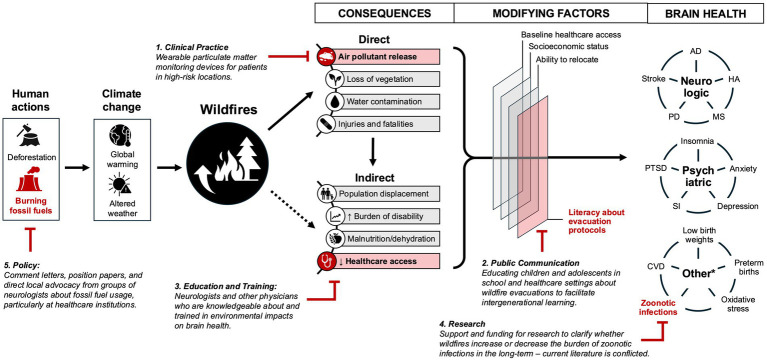 Figure 1
| Example | Phenomena | Mechanisms of harm | Brain diseases |
|---|---|---|---|
| Environmental contaminants – heavy metals, pesticides, air pollutants |
Increased environmental deposition due to human production and consumption ( Altered distribution due to changes in weather patterns ( |
Abnormal neuronal development during gestation due to placental transmission ( | ASD, childhood behavioral & cognitive disorders ( |
|
Developmental toxicity affecting molecular and functional neuroplasticity ( | PD, AD, ALS ( | ||
| Natural disasters – droughts, floods, and other extreme weather events |
Increased frequency due to ecologic shifts like elevated sea levels and rising temperatures ( Lack of infrastructure in areas that are newly vulnerable to natural disasters ( |
Stress secondary to downstream effects of weather events (displacement, poverty, loss of human life) causing inhibited neurogenesis ( | Depression, anxiety, PTSD ( |
|
Secondary malnutrition during early development inhibiting several formative neuroplastic processes ( | Neuropsychiatric illnesses, ADHD ( | ||
| Rising average and extreme temperatures – “global warming” |
Increased human consumption of fossil fuels and release of greenhouse gases ( Deforestation, agriculture practices, and industrialization ( |
Altered brain metabolism, reduction in cerebral blood flow, damaged blood–brain and blood-CSF barriers, changes in gene expression ( | Migraines, seizure, epilepsy ( |
|
Altered animal migration patterns causing increases vector-borne, zoonotic, and water-borne diseases ( | Infectious neurotropic diseases – Zika, Ebola, Naegleria ( |
| Domain | Priorities |
|---|---|
|
|
Develop protocols to assess and screen neurotoxic climate exposures in patients. Empower patients with accessible resources and information to influence their own green brain health. |
|
|
Relay information about green brain health best practices to the public with public awareness campaigns. Develop green brain health content for maternal-fetal medicine and pediatric neurology settings to facilitate intergenerational learning. |
|
|
Incorporate information about neurological impacts of climate change in didactic medical school pathophysiology curricula. Establish accredited preventive neurology fellowship programs which emphasize green brain health. |
|
|
Identify and prioritize research on detrimental climate exposures with the highest neurologic mortality and morbidity impacts. Review and reallocate funding to preventive brain health research. Monitor and investigate climate mitigation and adaptation responses for adverse neurological effects. |
|
|
Publish academic society and medical institutional statements detailing green health positions, priorities, and commitments. Advocate for green brain health priorities in neurology professional societies. |
Peer Reviews
No public reviews on file for this paper yet. If you reviewed it on a platform where reviews are public (OpenReview, ICLR, NeurIPS, ICML), you can paste yours below so the community can read it here.
Videos
No videos yet. Explain this paper in a talk, walkthrough, or lecture? Add one.
Taxonomy
TopicsClimate Change and Health Impacts · Health, Environment, Cognitive Aging · Air Quality and Health Impacts
Introduction
1
As the planet warms and the global population ages (1, 2), the cumulative population health burden of neurological diseases is rising. Neurological disorders are now the leading cause of lost disability-adjusted life years globally, and they are second only to cardiovascular diseases as a cause of premature mortality (3–5). To address this, the American Academy of Neurology (AAN) (6), World Health Organization (WHO) (4), US Centers for Disease Control and Prevention (CDC) (7), and other influential health organizations have proposed initiatives to foster population-level brain health across the globe. However, the roles of climate change and environmental health are not prioritized in these agendas. Given the extraordinary risks posed by climate change, it is imperative that our field: (1) formulates a shared position on what is known about the potential interplay of climate change with brain health, and (2) establishes short- and long-term climate-relevant goals for protecting brain health.
This commentary, inspired by an interdisciplinary health professions pilot course at Duke University School of Medicine, asserts that neurology trainees, practitioners, and professional organizations can and must steer our field to improve global population neurologic health amid a changing climate crisis. After defining the central concepts – brain health and climate change – and examining their intersection, we outline a proposed agenda of “green” brain health priorities, categorized into five key domains: (1) clinical practice, (2) public communication, (3) education and training, (4) research, and (5) policy. We propose that these recommendations are imperative to executing the existing commitments to brain health voiced by several stakeholder organizations given the current global burden of neurologic diseases and advancement of climate change.
Defining brain health
2
The term brain health first appeared in academic literature in 1989. However, it was not until 2006 that the first comprehensive, evidence-based definition was published by the National Institutes of Health (NIH) Cognitive and Emotional Health Project (4, 8, 9). The NIH proposed:
The development and preservation of the multidimensional cognitive structure that allows the older adult to maintain social connectedness, an ongoing sense of purpose, and the abilities to function independently, to permit functional recovery from illness or injury, and to cope with functional deficits (9).
Since then, interest in “brain health” has expanded significantly, from fewer than five citations in the academic literature in 2006 to more than 1,800 by 2021 (4, 8). The most recent attempt to create a unified definition of brain health comes from the AAN’s 2024–2028 Strategic Plan:
Brain health is a continuous state of attaining and maintaining the optimal neurologic function that best supports one’s physical, mental, and social well-being through every stage of life (6).
This definition and further explication from the Academy about its formulation reveal several fundamental components of brain health.
Disease state: Brain health does not imply the absence or presence of neurological disease; everyone has brain health (4, 6, 10–12).Life stage: Brain health is not limited to a specific stage of life; it refers to brain function across the lifespan (4, 6–8, 11, 12).Optimization: Optimization is a relative, personalized concept; optimal brain health for one individual may look very different from that of someone else (4, 6, 8, 12).Context: Brain health is experienced in the holistic context of one’s life; it is a function of biomedical, psychological, sociocultural, economic, and environmental factors (4, 8–10, 12, 13).Prevention: On a population level, advances in the field of brain health necessitate increased prevention efforts and attention to upstream drivers of brain health (6, 8, 10, 12–14).
The interplay of climate change with brain health
3
Definitions for “climate change” vary based on audience (e.g., academic versus public) and context (e.g., political versus ecological) (15). This commentary defines “climate change” as long-term anthropogenic shifts in global temperatures and weather patterns, resulting in impacts both direct (e.g., rising ocean levels, extreme weather events) and indirect (air and water pollution, environmental degradation) (16–18). In the context of brain health, climate change can be contextualized within a broader neural exposome – which encompasses an integrated array of exogenous and endogenous non-genetic factors that impact neurologic health and illness (19–21). Along with other components of the neural exposome, climate change contributors, including environmental contaminants, noise and light pollution, and weather patterns, exert influence on an individual’s health starting before conception, and through the life course they impact neuroplastic mechanisms that underpin major neurologic illness (22–24). A robust body of literature has demonstrated that climate change and its drivers have a wide range of negative health consequences, including but not limited to worsening of heat-related illnesses, malnutrition, vector-borne infections, and psychiatric illness, via direct health effects as well as indirect and downstream disruptions to systems of care and healthcare access (16–18).
Neurologic effects of climate change and its contributors
3.1
Some of the most well-defined climate risks that may plausibly harm brain health include air pollution, ecological changes (e.g., rising sea levels, altered animal migration patterns, destruction of green space), rising temperatures, and extreme weather events. While by no means a comprehensive list, these climate change contributors are well-established as contributors to poor neurologic outcomes via mechanisms affecting neurogenesis and neuroplasticity (20, 22, 24). Table 1 demonstrates the proposed mechanisms of neurologic harm and the resultant neurologic disorders that have been linked to selected aspects of climate change. Furthermore, the neurologic burden of climate change is not experienced equally across the human population. Social and environmental drivers of health, inequitable resource allocation ranging from local to international scales, and variable healthcare access perpetuate structures and ecosystems through which historically marginalized and disenfranchised populations disproportionately experience (1) direct neurotoxic environmental exposures and (2) downstream effects of climate change with brain health consequences (17, 18, 24, 25).
Brain health and climate change: a reciprocal relationship
3.2
Apart from what is already known about the negative effects of climate change on population brain health, there is an additional consideration specific to neurological illnesses. Brain function is a crucial component of an individual’s and population’s experience of disease and ability to respond to environmental challenges in the short- and long-term. Therefore, a reciprocal relationship exists between compromised brain function and worsening climate change (3, 4, 11). This interdependence is the basis for the theory of “green brain capital,” which emphasizes that healthy brains are needed to maintain a healthy environment and vice versa (11, 26). Therefore, by improving population brain health, we may also maximize our collective cognitive resources to fight climate change.
A call to action
4
Organizations with existing commitments to brain health, including the AAN and WHO, have considerable influence over a wide audience of interdisciplinary population health stakeholders, including clinical practitioners, public health professionals, policymakers, and the public. Their current positions establish strong foundations for incorporating a comprehensive set of goals for optimizing brain health in our rapidly changing climate, as is evidenced by the two following position statements—official, evidence-based documents developed by a coalition of expert professionals to inform policy and best practices on an advocacy issue.
The AAN 2021 telehealth position statement
4.1
The AAN regularly publishes position statements to influence and inform neurologic clinical practice, public policy, and ethics (27). The AAN position statement on telemedicine, last updated in 2021, advocates for expanded access to care, insurance coverage, provider reimbursement, and research on the optimization/limitations of virtual care (28). These efforts have measurably influenced public policy – in 2023, the AAN’s advocacy efforts contributed to extended Medicare coverage of telehealth services through the end of 2024 (29). The tangible impacts of the AAN’s advocacy for investment in and expansion of neurology telehealth services make clear that comparable efforts by the AAN and its peer organizations on the subject of green brain health would drive meaningful change in clinical practice and policy.
The American Lung Association 2022 healthy air position
4.2
The American Lung Association (ALA) has a longstanding record of advocating for environmental health initiatives and lobbying for policies that reduce pollution and mitigate climate change (30). These efforts have helped fortify the Clean Air Act and effectuate changes in the Environmental Protectional Agency’s policies to regulate emissions from motor vehicles, power plants, and gas and oil operations (31). In addition, the ALA has partnered with the CVS Health Foundation on an intervention in Phoenix, Arizona, which offers tools to healthcare providers and patients to reduce health risks on days of poor air quality and promotes local policies to improve lung health (32). The ALA’s model of research, advocacy, public communication, education, and clinical practice provides a meaningful example for how neurology professional societies could influence environmental health.
Discussion
5
The neurologic burden of climate change is significant and growing (2, 3, 25). Exposures to the direct impacts (rising sea levels, natural disasters, elevated temperatures) and indirect impacts (environmental pollution and ecologic changes) of climate change, particularly in the prenatal period and first 2 years of life, lead to brain disease through a variety of neurotoxic mechanisms (16, 20, 22, 23). Considering the major morbidity and mortality associated with these adverse neurologic consequences, we propose an initial green brain health agenda that would optimize long-term population brain health that spans five interrelated domains: clinical practice, communication, education and training, research, and public policy (Table 2). This agenda is a starting point that can be developed further through stakeholder engagement and discussion in the field; case studies are illustrated in Figure 1.
*Examples of green brain health interventions on wildfire neurotoxicity. A schematic that illustrates a quasi-linear framework of the progression from long-term anthropogenic changes to downstream neurological health effects. Five potential intervention points that correspond with the priority domains established in Table 2 are illustrated (16, 17, 52). Other illnesses with neurologic outcomes. AD, Alzheimer’s disease; HA, headache; MS, multiple sclerosis; PD, Parkinson’s disease; PTSD, post-traumatic stress disorder; SI, suicidal ideation; CVD, cardiovascular disease.
Clinical practice: screenings and patient resources
5.1
In line with the preventive nature of brain health, neurology clinical practice should include evidence-based routine protocols to assess and screen individual patient-level climate exposures that may pose neurological risk (33, 34). These tools can be incorporated into routine office visits along with traditional sociodemographic screenings, and they should have clear follow-up steps in the event of positive screens, focused on diminishing harmful exposures that have been identified. For example, if a patient screens positive for elevated household air pollution based on screening questions, they should receive education and recommendations about minimizing exposures through improved household ventilation and ways to improve air filtration (35). Providers should also be knowledgeable about patient-centered resources to improve green brain health. Existing tools like the AirNow Air Quality Index calculator and forecast (36), or Beat the Heat in Houston interactive map (37), are good models for tools that can help patients improve and maintain their brain health.
Public communication: awareness campaigns and pediatric education
5.2
Brain health, and specifically green brain health, is an appropriate and promising topic for public awareness campaigns. A similar model to effective stroke awareness campaigns (e.g., Stroke Heroes Act FAST) can be used to disseminate important information about green brain health to a large, diverse audience (38, 39). In addition, green brain health education should be prioritized in reproductive health, maternal-fetal medicine, and pediatric settings. The pre-conception period (including pregnancy planning), gestation, and the first 2 years of life comprise of several critically sensitive periods of neuroplasticity in which one’s neural exposome exposures are most deleterious, with potentially long-lasting consequences on brain health (12, 22, 40). Moreover, pediatric education facilitates intergeneration learning, where caregivers will indirectly receive information about green brain health (41, 42).
Education & Training: undergraduate medical curricula and fellowship training
5.3
More and more medical schools are incorporating information about planetary health and climate change into their curricula, both woven into existing material and as a dedicated topic (43, 44). It is critical that students learn about green brain health and the implications of climate change for neurological wellness and illness. Existing proposed curricula are available to be replicated, and they demonstrate the feasibility of either (1) a dedicated course to climate change and medicine during undergraduate medical education or (2) incorporating climate-relevant information into the existing curricula (e.g., asking educators to include at least one slide on the environmental implications of the medical content of their lectures) (45–47). At the graduate level, an accredited preventive neurology fellowship program should be established to train subspecialists in green brain health, among other preventive neurology topics (10, 14).
Research: literature review, funding, and implementation evaluation
5.4
Literature detailing the adverse effects of climate change on neurological wellbeing needs to be published, consolidated, and reviewed to identify top priority pathologies, brain functions, and populations. Institutions and grant-making organizations should favor funding preventive brain health research as a long-term investment in population brain health. Multidisciplinary, interprofessional groups are best equipped to conduct high impact research that appropriately integrates exogenous, endogenous, and behavioral factors of the neural exposome. Finally, emerging interventions and new techniques designed to improve green brain health need to be monitored not only for their impact but also for unintended negative consequences (16).
Policy: advocacy and positions
5.5
Professional societies are an effective, realistic channel for practitioner and researcher advocacy (48). On an institutional basis, neurological academic societies and medical institutions should routinely publish statements emphasizing the importance of and their commitment to green brain health to establish collective expert opinion about policy priorities (48, 49). Furthermore, it is imperative policy recommendations at all levels (local, national, global) recognize that brain and mental health disorders are an ongoing global public health crisis that affects nearly half of the world’s population and will realistically continue to do so in the decades to come, even with appropriate interventions (25). These statements would also serve to standardize and publicize evidence-based findings and standards of practice for practitioners to be aware of.
Conclusion
6
Climate change has serious implications for all areas of human health, and its effects on the brain and nervous system warrant especially urgent consideration given its unique, reciprocal bearings on society’s ability to control and adapt to a changing climate. Stakeholders should capitalize on escalating academic and professional interest in brain health to establish clear, unified goals for the field. While the recommendations in this commentary span five different domains, they constitute an agenda that largely focuses on preventive brain health, views neurologic health as a lifelong pursuit (with critical developmental windows in the prenatal period and early infancy), and emphasizes interprofessional collaboration in addressing this inherently multidisciplinary challenge. The priorities presented for neurological clinical practice, public communication, education and training, research, and policy are starting points for future efforts and interventions to preserve and protect green brain health for all.
The reference list from the paper itself. Each links out to its DOI / PubMed record.
- 1Martin JB. The integration of neurology, psychiatry, and neuroscience in the 21st century. Am J Psychiatry. (2002) 159:695–704. doi: 10.1176/appi.ajp.159.5.695, 11986119 · doi ↗ · pubmed ↗
- 2Béjot Y Yaffe K. Ageing population: a neurological challenge. Neuroepidemiology. (2019) 52:76–7. doi: 10.1159/000495813, 30602150 · doi ↗ · pubmed ↗
- 3Sisodiya SM. Climate change and the brain. Brain. (2023) 146:1731–3. doi: 10.1093/brain/awad 076, 36941776 PMC 10151177 · doi ↗ · pubmed ↗
- 4WHO Mental Health and Substance Use Team. Optimizing brain health across the life course: WHO position paper. Geneva: World Health Organization (2022).
- 5WHO Mental Health and Substance Use Team. Intersectoral global action plan on epilepsy and other neurological disorders: 2022–2031. Geneva: World Health Organization (2023).
- 6Rost NS Salinas J Jordan JT Banwell B Correa DJ Said RR . The brain health imperative in the 21st century—a call to action: the AAN brain health platform and position statement for the American Academy of Neurology’s committee on public engagement. Neurology. (2023) 101:570–9. doi: 10.1212/WNL.000000000020773937730439 PMC 10558159 · doi ↗ · pubmed ↗
- 7CDC Healthy Brain Initiative. Promoting brain health. Atlanta, GA: Centers for Disease Control and Prevention (2011).
- 8Chen Y Demnitz N Yamamoto S Yaffe K Lawlor B Leroi I. Defining brain health: a concept analysis. Int J Geriatr Psychiatry. (2022) 37. doi: 10.1002/gps.556434131954 · doi ↗ · pubmed ↗