Pentafluoroethyl Sulfoximine Reagent for the Photocatalytic Pentafluoroethylation–Difunctionalization of Styrene Derivatives
Lu Lin, Gabriel Goujon, Bruce Pégot, Guillaume Dagousset, Elsa Anselmi, Emmanuel Magnier, Gavin Chit Tsui

TL;DR
A new reagent enables the efficient addition of a pentafluoroethyl group to styrene derivatives under mild conditions, forming multiple bonds.
Contribution
A novel pentafluoroethyl sulfoximine reagent is introduced for photocatalytic difunctionalization of styrenes.
Findings
The sulfoximine reagent serves as a source of pentafluoroethyl radical under mild photocatalytic conditions.
The method allows the formation of C–O/C–N/C–S/C–C bonds alongside pentafluoroethylation of styrenes.
This approach expands the scope of difunctionalization compared to traditional copper-based methods.
Abstract
We herein describe the synthesis of a pentafluoroethyl sulfoximine and its application in the pentafluoroethylation–difunctionalization of styrene derivatives. This sulfoximine reagent acts as a source of pentafluoroethyl radical to react with styrenes under mild photocatalytic conditions. By using simple nucleophiles, the pentafluoroethyl group can be introduced to styrenes with concomitant formation of C–O/C–N/C–S/C–C bonds, which significantly broadens the difunctionalization scope involving pentafluoroethylation compared to previous copper-based methods.
Genes, proteins, chemicals, diseases, species, mutations and cell lines named across the full text — each resolved to its canonical identifier and authoritative record.
Click any figure to enlarge with its caption.
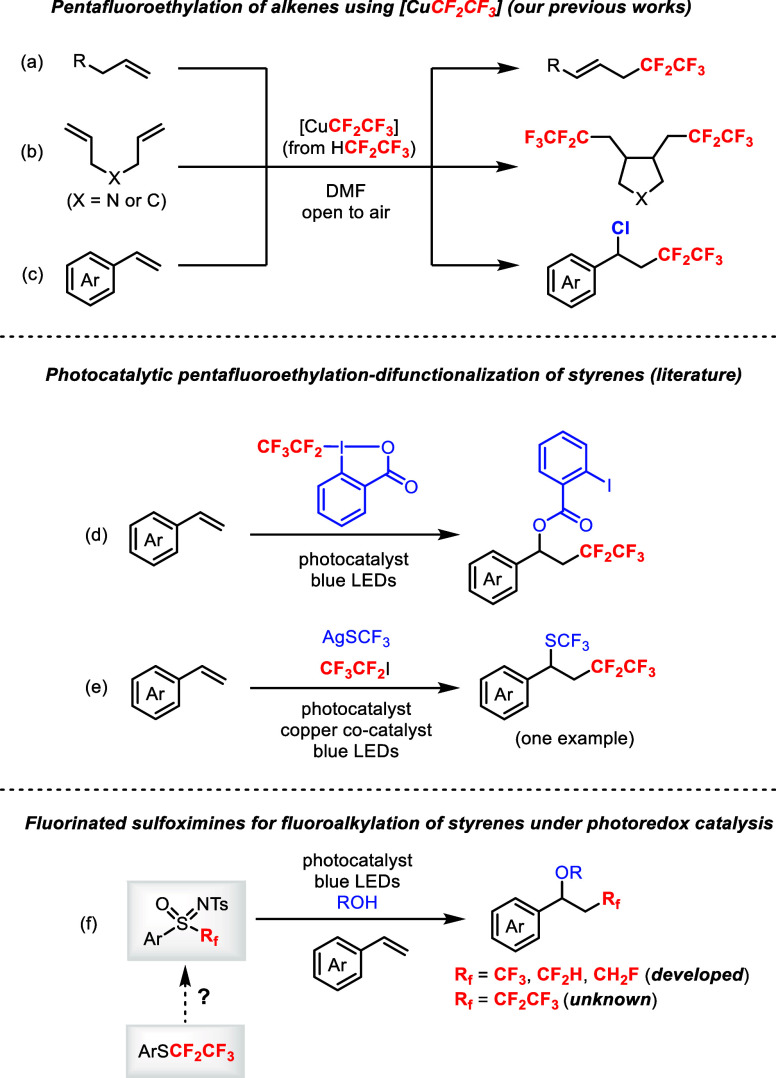 Figure 1
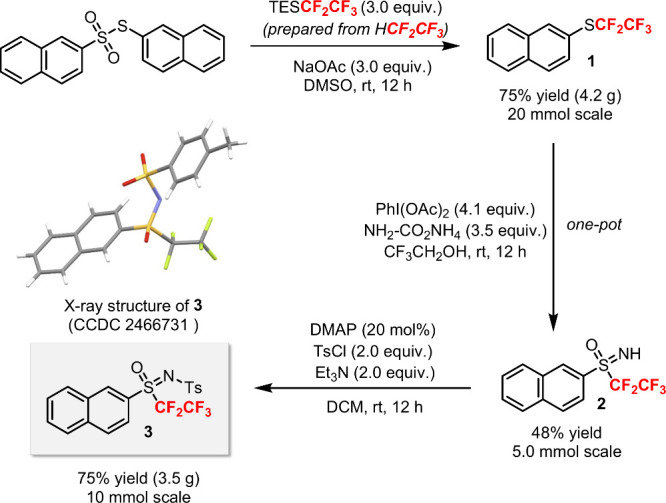 Figure 2
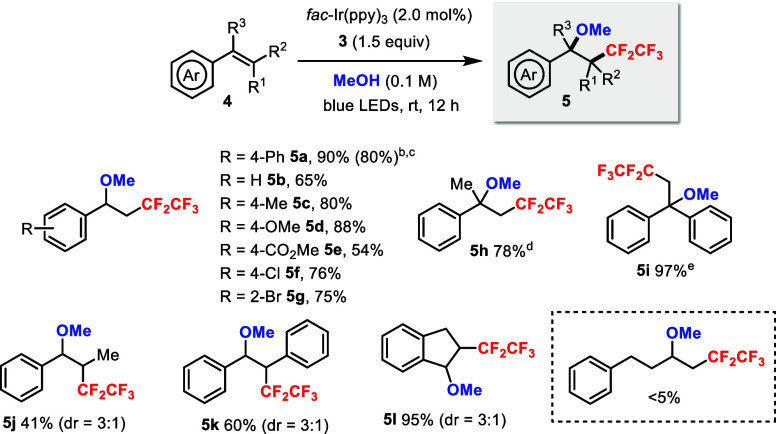 Figure 3
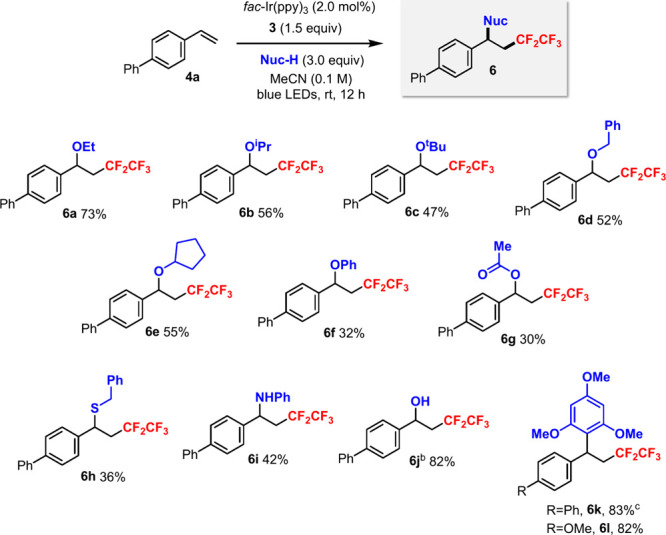 Figure 4
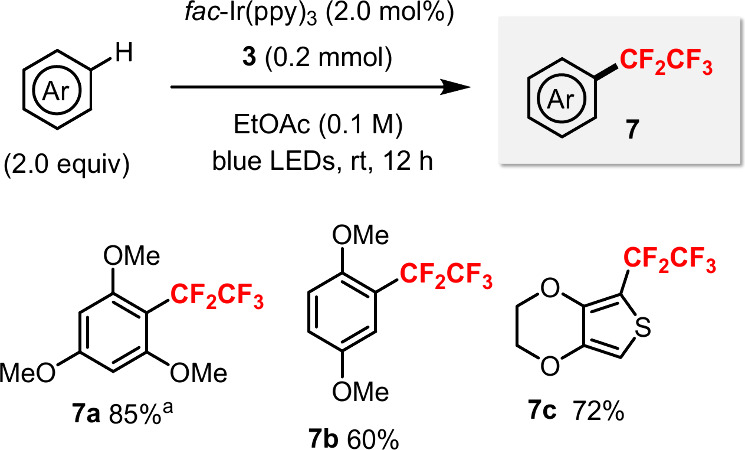 Figure 5
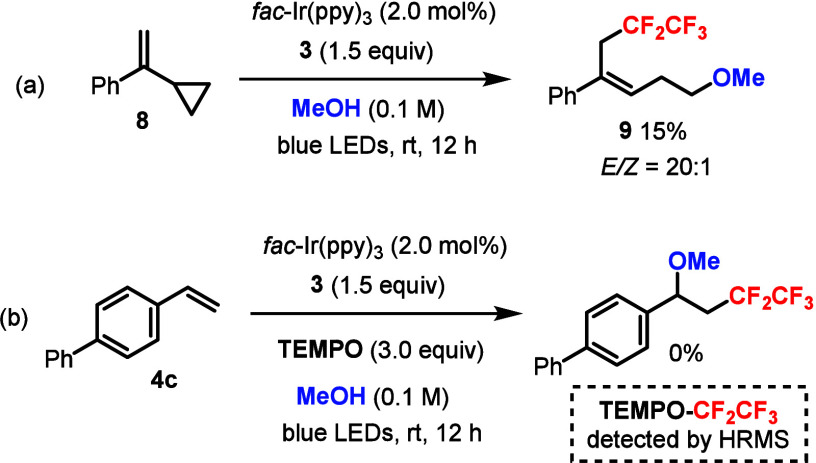 Figure 6
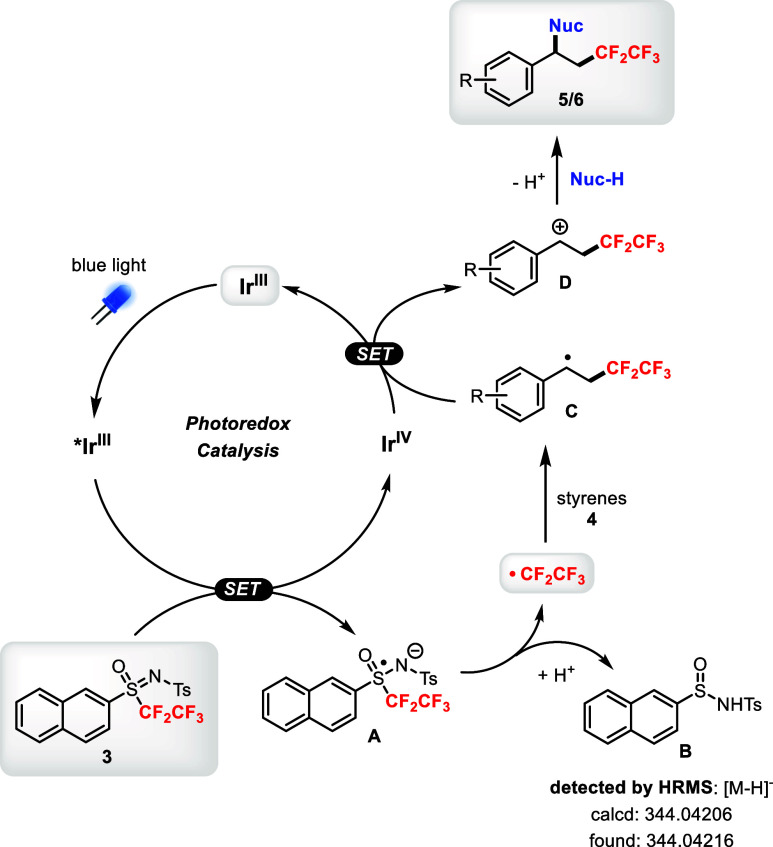 Figure 7
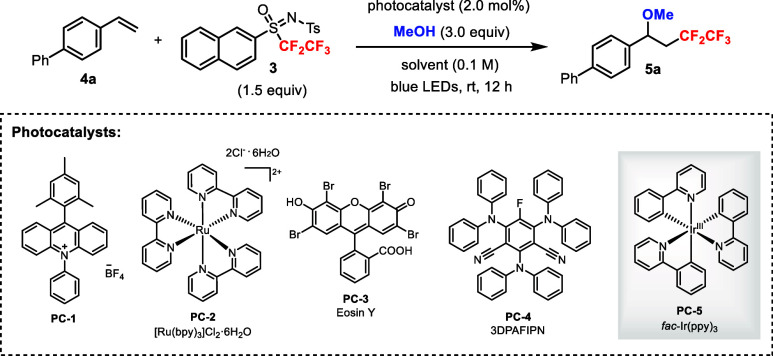 Figure 8
 Figure 9
 Figure 10
- —Research Grants Council, University Grants Committee10.13039/501100002920
- —Research Grants Council, University Grants Committee10.13039/501100002920
- —Chinese University of Hong Kong10.13039/501100004853
- —Universit? de Versailles Saint-Quentin-en-Yvelines10.13039/501100020875
Peer Reviews
No public reviews on file for this paper yet. If you reviewed it on a platform where reviews are public (OpenReview, ICLR, NeurIPS, ICML), you can paste yours below so the community can read it here.
Videos
No videos yet. Explain this paper in a talk, walkthrough, or lecture? Add one.
Taxonomy
TopicsFluorine in Organic Chemistry · Synthesis and Catalytic Reactions · Radical Photochemical Reactions
Perfluoroalkylation of alkenes is a direct and efficient way to introduce fluorine-containing groups into organic molecules due to the fact that alkenes are abundant and inexpensive feedstocks.? Trifluoromethylation of alkenes with concomitant functionalization (i.e., difunctionalization) has been achieved with broad scope.? By contrast, the difunctionalization of alkenes involving pentafluoroethylation is very limited. The pentafluoroethyl (−CF_2_CF_3_) group has been shown to be relevant for pharmaceutical applications.? More recently, we have demonstrated that pentafluoroethylated compounds can serve as useful building blocks for emerging fluorinated motifs by C–F bond functionalization.? Our group has a continuing interest in developing pentafluoroethylation reactions using alkenes. Previously, we have reported that unactivated alkenes and styrene derivatives can be pentafluoroethylated using a [CuCF_2_CF_3_] reagent derived from pentafluoroethane (Scheme).? For instance, allylic pentafluoroethylated products were obtained from unactivated alkenes (Schemea).? Bis-pentafluoroethylated cyclic compounds were obtained from 1,6-dienes (Schemeb).? Styrene derivatives afforded various pentafluoroethylated products, but only chloropentafluoroethylation was achieved satisfactorily for difunctionalization due to the presence of CuCl in the reaction mixture (Schemec).?
In recent years, photoredox catalysis has emerged as a powerful tool for difunctionalization of styrenes involving perfluoroalkylation.? We and others have reported a variety of photocatalytic trifluoromethylation,? difluoromethylation,? and monofluoroethylation? reactions of styrene derivatives with concomitant construction of new C–C and C–heteroatom bonds. However, examples of photocatalytic pentafluoroethylation are extremely rare in the literature. Hong, An, and co-workers described an acyloxy pentafluoroethylation of styrenes using the Togni II reagent (Schemed).? The C–O bond formation arises from the same fragment as the Togni reagent. The C–S bond formation was also possible but limited to the use of potassium O,O-diethyl phosphorothioate. Song and co-workers demonstrated one example of pentafluoroethylation of styrenes with trifluoromethylthiolation (Schemee).? The use of AgSCF_3_ and copper cocatalyst was necessary. Thus, a general protocol for the pentafluoroethylation–difunctionalization of styrenes with broad scope is still lacking.
One viable solution to this problem is the development of new pentafluoroethylation reagents that are applicable in photoredox catalysis. Fluorinated sulfoximines are versatile reagents for introducing fluoroalkyl groups.? We and others have shown that the fluorinated sulfoximines are useful sources of fluoroalkyl radicals under photoredox catalysis. ?−? ? In particular, the N-tosyl sulfoximines? containing CF_3_, CF_2_H, and CH_2_F groups have been successfully prepared and employed in the photocatalytic oxyfluoroalkylation of styrenes with water or alcohols (Schemef). ?,?,? However, to the best of our knowledge, the corresponding pentafluoroethyl sulfoximine remains unknown. We wish to report herein the efficient synthesis of this unprecedented pentafluoroethyl reagent on a large scale and its application in a wide range of new pentafluoroethylation–difunctionalizations of styrenes.
We first surmised that the targeted pentafluoroethyl sulfoximine could be prepared from the corresponding pentafluoroethyl sulfide. To test this hypothesis, we synthesized the pentafluoroethyl sulfide 1 from the corresponding thiosulfonate and TESCF_2_CF_3_ on a gram scale using our previous protocol (Scheme).? The ultimate source of CF_2_CF_3_ is the inexpensive gas pentafluoroethane (HCF_2_CF_3_, HFC-125), which was used to generate TESCF_2_CF_3_.? The choice of naphthyl substituent group was to avoid volatility of the compound (bp of PhSC_2_F_5_ = 53 °C, 28 mmHg). Next, one-pot synthesis of the NH-sulfoximine 2 from 1 was achieved using (diacetoxyiodo)benzene (PIDA) and ammonium carbamate.? Final tosylation of 2 afforded the NTs-sulfoximine 3 on a gram-scale. The structure of 3 was unambiguously confirmed by X-ray crystallography.
The capability of 3 to act as a source of a pentafluoroethyl radical under photoredox catalysis was uncertain at the outset. To this end, we tested 3 in the methoxypentafluoroethylation of styrene derivative 4a using methanol under photocatalytic conditions (Table).? Screening of various photocatalysts PC-1 to PC-5 under blue light irradiation revealed that fac-Ir(ppy)3 (PC-5) was an efficient catalyst affording product 5a in 71% yield (Table, entries 1–5). Further screening of solvents showed that MeCN could improve the yield to 90% (Table, entries 6–10). On the other hand, using MeOH as the solvent gave comparable yield (Table, entry 11). Using excess styrene 4a led to a lower yield (Table, entry 12). Finally, control experiments showed that both irradiation and photocatalyst were required for the reaction (Table, entries 13–14).
The scope of the alkenes was subsequently investigated under the optimized photocatalytic conditions (cf. Table, entry 13) using MeOH as the solvent (Scheme). Various functional groups were tolerated in the styrene derivatives (5a–g), including electron-donating (5d), electron-withdrawing (5e), and halogen (5f–g) groups. Reaction was also performed on a 1.0 mmol scale in 80% yield (5a). 1,1-Disubstituted alkenes such as α-methylstyrene and 1,1-diphenylethylene smoothly afforded products 5h and 5i, respectively. In comparison, 1,2-disubstituted alkenes such as *trans-*β-methylstyrene and trans-stilbene gave products 5j and 5k in lower yields, respectively. Indene, a cyclic alkene, gave the desired product 5l in a high yield. Only trace product was detected from an unactivated alkene.
Besides methanol, other nucleophiles (Nuc-H) could also be employed using the optimized conditions (cf. Table, entry 10) to achieve the pentafluoroethylation–difunctionalization of the styrene derivative 4a (Scheme). Common alcohols including ethanol (6a), isopropanol (6b), tert-butanol (6c), benzyl alcohol (6d), and cyclopentanol (6e) afforded the desired products in moderate yields. Phenol could also be used, albeit with a lower yield (6f). Even acetic acid promoted product formation (6g). Benzyl mercaptan (6h) and aniline (6i) were also suitable nucleophiles. By using a water/acetonitrile mixture, hydroxypentafluoroethylation was achieved in product 6j in good yield. This result was quite remarkable since previously the hydroxypentafluoroethylation could only take place with α-methylstyrenes using excess [CuCF_2_CF_3_] reagent and B_2_pin_2_.? An electron-rich arene could also provide the products 6k–l in high yields. Thus, the pentafluoroethylation of styrene derivatives with concomitant formation of C–O, C–S, C–N, and C–C bonds was successfully demonstrated.
Furthermore, the challenging C–H pentafluoroethylation of arenes was achieved with sulfoximine 3 photocatalytically (Scheme). In our previous work, this was only possible when using excess amounts of the [Ph_4_P]^+^[Cu(CF_2_CF_3_)2]^−^ reagent.?
We have also compared the reactivities between reagent 3 and trifluoromethylated NTs-sulfoximine analogues for the trifluoromethylation–difunctionalization of styrene derivatives (cf. Schemes and ? footnotes) and C–H bond trifluoromethylation (cf. Scheme footnotes). Under identical conditions, naphthyl and phenyl CF_3_ NTs-sulfoximine reagents have shown similar yields for the trifluoromethylation products as compared to 3, proving that the nature of the aryl and perfluoroalkyl groups of our sulfoximines has little impact on the reactivity (see SI for details).
Control experiments were carried out to gain more insight into the reaction pathway (Scheme). The radical clock experiment using cyclopropane 8 led to the ring-opened product 9 (Schemea). Adding a radical scavenger TEMPO to the standard conditions completely inhibited the product formation (Schemeb), and the TEMPO–CF_2_CF_5_ species was detected by HRMS. These results strongly suggested a radical mechanism for the photocatalytic pentafluoroethylation–difunctionalization of styrenes.
In addition, the redox potential of reagent 3 was measured by cyclic voltammetry (see Supporting Information). Its reduction potential value was measured at E 1 = −1.61 V relative to the SCE (saturated calomel electrode). It is worth noting that the S-naphthyl S-CF_3_ analogue was measured at a similar potential of −1.58 V vs SCE, while the S-phenyl S-CF_3_ sulfoximine has a lower potential of −1.73 V vs SCE. These results highlight the fact that the naphthyl substituent of the sulfoximine slightly improves the ease of reduction of the reagent. Luminescence quenching experiments were also carried out. The quenching rates determined using Stern–Volmer plots showed no quenching of the excited state Ir* of the iridium complex by the styrene 4a, whereas the sulfoximine 3 efficiently quenched the excited complex Ir* (see details in the SI). Based on the above experiments and literature evidence, ?,? the following plausible photoredox catalytic cycle is proposed for the pentafluoroethylation–difunctionalization of styrenes 4 with the sulfoximine reagent 3 (Scheme). The photocatalyst fac-Ir(ppy)3 (Ir ^ III ^) is first excited by visible light (blue LEDs) to become excited *Ir ^ III ^, a strong one-electron reductant that reduces sulfoximine 3 via a single-electron transfer (SET) process to generate A and Ir ^ IV ^. Fragmentation of A provides the key pentafluoroethyl radical and the sulfinamide B (detectable by HRMS).? The CF_3_CF_2_ radical reacts with styrene derivative 4 regioselectively to provide the benzylic radical C and form the carbon–CF_2_CF_3_ bond. The strongly oxidizing Ir ^ IV ^ oxidizes C via SET to form the benzylic carbocation D and regenerates Ir ^ III ^. Finally, trapping D with a nucleophile (Nuc-H) leads to difunctionalized products 5/6.
In summary, we have synthesized a new pentafluoroethyl NTs-sulfoximine as a source of a pentafluoroethyl radical. Under mild photocatalytic conditions, the three-component reaction involving the sulfoximine reagent, styrene derivatives, and nucleophiles could take place regioselectively to introduce the pentafluoroethyl group to styrenes with concomitant construction of carbon–heteroatom and carbon–carbon bonds. Further development of radical pentafluoroethylation using this reagent is ongoing in our laboratories.
Supplementary Material
The reference list from the paper itself. Each links out to its DOI / PubMed record.
- 1b Patai, S. The Chemistry of Double Bonded Functional Groups; Wiley: Chichester, U.K., 1997.
- 2a Egami H.Sodeoka M.Trifluoromethylation of Alkenes with Concomitant Introduction of Additional Functional Groups Angew. Chem., Int. Ed.2014538294830810.1002/anie.20130926024961669 · doi ↗ · pubmed ↗
- 3a Chiu A. T.Carini D. J.Duncia J. V.Leung K. H.Mc Call D. E.Price J.William A.Wong P. C.Smith R. D.Wexler R. R.Timmermans P. B. M. W. M.Du P 532: A second generation of nonpeptide angiotensin II receptor antagonists Biochem. Biophys. Res. Commun.199117720921710.1016/0006-291X(91)91969-J 2043107 · doi ↗ · pubmed ↗
- 4a Fu Z.Tsui G. C.Palladium-Catalyzed Allylic C–F Bond Functionalization of Pentafluoroethyl Alkenes with Heteroatom Nucleophiles Org. Lett.202527101411014610.1021/acs.orglett.5c 0321740889997 PMC 12442228 · doi ↗ · pubmed ↗
- 5a Yang X.Tsui G. C.Radical Pentafluoroethylation of Unactivated Alkenes Using Cu CF 2CF 3 Org. Lett.2020224562456710.1021/acs.orglett.0c 0164632462879 · doi ↗ · pubmed ↗
- 6a Koike T.Small Aromatics Bearing Two Diarylamino Termini: Highly Reducing Organic Photocatalysts Synlett 20243541241810.1055/a-2126-1897 · doi ↗
- 7a Yasu Y.Koike T.Akita M.Intermolecular Aminotrifluoromethylation of Alkenes by Visible-Light-Driven Photoredox Catalysis Org. Lett.2013152136213910.1021/ol 400627223600821 · doi ↗ · pubmed ↗
- 8a Arai Y.Tomita R.Ando G.Koike T.Akita M.Oxydifluoromethylation of Alkenes by Photoredox Catalysis: Simple Synthesis of CF 2H-Containing Alcohols Chem. Eur. J.2016221262126510.1002/chem.20150483826639021 PMC 4737308 · doi ↗ · pubmed ↗