Alcohol Oxidase–Imine Reductase Cascade for One-Pot Chiral Amine Synthesis
Anya Miletic, Christopher J. Truby, Nicholas J. Turner, Rebecca E. Ruscoe

TL;DR
This paper introduces a new one-pot method using enzymes to efficiently produce chiral amines from allylic alcohols.
Contribution
A novel biocatalytic cascade using Alcohol Oxidase and Imine Reductase for streamlined chiral amine synthesis.
Findings
The cascade method works under mild conditions and handles a wide range of substrates.
The tandem enzymatic system outperforms traditional stepwise methods in selectivity and efficiency.
The system shows substrate-dependent selectivity, enhancing the synthesis of enantioenriched amines.
Abstract
We report a one-pot biocatalytic cascade for the conversion of allylic alcohols into enantioenriched secondary amines through a sequence involving oxidation followed by conjugate reduction–reductive amination (CR–RA). This transformation, catalyzed by a cholesterol oxidase (ShCO) and an ene-imine reductase (EneIRED), proceeds under mild conditions and accommodates a broad substrate scope. In several cases, the cascade outperforms the stepwise method and exhibits substrate-dependent selectivity, highlighting the advantages of tandem enzymatic systems for efficient and streamlined chiral amine synthesis.
Genes, proteins, chemicals, diseases, species, mutations and cell lines named across the full text — each resolved to its canonical identifier and authoritative record.
Click any figure to enlarge with its caption.
 1
1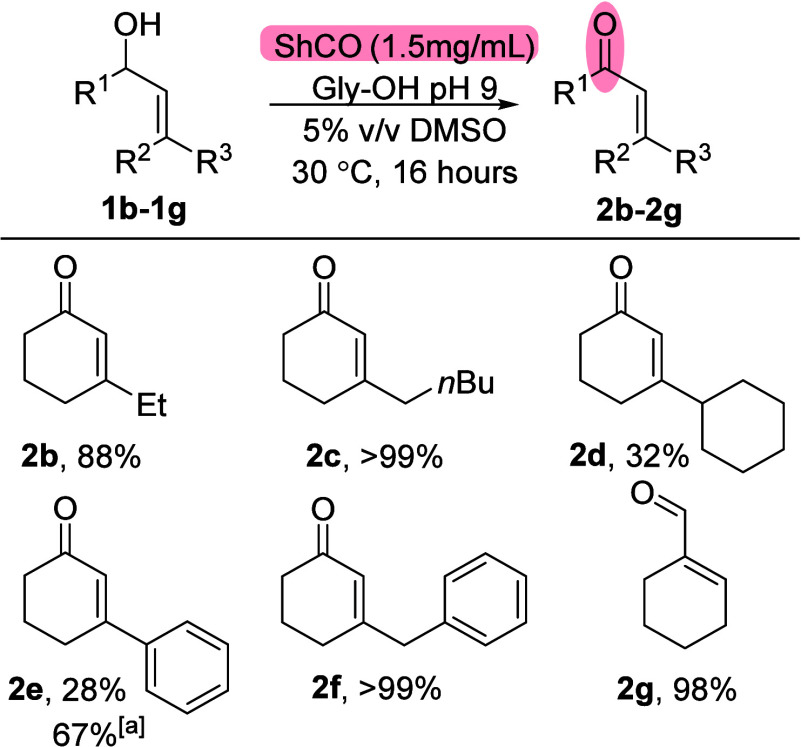 2
2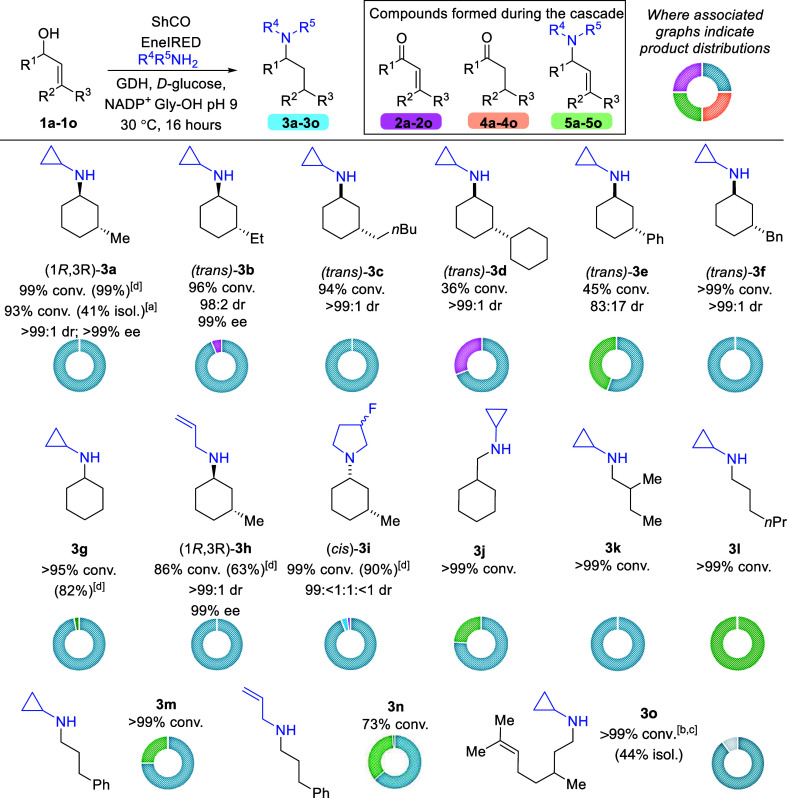 1
1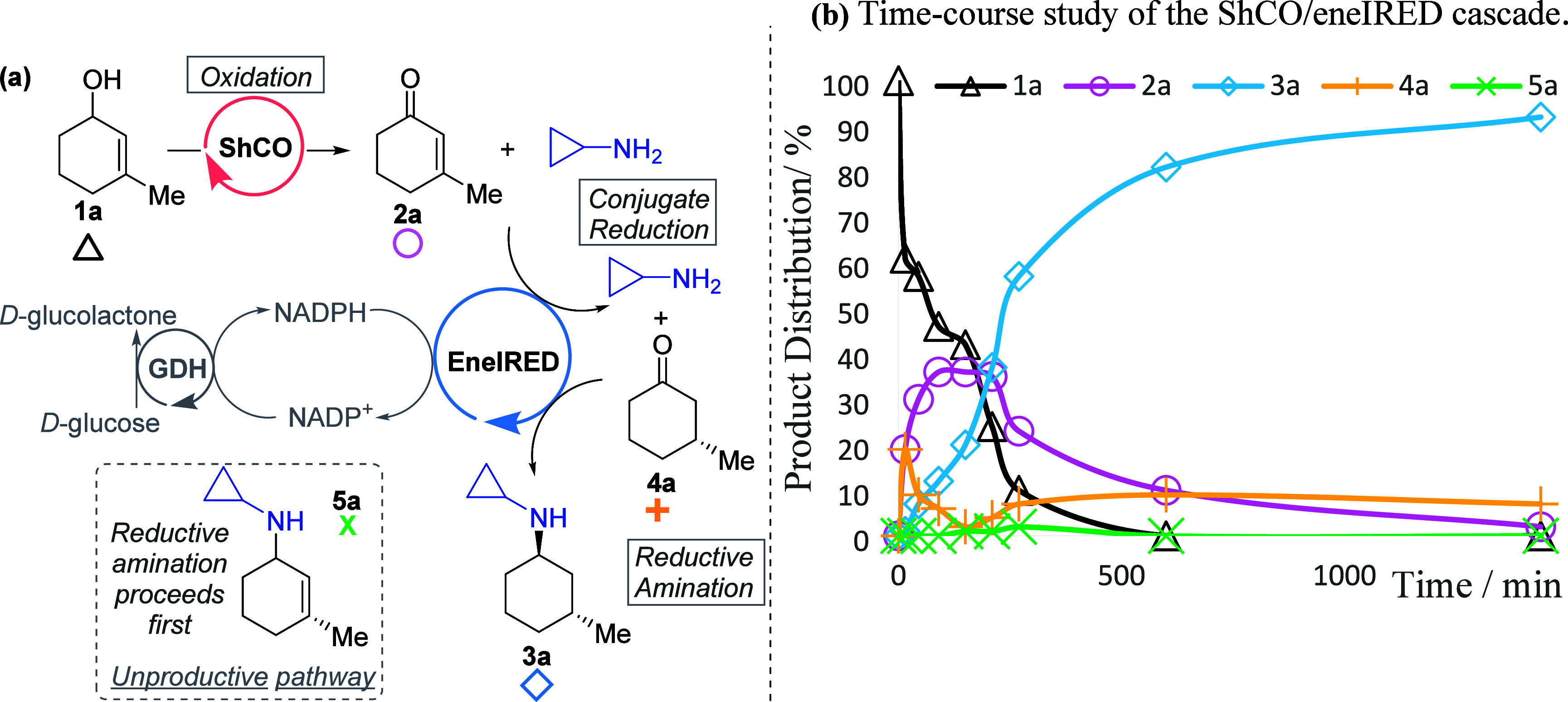 2
2| condition | buffer | cosolvent |
|
|---|---|---|---|
| 1 | KPi | >99 | |
| 2 | Gly-OH | 97 | |
| 3 | Gly-OH | DMSO | 94 |
- —Engineering and Physical Sciences Research Council10.13039/501100000266
- —Biochemical Society10.13039/501100000373
- —Royal Society of Chemistry10.13039/501100000704
Peer Reviews
No public reviews on file for this paper yet. If you reviewed it on a platform where reviews are public (OpenReview, ICLR, NeurIPS, ICML), you can paste yours below so the community can read it here.
Videos
No videos yet. Explain this paper in a talk, walkthrough, or lecture? Add one.
Taxonomy
TopicsEnzyme Catalysis and Immobilization · Cyclopropane Reaction Mechanisms · Steroid Chemistry and Biochemistry
Introduction
1
Enantioenriched amine diastereoisomers are key structural motifs in numerous pharmaceutical and agrochemical compounds.? Their synthesis often involves multiple steps, which can limit the overall efficiency. Reductive amination (RA) is a widely employed method for the introduction of chiral amines and is frequently integrated into multistep synthetic sequences targeting these valuable molecules.?
Biocatalysis has increasingly emerged as a powerful and versatile approach for enabling a wide range of chemical transformations.? Given the importance of amine-containing compounds, considerable attention has been directed toward biocatalytic strategies for amine synthesis, including RA. ?,? Previously, we reported that screening a metagenomic panel of imine reductases (IREDs) resulted in the identification of enzymes capable of coupling aldehydes or ketones with amines.? Subsequently, we showed that a subset of these IREDs were able to deliver hydride equivalents to both C=C and C=N functionalities, leading to their designation as EneIREDs.? EneIREDs are multifunctional enzymes capable of sequential imine formation, alkene reduction, and imine reduction.
A key advantage of enzymes lies in their innate compatibility, allowing them to work in tandem in cascade reactions enabling multiple bond-forming steps to occur sequentially in a single vessel. ?−? ? ? Several groups have successfully combined IREDs and RedAms with other biocatalysts to develop such cascades. ?−? ? ? ? ? ? However, the ability of EneIREDs to exhibit their multifunctional reactivity within a tandem enzymatic system remains unexplored. Investigating this challenge not only offers deeper insight into the enzyme’s catalytic potential but also presents new opportunities for accessing enantioenriched amine diastereoisomers from a wider array of precursors.
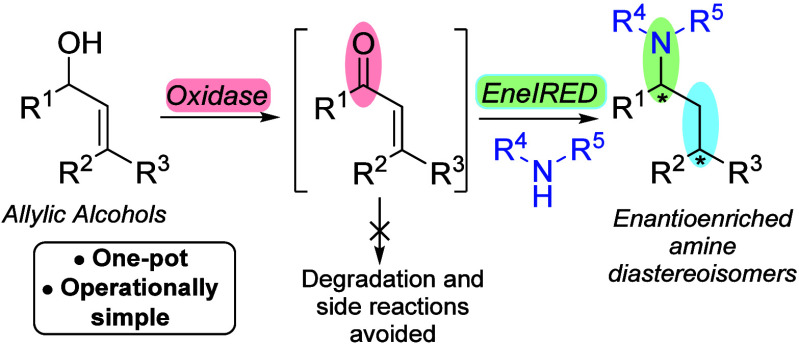
Aldehydes and, to some extent, ketones are highly reactive intermediates, and their isolation from biocatalytic processes is often hindered by volatility and susceptibility to degradation. These factors also complicate their use as starting materials in subsequent transformations. To address these challenges, we designed a one-pot cascade process in which α,β-unsaturated aldehydes and ketones are generated in situ via biocatalytic oxidation, followed directly by an in situ conjugate reduction–reductive amination (CR-RA) sequence (Scheme). This strategy also leverages the advantages of using allylic alcohols, which are often commercially available or easily prepared from common precursors via established methods. ?,?
General Scheme for the Proposed Cascade
Results and Discussion
2
To achieve this, we began by exploring the oxidase step using 3-methylcyclohex-2-en-1-ol 1a as a model substrate due to the fact that its enone derivative is known to have high activity in EneIRED-catalyzed CR–RA transformations.? Additionally, an engineered cholesterol oxidase from Streptomyces hygrospinosus (ShCO_a_ – a two point mutant, see the Supporting Information) has been shown to efficiently oxidize secondary alcohols,? including 1a, making it a suitable starting point for this cascade.
Under the optimal conditions previously reported for the ShCO_a_ oxidase,? the desired enone 2a was obtained in excellent conversion (>99%) using ShCO_a_ (Table, Entry 1).To enable a one-pot cascade combining the oxidase step with an EneIRED, we switched to glycine buffer, as it consistently yielded high conversions in EneIRED-catalyzed reductive aminations (Table, Entry 2),? which resulted in only a slight decrease in conversion (97%) at 10 mM 1a compared to KPi buffer (Table, Entry 1). We then introduced 5% v/v DMSO, an essential cosolvent for the EneIRED-catalyzed cascade.? Conversions remained high under these conditions, reaching 94% at 10 mM 1a (Entry 3).
1: Exploring Conditions for the Oxidation of Allylic Alcohol 1a Using ShCO
We next explored the substrate scope of the oxidase for the formation of a range of enals and enones under the optimized conditions (Scheme). Encouragingly, a series of C3 substituted cyclohex-2-en-1-ols were tolerated (1b–1g), with the exceptions of substrates with cyclohexyl and phenyl groups at this position (1d and 1e, respectively).
Scope of ShCOa Oxidations
The lower conversions observed for the cyclohexyl substituted allylic alcohol 1d may be related to solubility, as precipitates were observed on the introduction of the starting material into the reaction medium. Although our previous work demonstrated that the oxidase enzyme tolerates various solvents,? we did not pursue further optimization of this substrate by testing alternative solvents, which may have improved the conversion. The lower conversion for 3-phenyl substrate 1f could be overcome by employing an alternative oxidase mutant (ShCO_b_),? which showed a significant increase in conversion from 28% to 67% to the desired enone 2e (see the Supporting Information). Interestingly, this limitation was not seen for the benzyl-substituted allylic alcohol 1f, which formed the desired enone 2f in conversions up to 99% without the need to utilize a different oxidase mutant.
We next investigated the formation of simple enal substrates. Allylic alcohol 1g was efficiently converted to enal 2g (98% conv.), but other low-molecular-weight allylic alcohols exhibited substantial degradation or competing side reactions under the reaction conditions or during the isolation of the product (see the Supporting Information).
Next, we explored combining ShCO_a_ and EneIRED in a one pot cascade approach (Figure). This required the addition of an amine coupling partner, NADP^+^ and a glucose dehydrogenase (GDH) recycling system. We focused first on C3-substituted cyclohex-ene-1-ols (1a–1f), given the preference of EneIRED for six-membered rings. Simple linear alkyl chains at the C3 position were well tolerated, affording excellent conversions (>94%) to the expected products (3a–3c) with excellent diastereo- and enantioselectivity (>98:2 dr and 99% ee). A preparative scale reaction at 0.3 mmol gave 3a with conversions of 93% and 41% isolated yield.
Scope of the ShCOa and eneIRED cascade. Desired amine products (3a–3o) are drawn, with product distributions illustrated by the donut chart. Conversions and product distributions are calculated based on percentage area from GCMS chromatograms against authentic analytical standards. [a] Conversions and yields for 0.3 mmol scale up. [b] ee not measured. [c] Aldimine intermediate observed (see the Supporting Information). [d] GCMS yield based on calibration curves (Supporting Information). Reaction conditions: purified ShCOa (1.5 mg/mL), EneIRED crude lysate (4 mg/mL), allylic alcohol (10 mM), amine (200 mM), GDH (1 mg/mL), D-glucose (10 mg/mL), NADP+ (1 mg/mL), 5% v/v DMSO, Gly-OH buffer corrected to pH 9. Total reaction volume = 500 μL. Reactions were shaken at 30 °C for 16 h. See the Experimental Section for further information.
To investigate steric effects at the 3-position, we introduced a cyclohexyl substituent. The oxidase-only transformation of substrate 1d exhibited low conversion, a trend that was similarly reflected in the full cascade process. The second step of the cascade also proceeded slowly, with substantial intermediate enone 2d observed, consistent with observations from the isolated EneIRED reaction.? In contrast, conversions to desired 3e reached 25% when a phenyl ring was introduced at this position (allylic alcohol 1e) and intermediate enone 2e was not detected. Interestingly the EneIRED-only reaction afforded only 13% conversion to 3e from enone 2e, suggesting that the cascade may enhance turnover by controlling the concentration of enone 2e in situ. Furthermore, the cascade reaction yielded a higher proportion of the competing RA product 5e compared with the EneIRED-only reaction, highlighting the influence of cascade dynamics on chemoselectivity. With a benzyl substituent at this position (allylic alcohol 1f), conversions of
99% to the desired amine product 3f were observed with excellent diastereoselectivity (>99:1). This represents a significant improvement over the EneIRED reaction alone from enone 2f, where a large amount of ketone intermediate was seen (3:1:1, 4f:3f:2f).? Diastereoselectivity was also improved in the cascade compared with the EneIRED reaction alone. Unsubstituted cyclohexen-1-ol (1g) yielded a 95% conversion with 92% selectivity for the desired product (3g) and 8% RA product (5g) observed.
Finally, we screened both allylamine and 3-fluoropyrrolidine, which gave the desired products 3h and 3i in very good to excellent conversions (86% and 99%, respectively), with excellent diastereoselectivity and enantioselectivity (99% for 3h, ee not determined for 3i).
We then turned our attention to simple allylic alcohols that generate enal intermediates. We first examined simple disubstituted allylic alcohols, which delivered the desired amine products with >99% conversion to 3k. From previous reports of the EneIRED only transformation from enal 2k, the enantioselectivity with this substrate was poor (18% ee);? therefore, this was not measured here. Submitting E-cinnamyl alcohol 1l to the reaction conditions yielded both the CR-RA and RA products in a 3:1 ratio, respectively (3l:5l). A similar product distribution was observed when utilizing allylamine 3m.
To investigate the influence of alkene geometry on the reaction outcome, the geometric isomers geraniol (E-isomer) and nerol (Z-isomer) were subjected to the reaction conditions. Nerol exhibited high reactivity, affording >99% conversion with the major product being the desired amine 3o with approximately 10% of the aldimine intermediate observed (see the Supporting Information). Geraniol also underwent complete consumption (97%), but the predominant product was the aldimine intermediate, indicating that the reaction likely stalls at this stage, possibly due to the geometry and sterics impeding hydride delivery. Similar behavior has been observed in other biocatalytic cascade reactions involving this substrate.? Allylic alcohols bearing a six-membered ring in which an enal is formed in situ (1j) proceeded in excellent conversion (>99%) and produced the desired amine and competitive RA product in a ratio of 3:1 (3j:4j).
Finally, we carried out a time-course analysis of the reaction to determine the changes in product distribution (Figureb). Key intermediates in this analysis were detected, including the enone 2a, ketone 4a resulting from the conjugate reduction, and the final amine product 3a (Figurea).
(a) Proposed reaction pathway; (b) time course study where conversions and product distributions are calculated based on percentage area from GCMS chromatograms against authentic analytical standards.
Conclusions
3
In conclusion, we have successfully developed a tandem enzymatic cascade in which allylic alcohols are oxidized in situ, followed by a conjugate reduction–reductive amination (CR-RA) sequence. In some examples, distinct differences in reaction profiles were observed depending on whether the full cascade process was employed or the EneIRED step was performed in isolation from the oxidase. These findings underscore the advantages of tandem enzymatic processes, which not only streamline multistep transformations into a single reaction vessel but often deliver improved outcomes compared to stepwise procedures.
Experimental Section
4
General Procedure for Analytical Scale Biotransformations
for the ShCOa Oxidations from Scheme (500 μL Total Volume)
4.1
The following stock solutions were used in the setup of these reactions: ShCO_a_ stock concentrations range between 7 and 12 mg/mL stored in 100 mM phosphate buffer, pH 7.4. Allylic alcohol: stock concentration of 1 M in DMSO. Glycine buffer = 100 mM corrected to pH 9.
Unless stated otherwise, the following components were added to a 1.5 mL microcentrifuge tube in the following order: glycine buffer (final volume = 500 μL), DMSO (15 μL), allylic alcohol stock solution (10 μL, final concentration = 10 mM), and ShCO_a_ (final concentration = 1.5 mg/mL). The reaction mixture was shaken at 200 rpm and 30 °C for 16 h. The reaction mixture was extracted with EtOAc (2 × 500 μL) followed by centrifugations, and the organic extractions were used directly for GC-FID and/or GCMS analysis.
General
Procedure for Analytical Scale Biotransformations for the ShCOa–EneIRED Cascade Shown in Figure (500 μL Total Volume)
4.2
The following stock solutions were used in the setup of these reactions: ShCO_a_ stock concentrations range between 7 and 12 mg/mL stored in 100 mM phosphate buffer, pH 7.4. EneIRED stock concentration = 40 mg/mL in 100 mM phosphate buffer, pH 7.4. Allylic alcohol stock concentration = 1 M in DMSO. NADP^+^ stock concentration = 10 mg/mL. D-Glucose stock concentration was 100 mg/mL in dH_2_O. GDH stock concentration = 10 mg/mL in 100 mM phosphate buffer pH 7.4. amine (stock concentration of 500 mM in glycine buffer corrected to pH 9). Glycine buffer = 100 mM corrected to pH 9.
Unless stated otherwise, the following components were added to a 1.5 mL microcentrifuge tube in the following order: glycine buffer (final volume = 500 μL), NADP^+^ stock solution (50 μL, final concentration = 1 mg/mL), D-glucose stock solution (50 μL, final concentration = 10 mg/mL), GDH stock solution (50 μL, final concentration = 1 mg/mL), DMSO (15 μL), amine stock solution (200 μL, 20 equiv., final concentration = 200 mM), EneIRED stock solution (50 μL, final concentration = 4 mg/mL), ShCO_a_ stock solution (final concentration = 1.5 mg/mL), and allylic alcohol stock solution (10 μL, final concentration = 10 mM). The reaction mixture was shaken at 200 rpm and 30 °C for 16 h. The reactions were terminated by addition of 5.0 M NaOH (aq. 100 μL), clarified by centrifugation, and extracted into EtOAc (2 × 500 μL) followed by further centrifugation. The organic extractions were used directly for GC-FID or GCMS analysis.
General Procedure for Scale Up Procedures
for the ShCOa–EneIRED Cascade (0.3 mmol Scale)
4.3
The following stock solutions were used in the setup of these reactions: ShCO_a_ stock concentration = 10 mg/mL stored in 100 mM phosphate buffer, pH 7.4. EneIRED stock concentration = 40 mg/mL in 100 mM glycine buffer, pH 9.0. Allylic alcohol stock concentration = 1 M in DMSO. NADP^+^ stock concentration = 10 mg/mL. D-Glucose stock concentration = 100 mg/mL in dH_2_O. GDH stock concentration = 2 mg/mL in glycine buffer, pH 9.0. Amine stock concentration = 500 mM in glycine buffer corrected to pH 9. Glycine buffer = 100 mM corrected to pH 9.
To a 50 mL Falcon tube, the following components were added in the following order: NADP^+^ stock solution (3.0 mL, final concentration = 1 mg/mL), D-glucose stock solution (3.0 mL, final concentration = 10 mg/mL), amine stock solution (12 mL, 20 equiv., final concentration = 200 mM), and glycine buffer (1 mL, 100 mM, pH 9.0). The resulting solution was readjusted to pH 9.0. DMSO was then added (1.2 mL, final concentration = 5% v/v), followed by the addition of stock solutions of GDH (1.5 mL, final concentration = 0.1 mg/mL), EneIRED (3.0 mL, final concentration 4 mg/mL), and ShCO_a_ (4.5 mL, final concentration = 1.5 mg/mL). Finally, allylic alcohol stock solution (300 μL, final concentration = 10 mM) was added to the reaction mixture, and the reaction volume was made up to 30 mL with glycine buffer, before shaking in an incubator (48 h, 200 rpm, 30 °C). Extraction with Et_2_O (3 × 10 mL) and centrifugation were used to separate layers effectively. The organic fractions were then washed with deionized water (4 × 10 mL) and dried (MgSO_4_), and the solvent was removed in vacuo, yielding the crude product.
Supplementary Material
The reference list from the paper itself. Each links out to its DOI / PubMed record.
- 1Nugent, T. C. Chiral Amine Synthesis. Methods, Developments and Applications; Wiley-VCH: Weinheim, 2010.
- 2Afanasyev O. I.Kuchuk E.Usanov D. L.Chusov D.Reductive Amination in the Synthesis of Pharmaceuticals Chem. Rev.201911923118571191110.1021/acs.chemrev.9b 0038331633341 · doi ↗ · pubmed ↗
- 3Bell E. L.Finnigan W.France S. P.Green A. P.Hayes M. A.Hepworth L. J.Lovelock S. L.Niikura H.Osuna S.Romero E.Ryan K. S.Turner N. J.Flitsch S. L.Biocatalysis Nature Reviews Methods Primers 2021114610.1038/s 43586-021-00044-z · doi ↗
- 4Yuan B.Yang D.Qu G.Turner N. J.Sun Z.Biocatalytic Reductive Aminations with NAD(P)H-Dependent Enzymes: Enzyme Discovery, Engineering and Synthetic Applications Chem. Soc. Rev.202453122726210.1039/D 3CS 00391 D 38059509 · doi ↗ · pubmed ↗
- 5Lewis R. D.France S. P.Martinez C. A.Emerging Technologies for Biocatalysis in the Pharmaceutical Industry ACS Catal.20231385571557710.1021/acscatal.3c 00812 · doi ↗
- 6Marshall J. R.Yao P.Montgomery S. L.Finnigan J. D.Thorpe T. W.Palmer R. B.Mangas-Sanchez J.Duncan R. A. M.Heath R. S.Graham K. M.Cook D. J.Charnock S. J.Turner N. J.Screening and Characterization of a Diverse Panel of Metagenomic Imine Reductases for Biocatalytic Reductive Amination Nat. Chem.202113214014810.1038/s 41557-020-00606-w 33380742 PMC 7116802 · doi ↗ · pubmed ↗
- 7Thorpe T. W.Marshall J. R.Harawa V.Ruscoe R. E.Cuetos A.Finnigan J. D.Angelastro A.Heath R. S.Parmeggiani F.Charnock S. J.Howard R. M.Kumar R.Daniels D. S. B.Grogan G.Turner N. J.Multifunctional Biocatalyst for Conjugate Reduction and Reductive Amination Nature 20226048610.1038/s 41586-022-04458-x 35388195 · doi ↗ · pubmed ↗
- 8Rosenthal K.Bornscheuer U. T.Lütz S.Cascades of Evolved Enzymes for the Synthesis of Complex Molecules Angew. Chem., Int. Ed.20226139 e 20220835810.1002/anie.20220835836026546 · doi ↗ · pubmed ↗