Mycobacterium decipiens Infection in Patient Receiving Anti–TNF-α Therapy, France, 2024
Justin Charles-Antoine Destoop, Corentin Poignon, William Danjou, Alexandre Bleibtreu, Valerie Pourcher, Gentiane Monsel

TL;DR
A patient in France with inflammatory bowel disease developed a skin infection from Mycobacterium decipiens, a new species related to tuberculosis, and was successfully treated with oral antibiotics.
Contribution
This is the first reported case of M. decipiens infection in a patient receiving anti–TNF-α therapy.
Findings
M. decipiens infection occurred in a patient on anti–TNF-α therapy for inflammatory bowel disease.
The infection was successfully treated with an oral antimicrobial regimen.
M. decipiens shows high genomic similarity to M. tuberculosis.
Abstract
Mycobacterium decipiens is a newly identified species with high genomic similarity to M. tuberculosis. We report a cutaneous M. decipiens infection in a patient in France who had inflammatory bowel disease being treated with anti–tumor necrosis factor-α therapy. The infection was successfully treated with an oral antimicrobial regimen.
Genes, proteins, chemicals, diseases, species, mutations and cell lines named across the full text — each resolved to its canonical identifier and authoritative record.
Click any figure to enlarge with its caption.
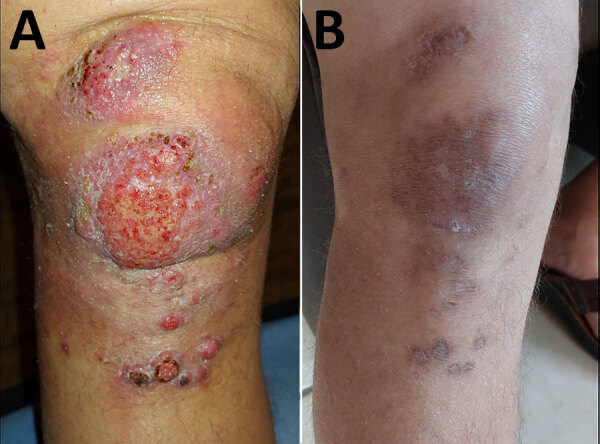 Figure 1
Peer Reviews
No public reviews on file for this paper yet. If you reviewed it on a platform where reviews are public (OpenReview, ICLR, NeurIPS, ICML), you can paste yours below so the community can read it here.
Videos
No videos yet. Explain this paper in a talk, walkthrough, or lecture? Add one.
Taxonomy
TopicsMycobacterium research and diagnosis · Infectious Diseases and Tuberculosis · Tuberculosis Research and Epidemiology
Mycobacterium decipiens is a recently identified nontuberculous mycobacterium genetically closest to the M. tuberculosis complex but of low virulence. Since its description in 2018, the medical literature documents 2 human infections (1,2). We report a cutaneous case of M. decipiens in a 60-year-old man living in an area between Paris and Corsica, France.
The patient sought treatment for skin lesions on his anterior right knee evolving over 9 months. His medical history included irritable bowel disease treated with the anti–tumor necrosis factor-α monoclonal antibody adalimumab (80 mg subcutaneously on the abdomen every 2 wks) for 9 years. Two months after a 2-week trip to French Guiana, where he hiked in forests and swam in rivers and pools, he noticed an erythematous papule that progressively worsened. He reported no history of trauma, sick contacts, or animal exposure and no adalimumab injections during the trip. He did report multiple mosquito bites. The man’s occupation involved building renovation and, on returning from French Guiana, he emptied stagnant swimming pool water in Corsica.
Clinical examination revealed an erythematous, exudative, budding lesion over the patella, with multiple satellite nodules (Figure, panel A). Ipsilateral inguinal lymphadenopathy was nontender and subcentimetric. The patient reported no fever or weight loss. Magnetic resonance imaging of the right knee revealed superficial prepatellar bursitis and tendinopathy of the patellar and pes anserinus tendons. Blood counts and protein electrophoresis were unremarkable; C-reactive protein was moderately elevated at 25.6 mg/L (normal <5 mg/L). HIV serology result was negative.
Histopathologic examination of a surgical biopsy showed epithelioid and giant cell granulomas without necrosis, along with superficial and deep lymphocytic inflammation around capillaries. Direct mycobacteriologic examination with auramine and Ziehl–Neelsen staining revealed 1–9 acid-fast bacilli per microscopic field. M. tuberculosis PCR (MDR/MTB ELITe MGB kit on ELITe InGenius platform; ELITechGroup; https://www.elitechgroup.com), targeting IS6110 and rpoB, produced negative results. Cultures produced dry, chamois-colored colonies on both liquid (mycobacteria growth indicator tube, modified 7H9) and solid (Coletsos) media. We observed growth after 24 days in the liquid medium and after 27 days on Coletsos medium at 30°C and 37°C; colonies were larger at 30°C. Commercial-line probe assays (GenoType CM and AS; Bruker; https://www.bruker.com) covering the most common and pathogenic nontuberculous mycobacterium as well as the M. tuberculosis complex failed to identify the isolate (3).
Sequencing of the 16S rRNA and hsp65 genes showed 100% identity with M. decipiens (ATCC TSD-117; GenBank OY970459.1; TBL 1200985, Genbank NR_178632.1 for 16S and GenBank KJ371035.1 for hsp65). The closest non–M. decipiens matches were M. tuberculosis strains LP-0106963-RM2 (GenBank CP194255.1) and RM1 (GenBank CP194256.1), which showed 99.4% identity for 16S, and M. szulgai (GenBank KC481265.1, 96.2%) and M. intracellulare subspecies. yongonense (GenBank OR672012.1, 95.7%) for hsp65. Whole-genome sequencing confirmed the identification; analysis with KRAKEN2 using a dedicated mycobacterial reference database identified the isolate as M. decipiens, with 92.8% of reads assigned (4). We deposited raw reads in the National Center for Biotechnology Information under BioProject PRJNA1308041 (accession no. SRR35034371).
We determined MICs for antimicrobial drugs potentially active against slow-growing mycobacteria using the SLOMYCO Sensititer system (Thermo Fisher Scientific; https://www.thermofisher.com) with Mueller–Hinton medium incubated at 30°C. MICs were readable after 10 days of incubation, and interpretation followed Clinical and Laboratory Standards Institute guidelines (5) for slowly growing mycobacteria other than M. avium and M. kansasii. The strain was susceptible to clarithromycin, rifabutin, moxifloxacin, amikacin, linezolid, and trimethoprim/sulfamethoxazole but resistant to rifampin.
The patient received empirical treatment with clarithromycin, ethambutol, and rifampin, resulting in poor response after 1 month. Once M. decipiens was identified, we replaced rifampin with moxifloxacin, leading to rapid clinical improvement within 4 weeks. We reduced adalimumab to 40 mg every 2 weeks. The patient continued on combination therapy for 2 additional months after complete remission. Reduction of adalimumab triggered an irritable bowel disease flare requiring corticosteroids and mesalazine enemas. Six months after discontinuation of antimicrobial drugs, only postinflammatory scarring remained (Figure, panel B).
M. decipiens is a slow-growing species, with optimal growth at 32°C–35°C. Colonies are rough, nonpigmented, and chamois-colored, resembling M. tuberculosis. Researchers have noted misidentification by rapid M. tuberculosis identification assays, complicating microbiologic diagnosis (6).
The reservoir of M. decipiens remains unknown. Reported cases of M. decipiens infection involved patients who had recently traveled to tropical regions (US Virgin Islands, Maldives, and French Guiana), suggesting a possible epidemiologic link (1,2). In this case, the patient reported river bathing in French Guiana and exposure to stagnant swimming pool water. In another case, the patient reported bathing in a tidal pool, raising the possibility of an aquatic reservoir (1). Reports have noted resistance of M. decipiens to first-line antituberculous drugs, including rifampin, isoniazid, and ethambutol (6). In our case, discontinuing rifampin and initiating moxifloxacin brought rapid clinical improvement. A prior reported case likewise involved administration of a macrolide-moxifloxacin combination with a third agent, which led to successful recovery (1).
In conclusion, clinical strains of M. decipiens in humans, as reported both here and in prior reports, appear to be susceptible to clarithromycin, moxifloxacin, linezolid, rifabutin, and trimethoprim/sulfamethoxazole (Table). Those agents should be considered in empirical regimens for possible M. decipiens infections, pending susceptibility results.
The reference list from the paper itself. Each links out to its DOI / PubMed record.
- 1Simner PJ, Hyle EP, Buckwalter SP, Branda JA, Brown-Elliott BA, Franklin J, et al. Tenosynovitis caused by a novel nontuberculous Mycobacterium species initially misidentified as a member of the Mycobacterium tuberculosis complex. J Clin Microbiol. 2014;52:4414–8. 25253791 10.1128/JCM.00967-14PMC 4313331 · doi ↗ · pubmed ↗
- 2Brown-Elliott BA, Simmer PJ, Trovato A, Hyle EP, Droz S, Buckwalter SP, et al. Mycobacterium decipiens sp. nov., a new species closely related to the Mycobacterium tuberculosis complex. Int J Syst Evol Microbiol. 2018;68:3557–62. 30204586 10.1099/ijsem.0.003031 PMC 6607433 · doi ↗ · pubmed ↗
- 3Richter E, Rüsch-Gerdes S, Hillemann D. Evaluation of the Geno Type Mycobacterium Assay for identification of mycobacterial species from cultures. J Clin Microbiol. 2006;44:1769–75. 10.1128/JCM.44.5.1769-1775.200616672405 PMC 1479216 · doi ↗ · pubmed ↗
- 4Hall MB. Mycobacterium representative Kraken 2 database. Zenodo. 2023 [cited 2025 Aug 19]. https://zenodo.org/doi/10.5281/zenodo.8339821
- 5Clinical and Laboratory Standards Institute. Performance Standards for Susceptibility Testing of Mycobacteria, Nocardia spp., and Other Aerobic Actinomycetes. 2nd edition. CLSI supplement M 24S. Wayne (PA): The Institute; 2023.31339680 · pubmed ↗
- 6Sous C, Frigui W, Pawlik A, Sayes F, Ma L, Cokelaer T, et al. Genomic and phenotypic characterization of Mycobacterium tuberculosis’ closest-related non-tuberculous mycobacteria. Microbiol Spectr. 2024;12:e 0412623. 38700329 10.1128/spectrum.04126-23PMC 11237670 · doi ↗ · pubmed ↗