Serendipity-Driven Telescoped Synthesis of 2‑Aryl Glycidic Esters from Aldehydes
Vincenzo Battaglia, Isaac G. Sonsona, Sara Meninno, Carlo Crescenzi, Alessandra Lattanzi

TL;DR
Scientists developed a new efficient method to synthesize valuable 2-aryl glycidic esters using a streamlined, room-temperature process.
Contribution
A novel telescoped synthesis method for glycidic esters with scalability and high yield is introduced.
Findings
A seven-reaction telescoped process yields glycidic esters in up to 73% overall yield.
The method uses aldehydes and operates at room temperature with benign solvents.
The epoxides are converted into new β-amino α-hydroxy esters with a quaternary stereocenter.
Abstract
A first general and practical method for the synthesis of valuable 2-(hetero)aryl glycidic ethyl esters has been developed using commercially available reagents and a catalyst. A telescoped three-step seven-reaction process, based on a Knoevenagel/nitro-Michael/hydroxylation/double elimination/epoxidation/esterification sequence, provides the epoxides in up to 73% overall yield. This one-pot protocol features (i) aldehydes as versatile feedstocks, among the reagents used in the process; (ii) all steps proceeding at room temperature in benign solvents; and (iii) scalability of the reaction up to 5 mmol. The epoxides are elaborated to obtain new attractive β-amino α-hydroxy esters, bearing a quaternary stereocenter, including tryptamine- and morpholine-based esters.
Genes, proteins, chemicals, diseases, species, mutations and cell lines named across the full text — each resolved to its canonical identifier and authoritative record.
Click any figure to enlarge with its caption.
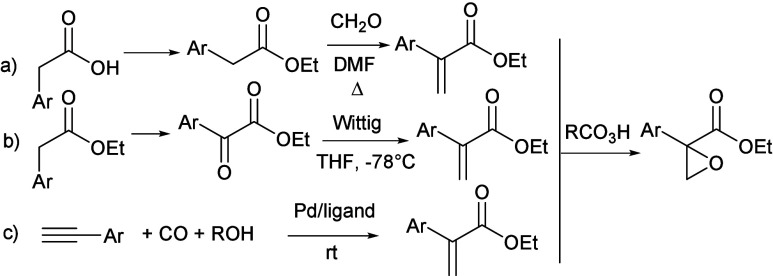 Figure 1
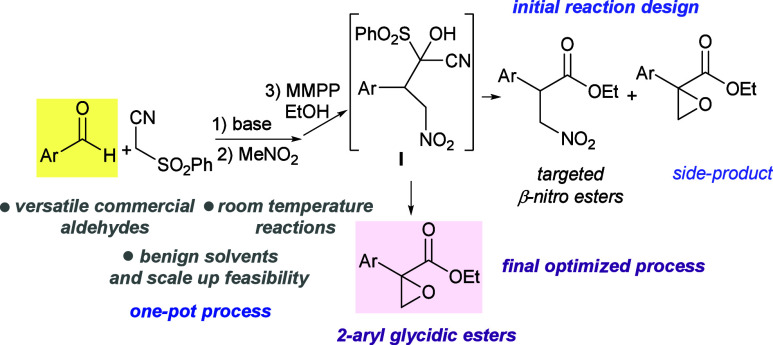 Figure 2
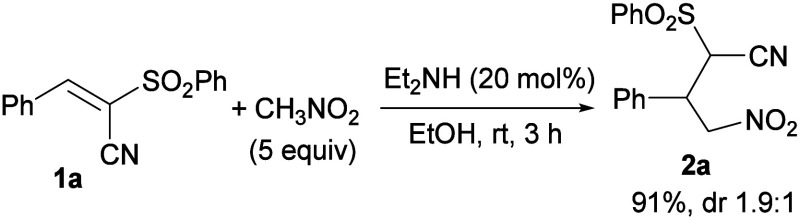 Figure 3
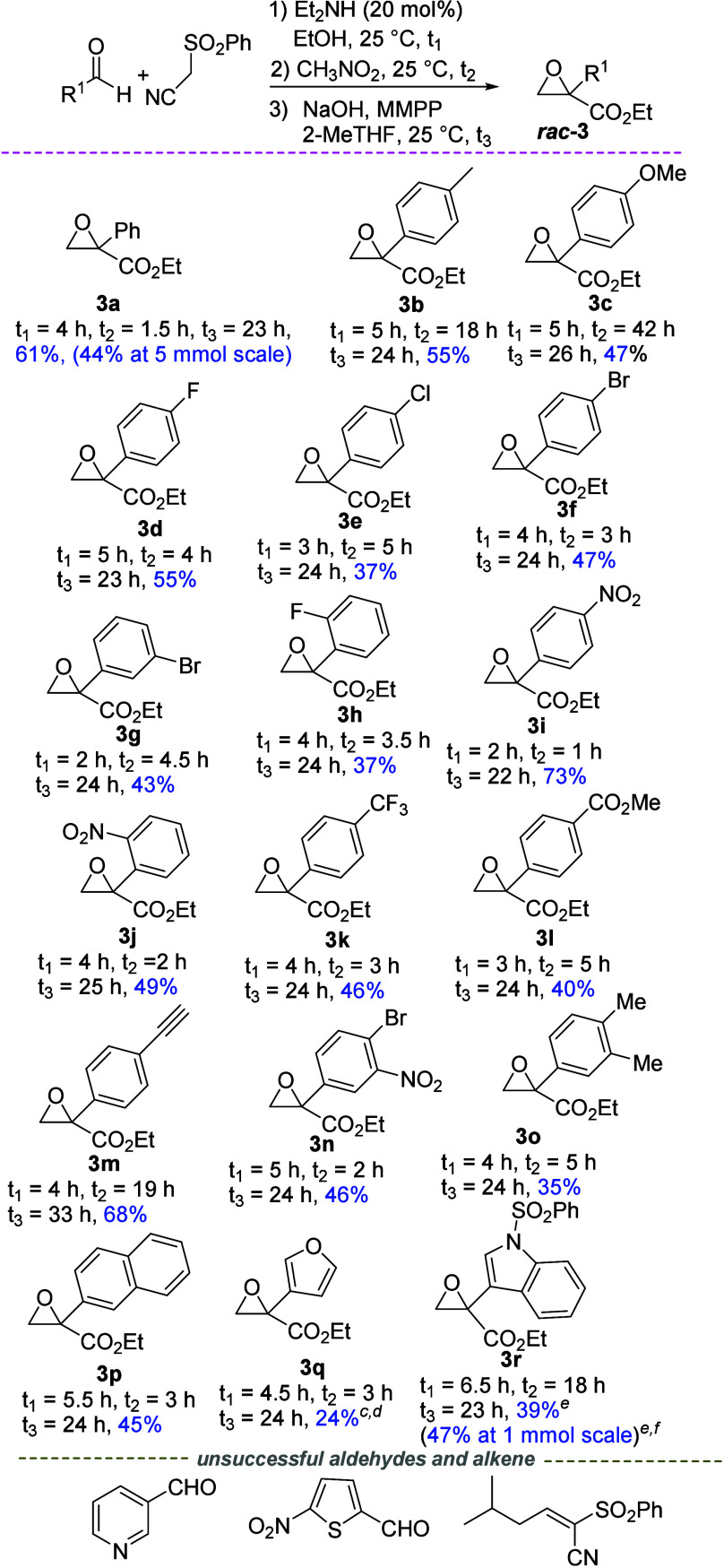 Figure 4
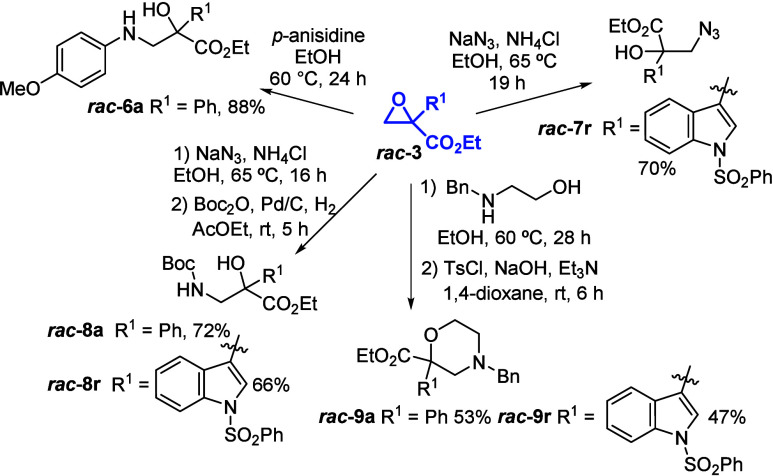 Figure 5
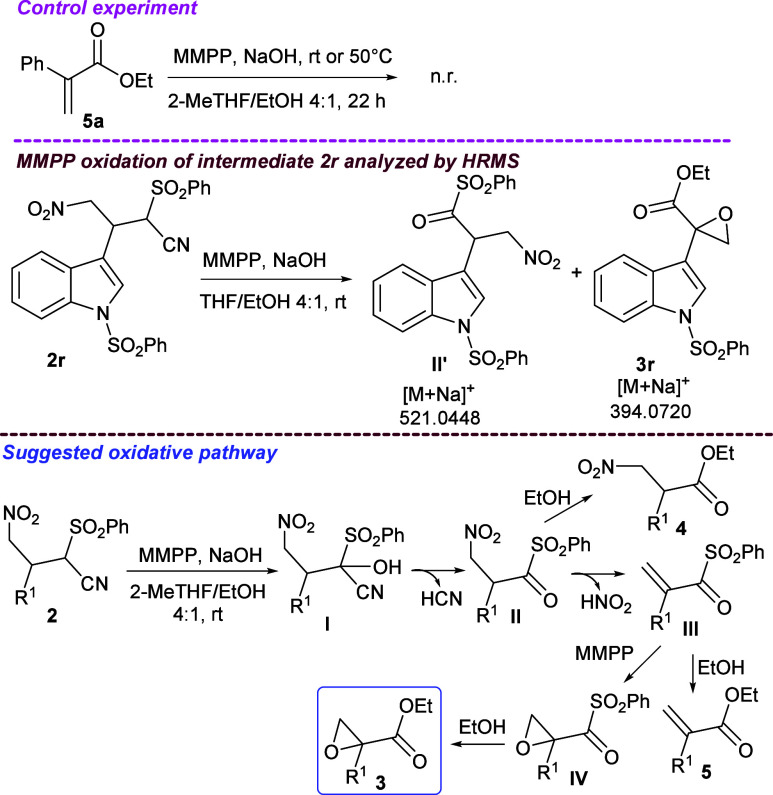 Figure 6
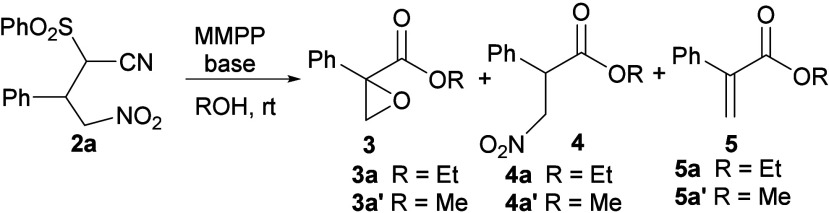 Figure 7
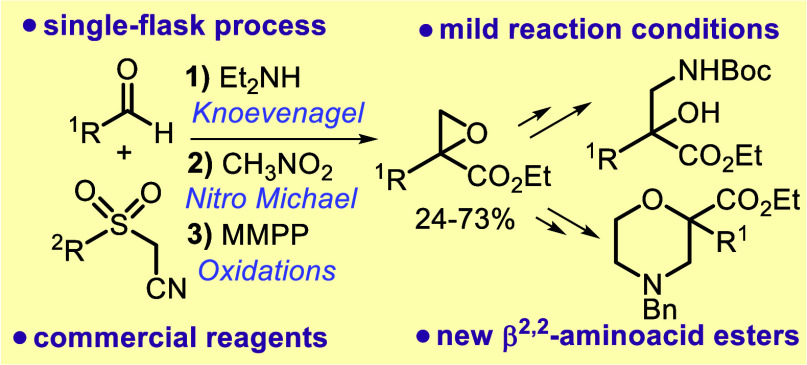 Figure 8
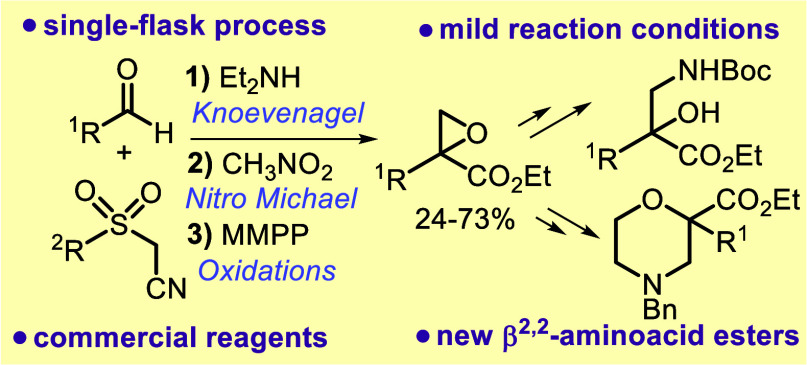 Figure 9
- —Ministero dell'Universit? e della Ricerca10.13039/501100021856
- —Ministero dell'Universit? e della Ricerca10.13039/501100021856
Peer Reviews
No public reviews on file for this paper yet. If you reviewed it on a platform where reviews are public (OpenReview, ICLR, NeurIPS, ICML), you can paste yours below so the community can read it here.
Videos
No videos yet. Explain this paper in a talk, walkthrough, or lecture? Add one.
Taxonomy
TopicsCarbon dioxide utilization in catalysis · Synthetic Organic Chemistry Methods · Asymmetric Synthesis and Catalysis
Glycidic esters belong to a class of epoxides with important applications in the synthesis of drugs? and are industrially relevant in epoxide resin production.? Their ring-opening reactions have been fruitfully explored for the synthesis of some representative pharmaceuticals such as anticancer adjuvant bestatin,? antihypertensive agent diltiazem,? or antitumor drug paclitaxel.? A literature survey showed a focus on the synthesis of 3-aryl-substituted glycidic esters as targets,? whereas methods for obtaining 2-aryl glycidic esters have not been developed. A typical oxidative approach for their synthesis involves a stepwise process with a first preparation of the α-aryl acrylates, starting from arylacetic acids or esters (Schemea,b). The olefination step is then carried out with formaldehyde in DMF under reflux? (Schemea). Alternatively, α-oxidation is necessary to obtain the α-keto ester, before performing a Wittig reaction under controlled conditions at −78 °C (Schemeb).? A single-pot synthesis of atropates has been recently reported starting from terminal alkynes in a palladium/ligand-catalyzed hydroesterification using carbon monoxide under high pressure at room temperature (Schemec).? The epoxidation of the alkene is the final step generally carried out with peroxyacids at temperatures higher than ambient temperature.? Being interested in the synthesis of amino acid derivatives,? we designed a rapid approach for obtaining the β-nitro ester precursors of β-amino acids, through a one-pot Knoevenagel/nitro-Michael reaction followed by the α-hydroxylation of the adduct with magnesium monoperoxyphthalate (MMPP) in EtOH? (Scheme). Intermediate I would have undergone elimination of HCN to form a α-ketosulfone and then been attacked in situ by the alcohol to give the β-nitro ester.? In preliminary experiments, the formation of the β-nitro ester was accompanied by the presence of the 2-aryl glycidic ester as a side product. This serendipitous result and the lack of a straightforward access to versatile 2-aryl glycidic esters were instrumental in the development of a method for their synthesis.
Herein, we illustrate a mild one-pot protocol, developed using commercial reagents and a catalyst, including aldehydes as key feedstocks and benign solvents, which enables us to obtain 2-aryl glycidic esters in good to high overall yields.
The approach can be scaled up to 5 mmol, and the epoxides elaborated to be transformed into new useful β-amino-α-hydroxy ester derivatives.
At the outset, the diethyl amine-catalyzed Knoevenagel reaction between aromatic aldehydes and phenylsulfonyl acetonitrile in EtOH at room temperature was chosen as the most effective and convenient protocol to obtain the alkenes, given the usage of a readily available base and ethanol as the solvent.? Pleasingly, the nitro Michael reaction with model alkene 1a, performed under the same conditions, proceeded rapidly to give adduct 2a in 91% yield (Scheme).
The reaction outcome met our expectations for being used as the second step of the one-pot sequence. Having secured the effective formation of adduct 2a, the α-hydroxylation step, initially designed for the synthesis of β-nitro methyl ester (Scheme), was performed under the previously reported conditions.? The α-hydroxy intermediate, according to the literature,? would have led to the β-nitro ester (Table). Under typical conditions,? adduct 2a reacted in MeOH, affording expected ester 4a′ (entry 1). Moreover, 2-phenyl glycidic methyl ester 3a′ was surprisingly detected, together with traces of α-phenyl acrylate 5a′ (entry 1). As anticipated, we became motivated to optimize the reaction conditions with the thought of developing a general one-pot method to access 2-aryl glycidic esters. Increasing the amount of MMPP with K_2_CO_3_ as the base provided a better conversion to nitro ester 4a′ (entry 2). Interestingly, epoxide 3a was obtained as the major product when EtOH was employed (entry 3). The use of an excess of MMPP slightly improved the selectivity of the reaction mixture (entry 4). Remarkably, the reaction performed in a THF/EtOH solvent mixture? enabled to reach higher and selective conversion to epoxide 3a, as only traces of products 4a and 5a were detected (entry 5). Common bases were then evaluated under these conditions (entries 6–9). Being that the reaction mixtures were not homogeneous, a clear trend was not observed between base strength and the yield obtained. NaOH and K_2_CO_3_ proved to be the most effective, with the former providing the highest conversion and selectivity (entry 9). Finally, THF was successfully replaced by a greener alternative, 2-methyl tetrahydrofuran (2-MeTHF) (entry 10). Further optimization did not improve the reaction outcome (Table S1).
Under the optimized conditions, the one-pot synthesis of racemic 2-aryl glycidic ethyl esters 3 was next studied (Scheme). The epoxides were generally obtained in good to high overall yields. Model 2-phenyl glycidic ethyl ester 3a was isolated in 61% yield, attesting to the fact that the diethyl amine-catalyzed Knoevenagel/nitro-Michael reactions proceeded in high yields, upon comparison of this result with the conversion observed for epoxide 3a in the MMPP oxidation sequence (73% yield, entry 10 of Table). para-Electron-donating groups or halogen atoms at different positions of the phenyl ring were well tolerated as epoxides 3b–h were isolated in 37–55% yields. Epoxides 3i–l, phenyl substituted with para- and ortho-electron-withdrawing groups, were recovered in very good and up to 73% yields. Inferior conversions are observed for epoxides derived from more sterically demanding ortho-substituted aldehydes. Epoxides 3m–o, bearing double substitution or unsaturated groups on the phenyl ring, were obtained in satisfactory to fairly good yields (up to 68%). Finally, 2-naphthyl-substituted and heteroaromatic 3-furyl- and 3-indolyl-substituted glycidic ethyl esters 3p–r were isolated in moderate to good yields (up to 45%). Remarkably, although the furyl ring is known to suffer oxidation by peracids,? epoxide 3q was successfully obtained in 24% overall yield, the MMPP oxidation being performed at −20 °C. However, oxidant susceptible pyridine- and thiophene-based aldehydes turned out to be unsuccessful reagents. The process proceeded slightly less efficiently when applied to prepare model epoxide 3a at a 5 mmol scale, whereas improvements were observed for epoxide 3r, obtained in 47% yield, working at a 1 mmol scale and using 40 mol % Et_2_NH. Application of the protocol to prepare 2-aliphatic glycidic esters proved to be unsuccessful. When starting from the isobutyl-substituted alkene, a complex mixture was obtained and traces of the corresponding ethyl β-nitro ester were observed.
For the sake of comparison, alkylidene derived from benzaldehyde and malononitrile was treated under the conditions reported in Scheme (for steps 2 and 3). Compound 4a was recovered in 25% yield, whereas epoxide 3a was not detected. Notably, the presence of the phenylsulfone group on the alkene appears to be crucial for the reaction outcome. ?,?
Surprisingly, ring-opening reactions of 2-aryl glycidic ethyl esters have rarely been explored for derivatization, in contrast to their 3-aryl glycidic ester counterparts. Given a facile access to terminal glycidic esters 3, a variety of postfunctionalizations with different nitrogen-based nucleophiles were designed to prepare non-natural β^2,2^-amino acid derivatives, taking advantage of the highly regioselective ring-opening reactions they undergo (Scheme). The members of this class of amino acids, including α-hydroxy-β-amino acid derivatives, are relevant scaffolds in the pharmaceutical industry, subunits useful for the synthesis of natural products and drugs.?
Epoxide 3a treated with p-anisidine afforded α-hydroxy-β-amino ester 6a in 88% yield. NaN_3_ was then employed to prepare functionalized precursors to use in click chemistry as a tool to facilitate drug discovery.? Specifically, starting from indolyl-substituted epoxide 3r, alcohol 7r was obtained in 70% yield. Further reduction, with in situ Boc protection of the primary amine, afforded simple access to new tryptamine derivative 8r, bearing a quaternary stereocenter, in 66% overall yield. Tryptamine derivatives are often used as intermediates for the synthesis of drugs and are key units of alkaloids.? The same process, applied to model epoxide 3a, led to N-Boc α-hydroxy-β-amino ethyl ester 8a in 72% overall yield. Finally, an approach to construct new morpholine esters has been showcased through N-benzyl ethanol amine epoxide ring opening followed by tosylation and intramolecular nucleophilic substitution. Accordingly, morpholines 9a and 9r were obtained in 53% and 47% yields, respectively.? This route highlights 2-aryl glycidic esters as versatile building blocks to access unprecedented morpholine esters 9, which could be used to obtain a variety of morpholinol derivatives, key compounds involved in the synthesis of neurokinin receptor antagonists.? To determine the entire reaction pathway, a control experiment was first performed. In the preliminary study illustrated in Table, traces of acrylate 5a were detected. Hence, to assess if the epoxidation occurred on acrylate 5a, this compound was treated under the same oxidative conditions reported in Scheme, either at room temperature or at 50 °C (Scheme). The process was also carried out in the absence of a base (Table S2). Acrylate 5a proved to be unreactive, a result in agreement with the literature, indicating that harsher reaction conditions are necessary for the epoxidation to proceed.? This result suggested that another alkene intermediate would undergo epoxidation by MMPP. Oxidation on compound 2r, carried out under the same conditions, was next studied over time via HRMS analysis.? Besides epoxide 3r, intermediate II′ was detected, which is a postulated precursor of observed nitro ester 4 (Table).
On the basis of all of the data, a plausible pathway is proposed to occur in the MMPP oxidation of nitro-Michael adducts 2 to epoxides 3 (Scheme). Compound 2 is hydroxylated to intermediate I, which undergoes the elimination of HCN to give crucial intermediate II. According to their structure, nitro compounds are prone to eliminate nitrous acid under basic conditions.? In a THF or 2-MeTHF/EtOH medium, intermediate II would eliminate nitrous acid to afford alkene III, which being more electrophilic than acrylate 5, is susceptible to nucleophilic epoxidation by MMPP,? giving intermediate IV. Indeed, we previously observed that intermediates of type II are not easily attacked by EtOH? and sterically hindered alcohols to give the ester when compared with MeOH. This would make intermediate II more susceptible to elimination to afford alkene III than esterification to afford compound 4. This reactivity is expected to be enhanced in the 2-MeTHF/EtOH mixture, where higher conversion and selectivity toward the epoxide pathway were observed (Table). However, in pure alcoholic media, intermediate II would evolve into β-nitro ester 4 to a significant extent before the elimination of nitrous acid takes place. Epoxy intermediate IV, once formed, undergoes esterification by ethanol to give epoxide 3. Partial esterification of intermediate III would account for the presence of acrylate 5, detected in the MMPP oxidation of 2a (Table).
In conclusion, we developed a first general and convenient route to easily prepare 2-aryl glycidic ethyl esters from commercial sources, including aldehydes as feedstocks. Remarkably, the one-pot sequential process can be carried out at room temperature in benign solvents, enabling an effective synthesis of the epoxides in good to high overall yields. The protocol can be scaled up, and the synthetic utility of the 2-aryl glycidic esters has been demonstrated. By leveraging highly selective ring-opening reactions, interesting new α-hydroxy-β-amino acid derivatives, encompassing tryptamine and morpholine esters, can be obtained.
Supplementary Material
The reference list from the paper itself. Each links out to its DOI / PubMed record.
- 1a Pellissier, H. ; Lattanzi, A. ; Dalpozzo, R. Asymmetric Synthesis of Three-Membered Rings; Wiley-VCH, 2017; pp 379–514.
- 2a Huang S.Huang T.Liu M.Liu D.Hu X.Zhu W.Chen Z.Huang S.Zhang X.Hyperbranched polymers Functionalized Zein as Tumor Microenvironment-Responsive Drug Delivery System for Sustained and Controlled Release of Doxorubicin J. Drug Delivery Sci. Technol.202511310733310.1016/j.jddst.2025.107333 · doi ↗
- 3a Kim H. W.Ko M.-K.Park S. H.Shin S.Kim S.-M.Park J.-H.Lee M. J.Bestatin, A Pluripotent Immunomodulatory Small Molecule, Drives Robust and Long-Lasting Immune Responses as an Adjuvant in Viral Vaccines Vaccines 2023111690170810.3390/vaccines 1111169038006022 PMC 10675184 · doi ↗ · pubmed ↗
- 4a Budriesi R.Cosimelli B.Ioan P.Carosati E.Ugenti M. P.Spisani R.Diltiazem Analogues: The Last Ten Years on Structure Activity Relationships Curr. Med. Chem.20071427928710.2174/09298670777994112217305533 · doi ↗ · pubmed ↗
- 5a Sharma A.Bhatia S. K.Banyal A.Chanana I.Kumar A.Chand D.Kulshrestha S.Kumar P.An Overview on Taxol Production Technology and Its Applications as Anticancer Agent Biotechnol. Bioprocess Eng.20222770672810.1007/s 12257-022-0063-3 · doi ↗
- 6a Yudin, A. K. Aziridines and Epoxides in Organic Synthesis; Wiley-VCH: Weinheim, Germany, 2006.
- 7Nicely A. M.Popov A. G.Wendlandt H. C.Trammel G. L.Kohler D. G.Hull K. L.Cu-Catalyzed Three-Component Carboamination of Electron Deficient Olefins Org. Lett.2023255302530710.1021/acs.orglett.3c 0186637440170 PMC 10771120 · doi ↗ · pubmed ↗
- 8Kawashima S.Aikawa K.Mikami K.Rhodium-Catalyzed Hydrocarboxylation of Olefins with Carbon Dioxide Eur. J. Org. Chem.201620163166317010.1002/ejoc.201600338 · doi ↗