Lipoprotein(a) and the Early Diagnosis, Complexity, and Extent of Coronary Artery Disease and Myocardial Infarction
Casper F. Coerkamp, Victor A. Verpalen, Kaoutar Bouhbouh, Mick P.L. Renkens, Lars S. Witte, Yannick Kaiser, Remko S. Kuipers, Steven A.J. Chamuleau, Paul Knaapen, Ronak Delewi, Bimmer E.P.M. Claessen, Maik J. Grundeken, R. Nils Planken, Peter Damman, Erik S.G. Stroes

TL;DR
High levels of lipoprotein(a) are linked to earlier and more severe coronary artery disease and heart attacks.
Contribution
This study shows that very high Lp(a) levels are strongly associated with early CAD diagnosis and increased MI risk.
Findings
Very high Lp(a) is linked to earlier obstructive CAD diagnosis and MI occurrence.
Individuals with high Lp(a) have a 15.9-fold higher risk of recurrent MI.
Lp(a) is associated with multivessel CAD but not with a high SYNTAX score.
Abstract
Lipoprotein(a) [Lp(a)] is a potent, independent causal risk factor for coronary artery disease (CAD). This study aimed to assess the association between Lp(a) and the diagnosis, clinical presentation, and angiographic characteristics of obstructive CAD and occurrence of myocardial infarction (MI). We included 446 individuals with very high Lp(a) (>230 nmol/L) who underwent routine lipid profiling, matched 2:1 by age and sex using nearest-neighbor propensity matching to 223 controls with low Lp(a) (≤7 nmol/L). Kaplan-Meier analysis was used to assess CAD- and MI-free survival. Multivariable ORs were calculated for multivessel disease and the SYNergy Between percutaneous coronary intervention with TAXus and Cardiac Surgery-1 score. Median follow-up time, defined by age at last follow-up, was 60 years (Q1-Q3: 50-71). Individuals with very high Lp(a) had significantly lower event-free…
Genes, proteins, chemicals, diseases, species, mutations and cell lines named across the full text — each resolved to its canonical identifier and authoritative record.
Click any figure to enlarge with its caption.
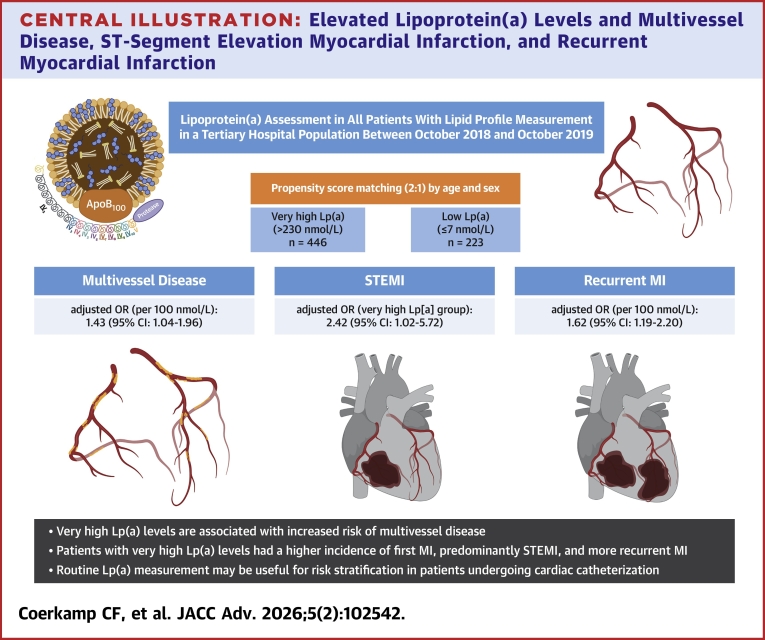 Figure 1
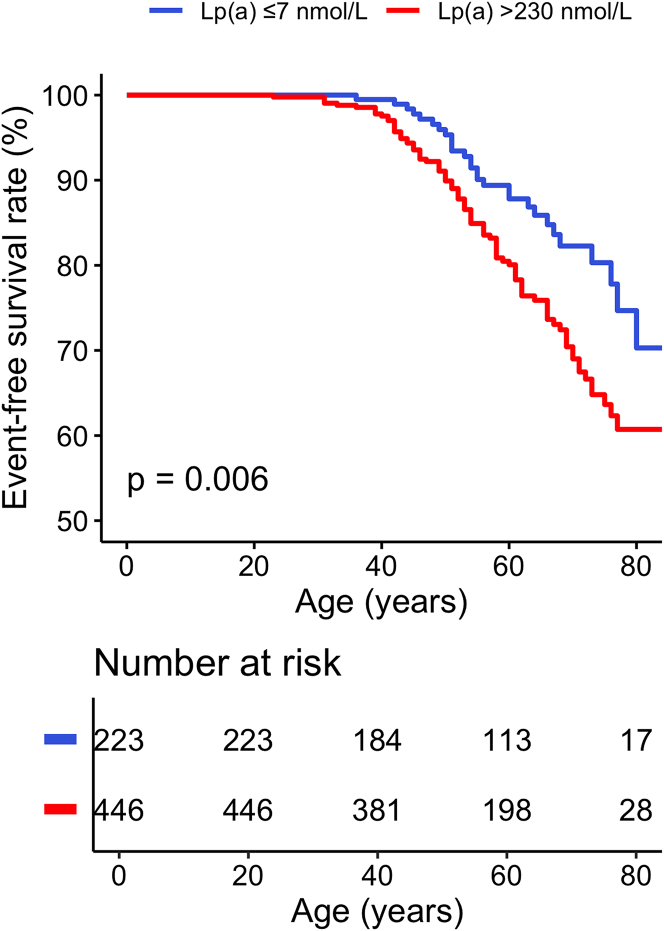 Figure 2
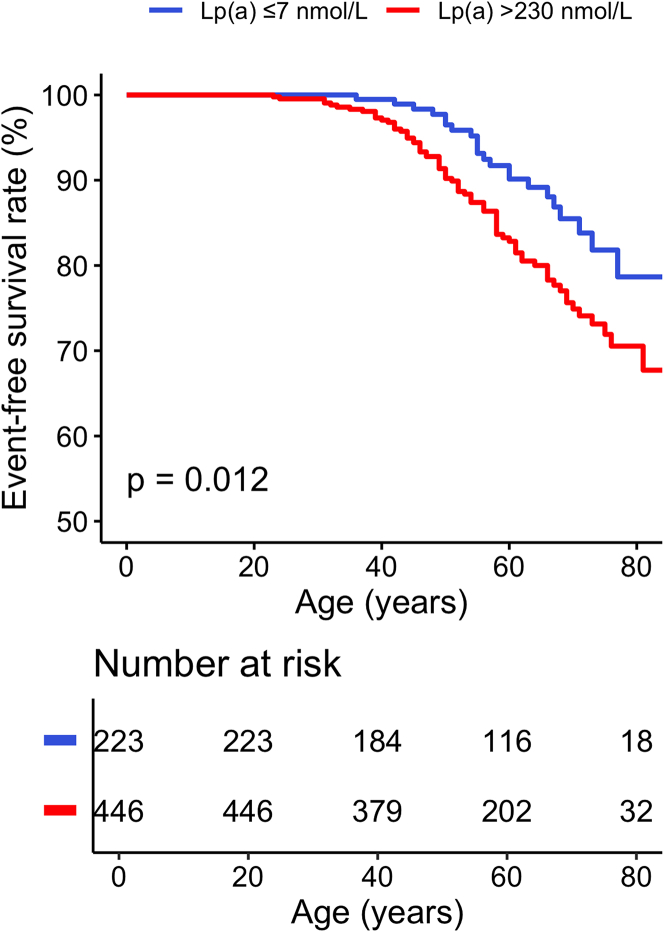 Figure 3
 Figure 4
Peer Reviews
No public reviews on file for this paper yet. If you reviewed it on a platform where reviews are public (OpenReview, ICLR, NeurIPS, ICML), you can paste yours below so the community can read it here.
Videos
No videos yet. Explain this paper in a talk, walkthrough, or lecture? Add one.
Taxonomy
TopicsLipoproteins and Cardiovascular Health · Protease and Inhibitor Mechanisms · Atherosclerosis and Cardiovascular Diseases