Improved Dye-Filling Protocol for Multiple Nematode Species
Luke T. Geiger, Joke Evenblij, Curtis M. Loer, Yasmin H. Ramadan, Oliver Hobert

TL;DR
This paper introduces a new dye-filling method that improves neuron visualization in multiple nematode species.
Contribution
A modified dye-filling protocol that works robustly across multiple nematode species and neuron types.
Findings
The protocol improves dye-filling in amphid, phasmid, and inner labial neurons in C. elegans and P. pacificus.
The method enables consistent visualization of male-specific ray sensory neurons and support cells.
The technique is robust and applicable across multiple nematode species.
Abstract
Dye-filling has been used extensively to study the development and morphology of sensory neurons in the nematode C. elegans . Here, we report a modified dye-filling protocol that improves the robustness of amphid, phasmid, and inner labial neuron dye-filling in C. elegans , as well as in the nematode satellite model P. pacificus. Our method also allows for the consistent visualization of male specific ray sensory neurons and associated support cells in these species.
Genes, proteins, chemicals, diseases, species, mutations and cell lines named across the full text — each resolved to its canonical identifier and authoritative record.
Click any figure to enlarge with its caption.
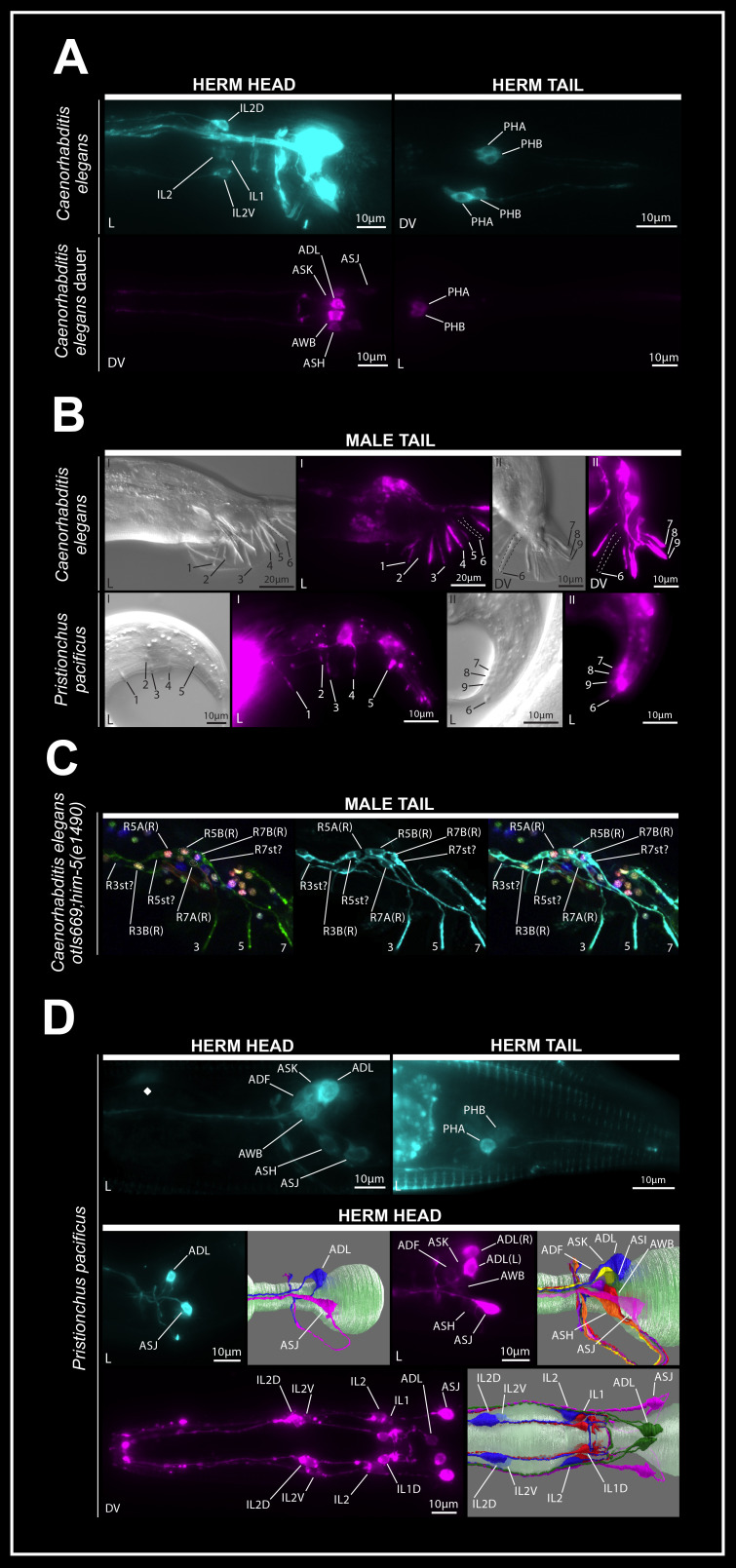 Figure 1
Peer Reviews
No public reviews on file for this paper yet. If you reviewed it on a platform where reviews are public (OpenReview, ICLR, NeurIPS, ICML), you can paste yours below so the community can read it here.
Videos
No videos yet. Explain this paper in a talk, walkthrough, or lecture? Add one.
Taxonomy
TopicsGenetics, Aging, and Longevity in Model Organisms · Nematode management and characterization studies · Planarian Biology and Electrostimulation