Electrochemical Synthesis of 3-Selenyl-Chromones via Domino C(sp2)-H Bond Selenylation/Annulation of Enaminones
João M. Brito, Isabella M. e Oliveira, Cassio A. O. Moraes, Alex R. Schneider, Tiago E. A. Frizon, Giancarlo V. Botteselle, Vijay P. Singh, André L. Stein, Gleison A. Casagrande, Giuseppe A. Camara, Antonio L. Braga, Jamal Rafique, Sumbal Saba

TL;DR
This paper presents a new electrochemical method to efficiently synthesize 3-selenylated chromone compounds under mild conditions.
Contribution
A novel electrosynthesis method for 3-selenylated chromones via a domino C(sp2)-H bond selenylation/annulation process.
Findings
The method operates under mild conditions with good functional group tolerance.
The reaction is scalable and has a wide substrate scope.
The reaction likely proceeds via a cation pathway based on preliminary experiments.
Abstract
Herein, we disclose a highly efficient pathway toward 3-selenylated chromone derivatives via electrosynthesis domino C(sp2)-H bond selenylation/cyclization/deamination of 2-hydroxyaryl enaminones with diselenides. This method showed mild conditions, easy operation, a wide substrate scope, and good functional group tolerance. Furthermore, this electrosynthesis strategy was amenable to scaling up the reaction. Additionally, the preliminary experiments revealed that this reaction probably proceeded via a cation pathway instead of a radical pathway.
Genes, proteins, chemicals, diseases, species, mutations and cell lines named across the full text — each resolved to its canonical identifier and authoritative record.
Click any figure to enlarge with its caption.
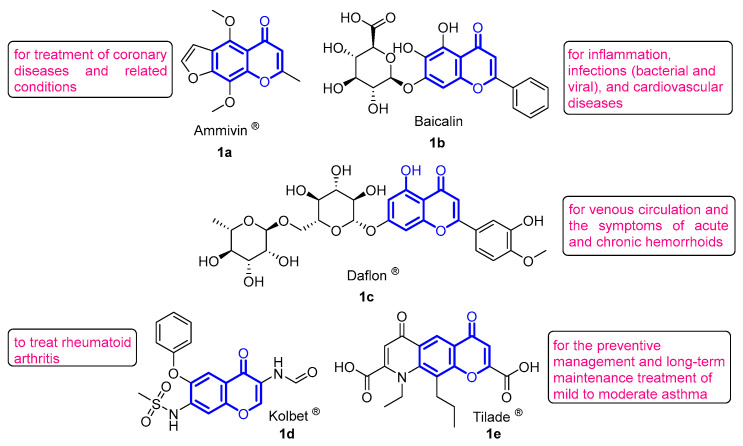 Figure 1
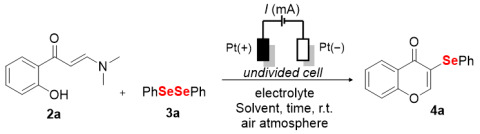 Figure 2
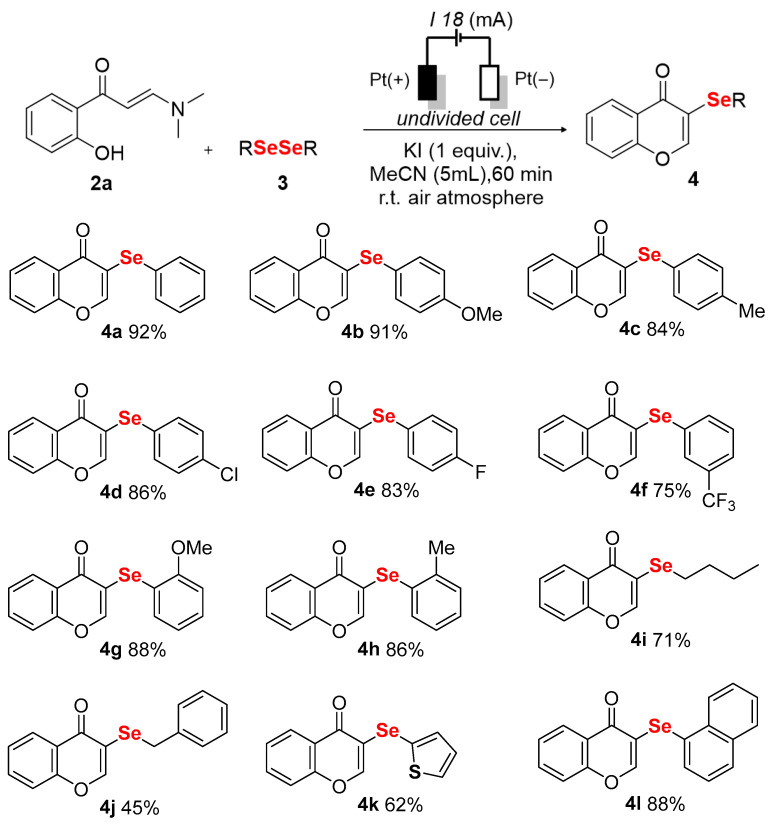 Figure 3
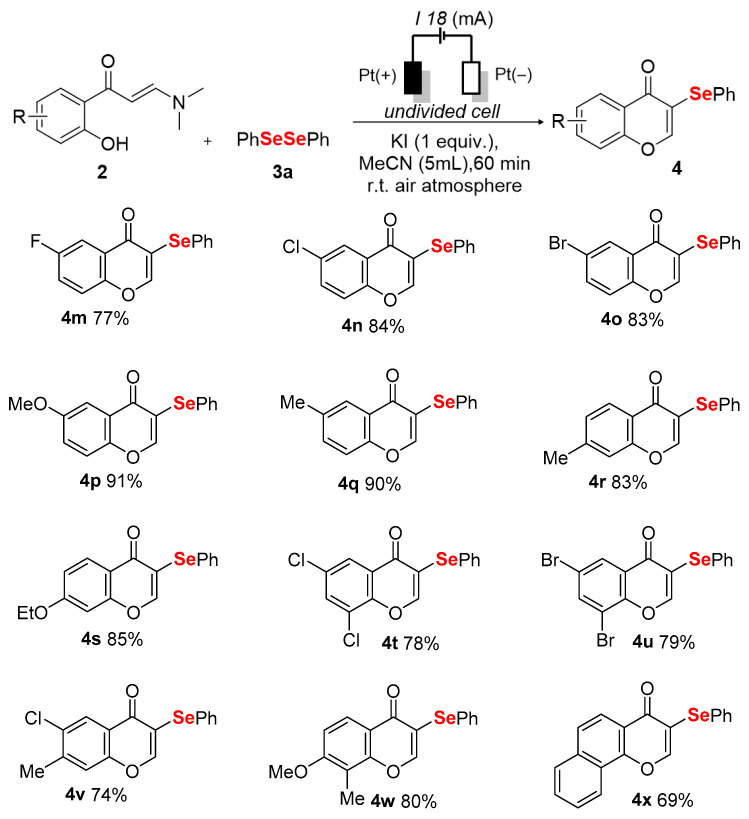 Figure 4
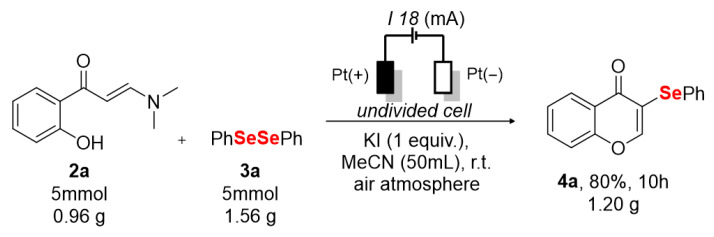 Figure 5
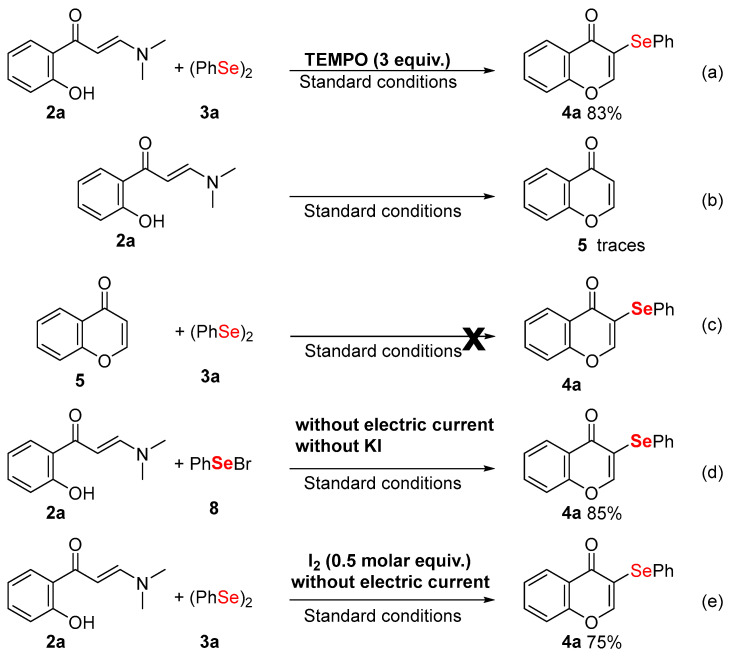 Figure 6
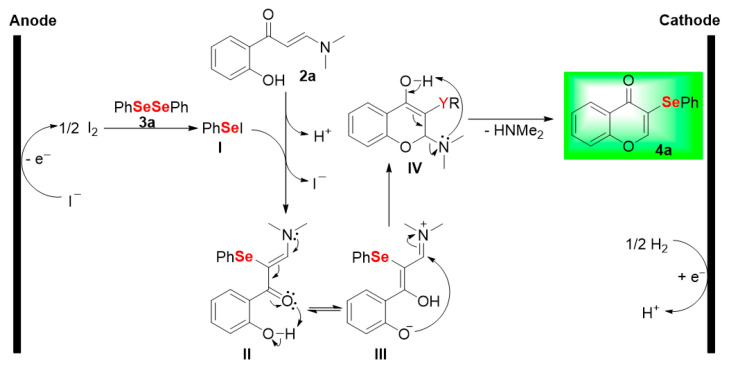 Figure 7
Peer Reviews
No public reviews on file for this paper yet. If you reviewed it on a platform where reviews are public (OpenReview, ICLR, NeurIPS, ICML), you can paste yours below so the community can read it here.
Videos
No videos yet. Explain this paper in a talk, walkthrough, or lecture? Add one.
Taxonomy
TopicsRadical Photochemical Reactions · Sulfur-Based Synthesis Techniques · Catalytic C–H Functionalization Methods