Detection of Feigned Impairment of the Shoulder Due to External Incentives: A Comprehensive Review
Nahum Rosenberg

TL;DR
This paper reviews methods to detect when people fake shoulder injuries for personal gain, emphasizing the need for a multi-step approach combining clinical and technological tools.
Contribution
The paper proposes a systematic integration of clinical, biomechanical, and technological assessments to improve detection of feigned shoulder impairments.
Findings
Feigned shoulder impairment detection requires a multidimensional evaluation combining clinical and objective measurements.
Instrumented strength testing and motion capture can reveal submaximal performance and compensatory strategies.
No single test can confirm feigned impairment; a combination of methods and rigorous documentation is necessary.
Abstract
Background: Feigned restriction of shoulder joint movement for secondary gain is clinically relevant and may misdirect care, distort disability determinations, and inflate system costs. Distinguishing feigning from structural pathology and from functional or psychosocial presentations is difficult because pain is subjective, performance varies, and no single sign or test is definitive. This comprehensive review hypothesizes that the systematic integration of clinical examination, objective biomechanical and neurophysiological testing, and emerging technologies can substantially improve detection accuracy and provide defensible medicolegal documentation. Methods: PubMed and reference lists were searched within a prespecified time frame (primarily 2015–2025, with foundational earlier works included when conceptually essential) using terms related to shoulder movement restriction,…
Genes, proteins, chemicals, diseases, species, mutations and cell lines named across the full text — each resolved to its canonical identifier and authoritative record.
Click any figure to enlarge with its caption.
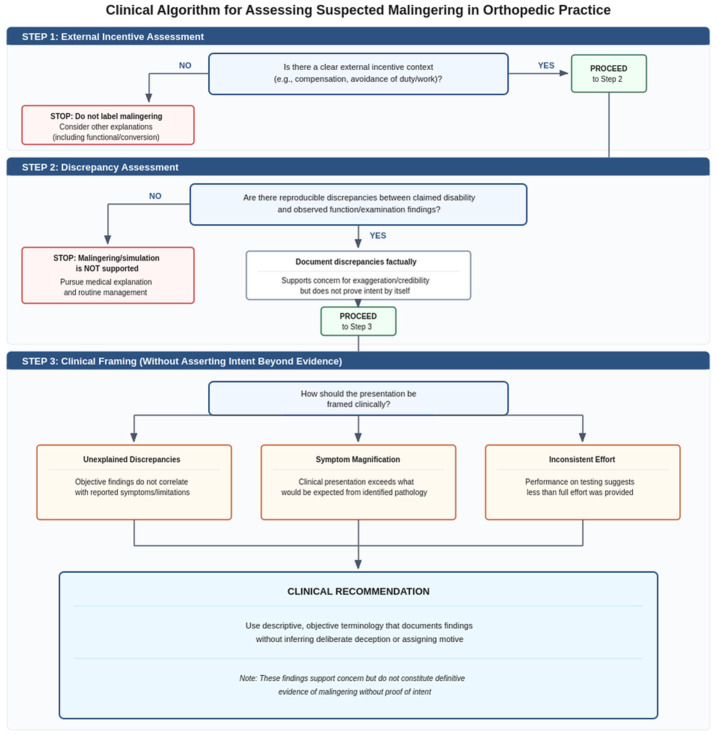 Figure 1
Peer Reviews
No public reviews on file for this paper yet. If you reviewed it on a platform where reviews are public (OpenReview, ICLR, NeurIPS, ICML), you can paste yours below so the community can read it here.
Videos
No videos yet. Explain this paper in a talk, walkthrough, or lecture? Add one.
Taxonomy
TopicsShoulder Injury and Treatment · Anesthesia and Pain Management · Nerve Injury and Rehabilitation