Knowledge and Awareness of Parents Regarding Congenital Inguinal Hernia and Its Complications in the Pediatric Population in Makkah Region, Saudi Arabia
Manar K Almaliki, Ghidaa A Alghamdi, Refal M Mahrouqi, Rifal S Alsharif, Malak W Alsabban, Waref H Felemban, Mohammed H Ageel

TL;DR
A study in Saudi Arabia found that parents have low awareness about congenital hernias in children, highlighting the need for better education to prevent complications.
Contribution
The study identifies significant gaps in parental knowledge about pediatric hernias in the Makkah region and links awareness to specific demographic factors.
Findings
Most parents showed poor knowledge of congenital inguinal and umbilical hernias and their symptoms.
Parents with a family history of hernias or who noticed swelling in their children had higher awareness levels.
Abstract
Introduction Congenital inguinal and umbilical hernias are common in pediatric populations and may lead to serious complications if not identified and managed promptly. Limited parental awareness can delay diagnosis and treatment, resulting in adverse health outcomes. Methods A descriptive cross-sectional study was conducted using an online questionnaire distributed to parents residing in the Makkah region of Saudi Arabia. The survey assessed demographic characteristics, awareness, and knowledge related to the causes, symptoms, risks, and management of congenital inguinal and umbilical hernias. A total of 470 responses were included in the analysis. Results Most participants demonstrated poor knowledge regarding both types of hernias, with the majority unaware of common symptoms or potential complications. Female parents, those with a family history of hernias, and those who had…
Genes, proteins, chemicals, diseases, species, mutations and cell lines named across the full text — each resolved to its canonical identifier and authoritative record.
Click any figure to enlarge with its caption.
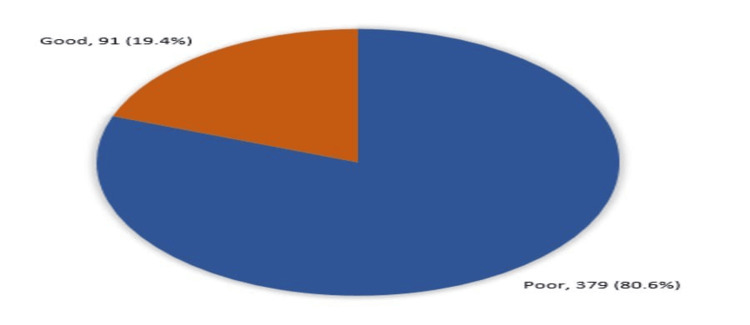 Figure 1
| Data | Frequency | Percentage |
| Gender | ||
| Male | 127 | 27.0% |
| Female | 343 | 73.0% |
| Marital status | ||
| Married | 318 | 67.7% |
| Divorced/widowed | 152 | 32.3% |
| Number of children | ||
| 1 child | 108 | 23.0% |
| 2 children | 105 | 22.3% |
| 3 children | 97 | 20.6% |
| 4 or more children | 160 | 34.0% |
| Educational level | ||
| Intermediate school | 33 | 7.0% |
| Secondary school | 94 | 20.0% |
| Diploma | 70 | 14.9% |
| Bachelor degree | 180 | 38.3% |
| Postgraduate degree | 93 | 19.8% |
| Have you noticed any of the following symptoms in your child between the ages of one month and 12 years? | ||
| Nothing | 333 | 70.9% |
| Umbilical swelling | 51 | 10.9% |
| Inguinal swelling | 54 | 11.5% |
| Both swellings | 32 | 6.8% |
| Family history of umbilical/inguinal hernia | ||
| None | 305 | 64.9% |
| Umbilical hernia | 90 | 19.1% |
| Inguinal hernia | 42 | 8.9% |
| Both of them | 33 | 7.0% |
| Knowledge items | Frequency | Percentage |
| Do you know what an umbilical hernia or congenital inguinal hernia is? | ||
| Only an umbilical hernia | 156 | 33.20% |
| Only inguinal hernia | 42 | 8.90% |
| Both of them | 87 | 18.50% |
| I don't know | 185 | 39.40% |
| In most simple umbilical hernia cases, what is the usual solution? | ||
| A simple condition that does not require a visit to the doctor | 79 | 16.80% |
| Simple condition, but it's better to see a doctor | 189 | 40.20% |
| Moderate condition and need to see a doctor | 116 | 24.70% |
| Serious condition requiring urgent medical intervention | 86 | 18.30% |
| In most simple inguinal hernia cases, what is the usual solution? | ||
| A simple condition that does not require a visit to the doctor | 57 | 12.10% |
| Simple condition, but it's better to see a doctor | 149 | 31.70% |
| Moderate condition and need to see a doctor | 164 | 34.90% |
| Serious condition requiring urgent medical intervention | 100 | 21.30% |
| Do you think umbilical and inguinal hernias can recur after treatment? | ||
| Yes, both types | 191 | 40.80% |
| Umbilical hernia only | 67 | 14.30% |
| Inguinal hernia only | 65 | 13.90% |
| None | 145 | 31.00% |
| The most common thing found inside an inguinal hernia bulge | ||
| Testicle for males | 66 | 14.10% |
| Ovaries for females | 40 | 8.50% |
| Part of the intestine | 101 | 21.60% |
| Fluids | 44 | 9.40% |
| Air | 22 | 4.70% |
| Don't know | 195 | 41.70% |
| The most common thing found inside an umbilical hernia bulge | ||
| Testicle for males | 36 | 7.70% |
| Ovaries for females | 35 | 7.50% |
| Part of the intestine | 139 | 29.70% |
| Fluids | 52 | 11.10% |
| Air | 41 | 8.80% |
| Don't know | 165 | 35.30% |
| There is a relationship between undescended testicles in children and inguinal hernia | ||
| Yes | 249 | 53.20% |
| No | 219 | 46.80% |
| How would you rate your level of knowledge about umbilical and congenital inguinal hernias? | ||
| Limited | 361 | 77.10% |
| Intermediate | 93 | 19.90% |
| Good | 14 | 3.00% |
| Factors | Overall knowledge level | p-value | |||
| Poor | Good | ||||
| Frequency | Percentage | Frequency | Percentage | ||
| Gender | .048* | ||||
| Male | 109 | 85.80% | 18 | 14.20% | |
| Female | 270 | 78.70% | 73 | 21.30% | |
| Marital status | 0.521 | ||||
| Married | 259 | 81.40% | 59 | 18.60% | |
| Divorced/widowed | 120 | 78.90% | 32 | 21.10% | |
| Number of children | .563^ | ||||
| 1 child | 87 | 80.60% | 21 | 19.40% | |
| 2 children | 83 | 79.00% | 22 | 21.00% | |
| 3 children | 83 | 85.60% | 14 | 14.40% | |
| 4/ more children | 126 | 78.80% | 34 | 21.30% | |
| Educational level | 0.939 | ||||
| Intermediate school | 25 | 75.80% | 8 | 24.20% | |
| Secondary school | 75 | 79.80% | 19 | 20.20% | |
| Diplome | 58 | 82.90% | 12 | 17.10% | |
| Bachelor degree | 146 | 81.10% | 34 | 18.90% | |
| Post-graduate degree | 75 | 80.60% | 18 | 19.40% | |
| Have you noticed any of the following symptoms in your child between the ages of 1 month and 12 years? | .049* | ||||
| Nothing | 275 | 82.60% | 58 | 17.40% | |
| Umbilical swelling | 42 | 82.40% | 9 | 17.60% | |
| Inguinal swelling | 40 | 74.10% | 14 | 25.90% | |
| Both swellings | 22 | 68.80% | 10 | 31.30% | |
| Family history of umbilical/inguinal hernia | .026* | ||||
| None | 253 | 83.00% | 52 | 17.00% | |
| Umbilical hernia | 75 | 83.30% | 15 | 16.70% | |
| Inguinal hernia | 28 | 66.70% | 14 | 33.30% | |
| Both of them | 23 | 69.70% | 10 | 30.30% | |
| Family history of umbilical/inguinal hernia | Have you noticed any of the following symptoms in your child between the ages of 1 month and 12 years? | p-value | |||||||
| Nothing | Umbilical swelling | Inguinal swelling | Both swellings | ||||||
| Frequency | Percentage | Frequency | Percentage | Frequency | Percentage | Frequency | Percentage | ||
| None | 258 | 84.60% | 16 | 5.20% | 18 | 5.90% | 13 | 4.30% | .001*^ |
| Umbilical hernia | 50 | 55.60% | 28 | 31.10% | 8 | 8.90% | 4 | 4.40% | |
| Inguinal hernia | 13 | 31.00% | 3 | 7.10% | 21 | 50.00% | 5 | 11.90% | |
| Both of them | 12 | 36.40% | 4 | 12.10% | 7 | 21.20% | 10 | 30.30% | |
| Predictors | p-value | ORA | 95% CI | |
| Lower | Upper | |||
| Unmarried vs. Married | 0.482 | 1.22 | 0.71 | 2.09 |
| Number of children | 0.878 | 1.02 | 0.82 | 1.26 |
| Higher educational level | 0.899 | 0.99 | 0.81 | 1.2 |
| Female vs. male gender | 0.049* | 1.81 | 1 | 3.3 |
| Family history of umbilical/inguinal hernia | 0.016* | 1.34 | 1.06 | 1.7 |
Peer Reviews
No public reviews on file for this paper yet. If you reviewed it on a platform where reviews are public (OpenReview, ICLR, NeurIPS, ICML), you can paste yours below so the community can read it here.
Videos
No videos yet. Explain this paper in a talk, walkthrough, or lecture? Add one.
Taxonomy
TopicsHernia repair and management · Congenital Diaphragmatic Hernia Studies · Intestinal Malrotation and Obstruction Disorders
Introduction
Congenital inguinal and umbilical hernias are common surgical conditions encountered in the pediatric population, with varying degrees of clinical significance. Inguinal hernias occur when abdominal contents, typically a portion of the intestine, protrude through a defect in the inguinal canal. In contrast, umbilical hernias arise from a defect in the abdominal wall at the site of the umbilicus. According to recent studies, inguinal hernias affect approximately 1-5% of infants, with a higher prevalence in premature infants and those with low birth weight [1]. Umbilical hernias are also prevalent, particularly among infants, with an incidence of 10-25%, and are more common in children of African descent [2].
Awareness and understanding of these congenital conditions are crucial for early recognition and timely intervention. Despite their frequency, many parents and caregivers lack adequate knowledge of the signs and potential complications associated with hernias. A study by Assakran et al. reported that a significant portion of parents were unaware of the possible risks of untreated hernias, such as incarceration and strangulation, which can lead to serious morbidity and even mortality [3]. This lack of awareness may contribute to delayed diagnosis and treatment, underscoring the need for improved education among both healthcare providers and the public.
The primary management of congenital inguinal and umbilical hernias involves surgical intervention, which is generally safe and effective. However, clinical approaches vary, and the timing of surgery can significantly impact patient outcomes. Umbilical hernias, in particular, may be monitored for spontaneous closure in cases where the defect is small and asymptomatic. One study found that by the age of five, approximately 88.6% of children experienced spontaneous closure of umbilical hernias [4].
Complications associated with congenital hernias can be severe. Incarceration occurs when herniated tissue becomes trapped, compromising its blood supply, while strangulation can result in tissue necrosis if not addressed promptly. These complications may present as testicular atrophy, hernia recurrence, or bowel ischemia [5]. The overall complication rate for umbilical hernias in infants is estimated to be around 2-4% [6], while the complication rate for congenital inguinal hernias is estimated at approximately 6.5% [7].
The potential for these serious outcomes highlights the necessity for healthcare professionals to educate families about the signs of hernias and the importance of seeking timely medical advice. Therefore, this study aims to evaluate parental awareness of congenital inguinal and umbilical hernias and their potential complications in the Makkah region of Saudi Arabia.
Materials and methods
The study adopted a web-based, descriptive cross-sectional design, which is suitable for assessing knowledge and awareness within a specific population at a single point in time. Data were collected through an online questionnaire targeting parents of pediatric patients residing in the Makkah region of Saudi Arabia. This design was chosen to facilitate wide participation and accessibility, allowing parents to complete the questionnaire conveniently through a secure online platform. The objective was to assess parental knowledge and awareness regarding congenital inguinal and umbilical hernias, including definitions, risk factors, complications, and management.
The study was conducted over a 12-month period, including data collection, analysis, and manuscript preparation. The study was approved by the Institutional Review Board (IRB) of Umm Al-Qura University (approval number: HAPO-02-K-012-2025-10-2953). Participation was voluntary, and informed consent was obtained electronically at the beginning of the questionnaire. No personally identifying information was collected, ensuring that all responses remained anonymous. Data was securely stored in a password-protected format, accessible only to the research team.
Study population
The study aimed to include all parents living in the Makkah region with at least one child. Parents who were not residents of Makkah, those without internet access, and individuals who did not have children were excluded. The required sample size was calculated for a cross-sectional design, assuming a 95% confidence level, targeting a minimum of 385 participants through a convenience sampling method.
Study tool
A simple, succinct questionnaire was designed using Google Forms (Google LLC, Mountain View, California, United States), and participants received an electronic link with a brief explanation of the study's objectives and a request for voluntary participation, distributed via data collectors to the eligible population. The online questionnaire, which was developed and validated by the authors of a previous study [8], was divided into two sections: the first collected demographic data such as gender, residency, marital status, educational level, and number of children, while the second assessed general awareness about umbilical and inguinal hernias. The questionnaire included multiple-choice and true/false questions to gather comprehensive information about parents' understanding and perceptions of these conditions. Knowledge scoring was based on participants’ correct responses, with a total score converted to a percentage. A 60% cutoff point was used to distinguish between adequate and inadequate knowledge levels, consistent with prior studies [9,10].
Data analysis
Data analysis was performed using IBM SPSS Statistics for Windows, version 28.0 (Released 2021; IBM Corp., Armonk, New York, United States). Descriptive statistics were used to summarize the socio-demographic characteristics of the study participants, including frequency and percentage distributions for categorical variables. To assess parents' knowledge regarding congenital inguinal and umbilical hernias and their complications, each correct response was awarded one point, and the total knowledge score was calculated by summing the individual scores. Parents with a total score below 60% were categorized as having poor knowledge, while those with scores equal to or above 60% were classified as having good knowledge. Inferential statistical analyses were conducted to examine associations between overall knowledge level and independent variables. The Pearson Chi-square test was applied to assess relationships between categorical variables, such as gender, marital status, number of children, educational level, and family history of hernia. In cases where expected cell frequencies were less than five, Fisher’s exact test was used to ensure statistical validity. A p-value of less than 0.05 was considered statistically significant.
Results
Table 1 presents the socio-demographic characteristics of the study population. Of the 470 participants, the majority were female (n=343, 73.0%). In terms of marital status, a significant proportion of participants were married (n=318, 67.7%). Regarding the number of children, the largest group had four or more children (n=160, 34.0%), followed by those with one child (n=108, 23.0%), two children (n=105, 22.3%), and three children (n=97, 20.6%). Educationally, most participants had a bachelor’s degree (n=180, 38.3%). Regarding the symptoms observed in their children between one month and 12 years, the majority reported no symptoms (n=333, 70.9%), while 51 (10.9%) noticed umbilical swelling, 54 (11.5%) inguinal swelling, and 32 (6.8%) reported both swellings. As for the family history of hernias, most participants reported no history of umbilical or inguinal hernia (n=305, 64.9%).
Table 2 outlines the knowledge and awareness of congenital inguinal hernia and its complications among parents in the Makkah Region, Saudi Arabia. Regarding the recognition of this condition, 33.2% (n=156) of parents knew only about umbilical hernias, 8.9% (n=42) knew only about inguinal hernias, 18.5% (n=87) were aware of both types, and 39.4% (n=185) had no knowledge of either. When asked about the usual solution for simple inguinal hernia, 34.9% (n=164) considered it a moderate condition that needed medical consultation, while 12.1% (n=57) thought it did not require a doctor’s visit. A significant portion of parents (n=191, 40.8%) believed that both types of hernias could recur after treatment, while 31.0% (n=145) disagreed. Regarding the contents of an inguinal hernia bulge, 21.6% (n=101) correctly identified part of the intestine, while 41.7% (n=195) did not know. A majority of parents (n=249, 53.2%) recognized a link between undescended testicles and inguinal hernias, while 46.8% (n=219) did not. Lastly, when asked to rate their knowledge of this hernia, a large majority (n=361, 77.1%) considered their knowledge limited, while 19.9% (n=93) rated it intermediate, and only 3.0% (n=14) felt they had good knowledge.
Figure 1 shows the overall knowledge and awareness levels of congenital inguinal hernia and its complication among parents in the Makkah Region. The majority of participants (n=379, 80.6%) had a poor level of knowledge, while only 19.4% (n=91) showed a good understanding of the condition.
The overall knowledge and awareness of the study participants regarding congenital inguinal hernia and its complications in the pediatric population
Table 3 examines the association between various socio-demographic and clinical factors and the overall knowledge level of congenital inguinal hernia among parents in the Makkah Region, Saudi Arabia. A statistically significant association was found between gender and knowledge level (p = 0.048), with a higher proportion of female parents (21.3%) having good knowledge compared to males (14.2%). Additionally, noticing symptoms in children was significantly associated with knowledge (p = 0.049); parents who observed both umbilical and inguinal swellings had the highest level of good knowledge (31.3%), compared to only 17.4% among those who noticed no symptoms. Family history of hernia also showed a significant relationship (p = 0.026), where 33.3% of those with a family history of inguinal hernia and 30.3% with both types reported good knowledge, compared to just 17.0% among those with no family history. On the other hand, marital status (p = 0.521), number of children (p = 0.563), and educational level (p = 0.939) were not significantly associated with knowledge level.
Table 3: Association between socio-demographic and clinical factors and overall knowledge level of congenital inguinal hernia among study participants (N=470)P: Pearson X2 test; P < 0.05 (significant)
Table 4 explores the association between family history of inguinal hernia and the observation of related symptoms in children aged one month to 12 years. The association was statistically significant (p = .001), indicating that parents with a family history of hernia were more likely to notice symptoms in their children. Among parents with no family history, the majority (84.6%) reported no symptoms in their children, while very few noticed umbilical swelling (5.2%), inguinal swelling (5.9%), or both swellings (4.3%). In contrast, among those with a family history of an inguinal hernia, 50.0% observed inguinal swelling and 11.9% reported both types of swelling. Notably, 30.3% of parents with a history of both hernia types noticed both swellings in their children, compared to only 4.3% in the group with no family history.
Table 4: Association between family history of hernia and noticing symptoms in children aged one month to 12 yearsP: Exact probability test; P < 0.05 (significant)
The multivariable analysis (Table 5) showed that most demographic factors were not significantly associated with parental awareness of congenital inguinal and umbilical hernias. Marital status, number of children, and educational level had no significant effect on awareness. In contrast, two factors were reported as significant predictors. Female parents had higher odds of being aware compared with males, with the association reaching statistical significance (adjusted odds (AOR) = 1.81; 95%CI: 1.00-3.30; p = 0.049). Additionally, parents with a family history of umbilical or inguinal hernias were more likely to be aware of these conditions (AOR = 1.34; 95%CI: 1.06-1.70; p = 0.016).
Table 5: Multivariable logistic regression analysis of predictors of parental awareness of congenital inguinal and umbilical herniasAOR: adjusted odds ratio; CI: confidence interval; P < 0.05 (significant)
Discussion
The study population consisted predominantly of female parents. A notable proportion of the participants were married, with the largest segment having four or more children. In terms of educational level, the majority of the parents held a bachelor's degree. Regarding their children within the specified age range, most parents observed no symptoms indicative of a hernia. Among those who did notice symptoms, umbilical and inguinal swellings were the primary observations, with a smaller group reporting both. The majority of the participating parents indicated no family history of either umbilical or inguinal hernias, although a considerable portion reported a history of umbilical hernia in their families, followed by a smaller percentage with a family history of inguinal hernia or both types.
Regarding hernia awareness among parents, the current study showed a significant defect in their knowledge and awareness regarding congenital inguinal and umbilical hernias. The results showed that a substantial proportion of parents lack basic understanding of these conditions, their complications, and appropriate management strategies.
Knowledge of congenital inguinal hernia
In this study, only a few parents were aware of both inguinal and umbilical hernias, while more than one-third did not know about either condition. This lack of awareness is concerning, given that congenital hernias are common in pediatric populations, with inguinal hernias occurring in 1-5% of children and umbilical hernias in 10-20% of infants [11]. A similar study conducted in Nigeria found that 47.2% of parents had heard about umbilical hernias, but only 28.6% were aware of inguinal hernias [12]. Comparatively, a study in Saudi Arabia showed that awareness of both umbilical and inguinal hernias was limited to about one-fifth of the participants. The overall knowledge regarding hernias was low, with the majority demonstrating poor knowledge [3]. Several studies documented a lack of knowledge about adult hernias among the general population [13-18]. However, this was contradicted by the study by Mafouz et al. (2020) [19], Alsaigh et al. (2023) [20], and Al Judia et al. (2018) [21], which indicates adequate hernia knowledge in the adult population.
Perceptions of hernia severity and need for medical care
Regarding management, less than half of the parents in our study believed that umbilical hernias required a doctor’s consultation, while a small percentage considered them harmless and did not need medical attention. This contrasts with a study from Egypt, where 58% of parents sought medical advice for umbilical hernias, reflecting higher health-seeking behavior [22]. The misconception that umbilical hernias are trivial may originate from cultural beliefs that they resolve spontaneously, which is true in many cases but not all [23]. For inguinal hernias, one-third of parents in our study recognized them as moderate conditions requiring medical attention, while a few of them underestimated their severity. This is concerning because inguinal hernias in children carry a risk of incarceration and strangulation, requiring prompt surgical intervention [24].
Understanding of hernia contents and complications
Only one-fifth of parents correctly identified intestinal contents in an inguinal hernia, while 29.7% did so for umbilical hernias. This indicates a poor understanding of hernia pathophysiology, which aligns with findings from a Pakistani study where only 18.5% of parents knew about hernia contents [25]. A notable finding was that about half of the parents reported an association between undescended testicles and inguinal hernias. However, nearly half of the parents in our study remained unaware of this link, which is clinically significant since cryptorchidism increases hernia risk [26]. Generally, the vast majority of parents rated their knowledge as limited, with only 3% believing they had a good understanding. This matches the assessed overall knowledge level, where 80.6% had poor knowledge levels, and also the poor level of parental knowledge locally [3,27] and internationally.
The study identified several socio-demographic and clinical factors influencing parental knowledge of congenital hernias. Female parents showed a higher level of knowledge compared to their male counterparts, a finding consistent with research indicating mothers' greater involvement in child healthcare. Experiencing a child with both umbilical and inguinal swellings was associated with the highest knowledge scores, highlighting the impact of direct observation on awareness. Furthermore, a family history of hernias, particularly inguinal or both types, strongly correlated with increased parental knowledge, suggesting familial experience plays a role in recognition. Interestingly, factors such as education level, marital status, and the number of children did not significantly influence knowledge. However, this finding should be interpreted with caution, as the study sample predominantly consisted of highly educated parents, which may have limited the variability needed to detect such associations.
Limitations
This study has several limitations. First, the use of a convenience sampling method and an online questionnaire may limit the generalizability of the findings, as participants with internet access and higher education levels were likely overrepresented, whereas parents with limited literacy or restricted internet access may have been underrepresented. Second, the cross-sectional design captures awareness at a single point in time, preventing the evaluation of causal relationships. Third, self-reported data may be subject to recall bias or social desirability bias. Finally, the study focused exclusively on parents residing in the Makkah region, which may not accurately reflect awareness levels in other regions of Saudi Arabia.
Conclusions
This study reveals a considerable lack of knowledge among parents in the Makkah region concerning congenital inguinal and umbilical hernias, with only a small fraction showing good awareness. Being of the female sex, having previously noticed hernia symptoms in a child, and having a family history of hernias were linked to better knowledge. Surprisingly, education level and marital status didn't seem to make a difference. However, this finding should be interpreted cautiously, as the sample predominantly consisted of highly educated parents, which may have limited the ability to detect associations with education level. When we compare these findings to studies in other countries, It appears that awareness levels among parents in Makkah region may be relatively lower compared to other regions, which could be associated with limited health education initiatives. Physicians and nurses should talk to parents about hernias during regular checkups, and we should have educational programs in local communities to help people recognize the signs early and seek medical help when needed. Furthermore, using social media and information from healthcare centers can be a great way to spread accurate information.
The reference list from the paper itself. Each links out to its DOI / PubMed record.
- 1Retrospective analysis of inguinal hernia in pediatric patients in a tertiary center, Addis Ababa, Ethiopia Open Access Surg Tigabie W Kiflu W Temesgen F 915152022 https://doi.org/10.2147/OAS.S 324618
- 2Multiple cases of umbilical hernias in children in rural Ghana Lancet Talwar A Talwar A Talwar A 14067361016201910.1016/S 0140-6736(19)31289-931305253 · doi ↗ · pubmed ↗
- 3Knowledge and awareness of congenital inguinal and umbilical hernia and its complications in the pediatric population among parents in Qassim Region, Saudi Arabia Cureus Assakran BS Alhumaidi NH Almutairi GS Alkhalifah FS Alayed FM 016202410.7759/cureus.71100 PMC 1154290939512950 · doi ↗ · pubmed ↗
- 4Age and probability of spontaneous umbilical hernia closure JAMA Pediatr He K Graham DA Vernacchio L Hatoun J Patane L Cramm SL Rangel SJ 49749817820243846629610.1001/jamapediatrics.2024.0087 PMC 10928535 · doi ↗ · pubmed ↗
- 5Incarcerated pediatric hernias Surg Clin North Am Abdulhai SA Glenn IC Ponsky TA 1291459720172789442310.1016/j.suc.2016.08.010 · doi ↗ · pubmed ↗
- 6Pediatric umbilical hernia Stat Pearls [Internet] Troullioud Lucas AG Bamarni S Panda SK Treasure Island (FL)Stat Pearls Publishing 2023 https://www.ncbi.nlm.nih.gov/books/NBK 459294/29083740 · pubmed ↗
- 7The incidence of inguinal hernia and associated risk factors of incarceration in pediatric inguinal hernia: a nation-wide longitudinal population-based study Hernia Chang SJ Chen JY Hsu CK Chuang FC Yang SS 5595632020162662113910.1007/s 10029-015-1450-x · doi ↗ · pubmed ↗
- 8Knowledge and awareness about congenital umbilical and Inguinal hernias in infants and children and its complication among parent's in Madinah, Saudi Arabia J Res Med Dent Sci Abdelghaffar A Helal H Abdullah T 2712752022 https://www.researchgate.net/publication/374544268_Knowledge_and_awareness_about_Congenital_Umbilical_and_Inguinal_hernias_in_infants_and_children_and_its_complication_among_parents_in_Madinah_Saudi_Arabia