Evidential Vulnerability of Religious Beliefs in the Context of Petitionary Prayers
Ze Hong, Cheneryue Zhang, Anzhuo Wang

TL;DR
This study explores how religious believers adjust their beliefs after prayers succeed or fail, revealing patterns that make religious beliefs resistant to disproof.
Contribution
The study provides empirical evidence on how religious beliefs are cognitively and culturally reinforced despite contradictory outcomes.
Findings
Believers tend to increase their belief after prayer successes and decrease it after failures, but with a bias toward reinforcing existing beliefs.
Participants attributed greater belief increases to improbable prayer outcomes, suggesting sensitivity to prior probabilities.
Muslims predicted belief increases even after failed prayers, aligning with doctrines that view hardships as divine tests.
Abstract
Petitionary prayers—requests made to a deity for specific outcomes—are widely practiced across religious traditions. While their efficacy remains a subject of theological debate, they exhibit remarkable resilience to disconfirmation. In three pre‐registered studies—a field study in China and two global surveys via Prolific—we examined how religious believers (Christians, Muslims, local deity worshippers, and Hindus) update beliefs and behaviors in response to prayer successes or failures for both hypothetical co‐religionists and themselves. Results indicate that belief updates generally follow a Bayesian pattern, with increases after prayer successes and decreases after failures, though with an asymmetry favoring belief reinforcement. Notably, participants from the Prolific sample exhibit sensitivity to the prior probability of prayed‐for events, attributing greater belief increases to…
Genes, proteins, chemicals, diseases, species, mutations and cell lines named across the full text — each resolved to its canonical identifier and authoritative record.
Click any figure to enlarge with its caption.
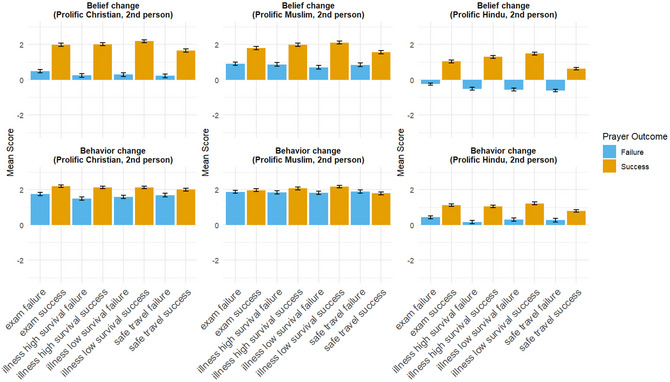 Figure 1
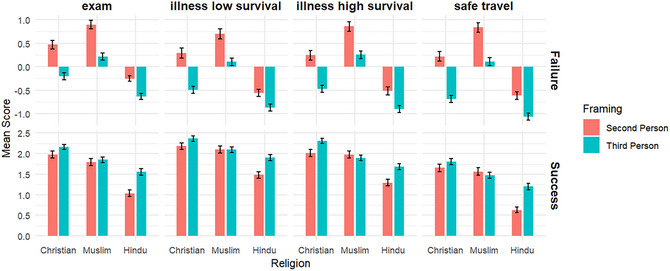 Figure 2
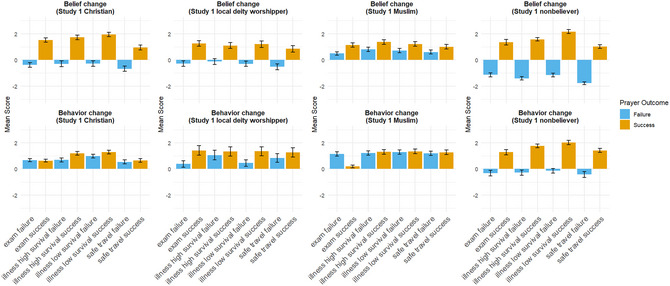 Figure 3
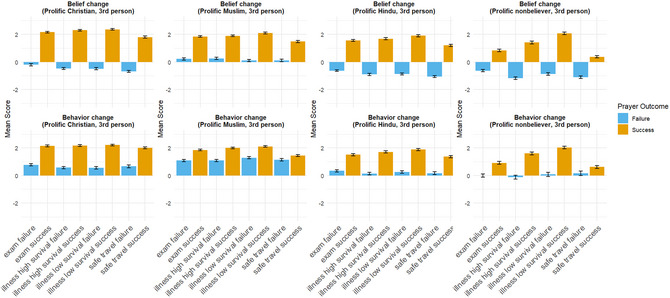 Figure 4
Peer Reviews
No public reviews on file for this paper yet. If you reviewed it on a platform where reviews are public (OpenReview, ICLR, NeurIPS, ICML), you can paste yours below so the community can read it here.
Videos
No videos yet. Explain this paper in a talk, walkthrough, or lecture? Add one.
Taxonomy
TopicsEvolutionary Game Theory and Cooperation · Epistemology, Ethics, and Metaphysics · Religion, Spirituality, and Psychology