Burden and trends of antimicrobial non-susceptibility in skin and soft tissue infections: nine-year microbiological surveillance from a tertiary hospital in Riyadh, Saudi Arabia
Yahya Shabi, Abdullah A. Alshehri, Khalifa Binkhamis, Mohammed Alqahtani, Thamir Saad Alsaeed, Ali Abdullah Aljaberi, Saleh Abdullah Alkhamis, Mohammad K. Alshomrani, Abdullah Z. Almutairi, Abdulah J. Alqahtani, Ahmad Jebril M. Bosaily, Fatimah Alshahrani

TL;DR
This study analyzed 9 years of microbiological data from a Saudi hospital to track antimicrobial resistance trends in skin and soft tissue infections.
Contribution
The study provides a detailed, species-level analysis of antimicrobial non-susceptibility trends in SSTIs in Saudi Arabia.
Findings
Gram-negative organisms were most common, with rising resistance to amikacin and carbapenems.
Staphylococcus aureus showed a decline in oxacillin resistance over time.
Tissue-derived isolates had higher meropenem non-susceptibility compared to swab isolates.
Abstract
Skin and soft tissue infections (SSTIs) impose a substantial global and regional burden, and their management is increasingly complicated by antimicrobial non-susceptibility. In Saudi Arabia, data remain fragmented, with few studies providing species-level analyses stratified by specimen type and infection depth. We retrospectively analyzed 6,760 wound and tissue specimens (2016–2024) from a tertiary hospital in Riyadh, Saudi Arabia. Organisms were identified using standard microbiological methods and VITEK 2. Antimicrobial susceptibility testing was interpreted according to CLSI M100, defining non-susceptibility as resistant or intermediate categories. Binary logistic regression was used to assess temporal trends in antimicrobial non-susceptibility, with year of isolation entered as a continuous predictor. Gram-negative organisms predominated (63.2%), followed by Gram-positives…
Genes, proteins, chemicals, diseases, species, mutations and cell lines named across the full text — each resolved to its canonical identifier and authoritative record.
Click any figure to enlarge with its caption.
 Figure 1
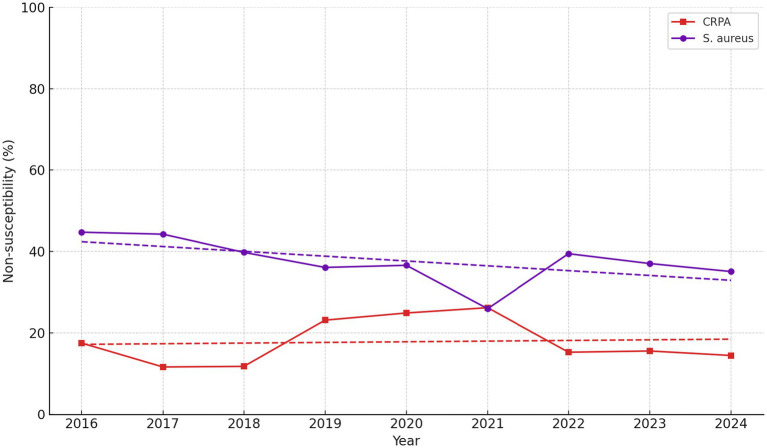 Figure 2
Peer Reviews
No public reviews on file for this paper yet. If you reviewed it on a platform where reviews are public (OpenReview, ICLR, NeurIPS, ICML), you can paste yours below so the community can read it here.
Videos
No videos yet. Explain this paper in a talk, walkthrough, or lecture? Add one.
Taxonomy
TopicsAntimicrobial Resistance in Staphylococcus · Bacterial Identification and Susceptibility Testing · Streptococcal Infections and Treatments