Jokers in the deck: A new temperature setting for the Columbia Card Task
Kevin Kapadia, Yunxiu Tang, Richard John

TL;DR
This paper introduces a new version of the Columbia Card Task, called Toasty, which improves the measurement of risk-taking behavior by randomizing loss card placement and testing incentives.
Contribution
The paper introduces a new hybrid version of the CCT (Toasty) and examines the impact of randomizing loss card placement and participant incentives.
Findings
The Toasty version behaves similarly to the Warm version but provides additional insights into risk-taking behavior.
Participants revealed loss cards roughly half the time and remained sensitive to game parameters like gain and loss amounts.
Incentivizing participants had little impact on the number of cards revealed.
Abstract
The Columbia Card Task (CCT) is a behavioral measure of risk-taking (BMRT), which has been cited over 1,500 times (Google Scholar, 3/1/2024). The original game had two versions (Hot and Cold), measuring affective and deliberative decision-making, respectively. Each version included 54 scored rounds where the loss cards were placed at the end, and nine unscored rounds where the loss cards were placed systematically among the gain cards. Over time, the CCT has gone through many iterations on critical components, such as the number of rounds, the position of the loss cards, and the introduction of a new version (Warm). Despite this, there are several issues with the CCT, notably a need for convergent validity with other measures of risk-taking. This paper reviews different iterations of the CCT, introduces a new (Toasty) version of the CCT that is a hybrid of the hot and warm versions,…
Genes, proteins, chemicals, diseases, species, mutations and cell lines named across the full text — each resolved to its canonical identifier and authoritative record.
Click any figure to enlarge with its caption.
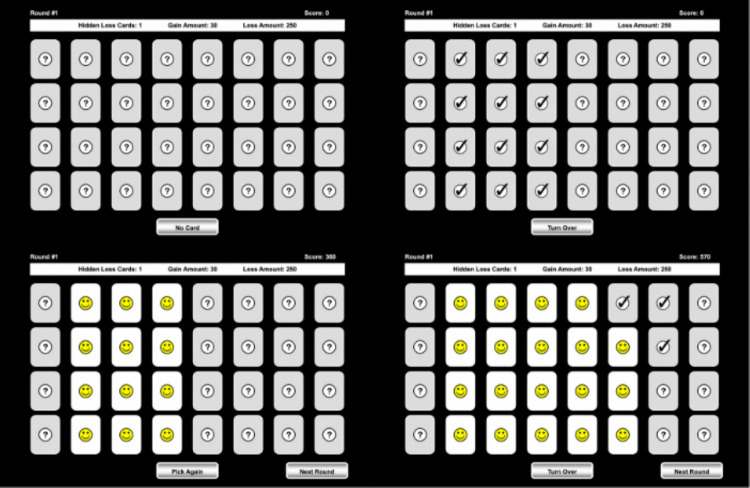 Figure 1
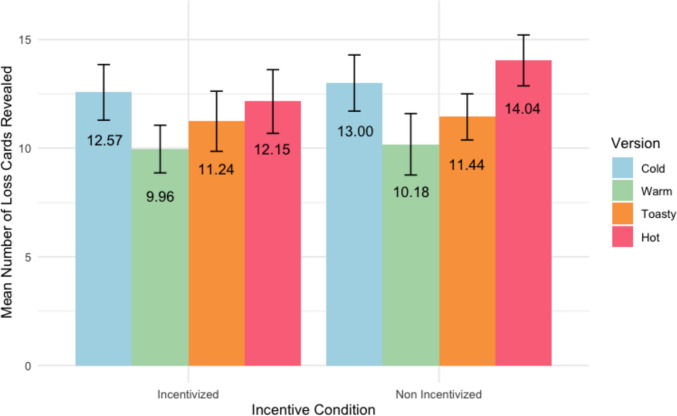 Figure 2
Peer Reviews
No public reviews on file for this paper yet. If you reviewed it on a platform where reviews are public (OpenReview, ICLR, NeurIPS, ICML), you can paste yours below so the community can read it here.
Videos
No videos yet. Explain this paper in a talk, walkthrough, or lecture? Add one.
Taxonomy
TopicsDecision-Making and Behavioral Economics · Neural and Behavioral Psychology Studies · Mind wandering and attention