Continuous Ketone Monitoring: Data From a Randomized Controlled Trial
Simon K Kjær, Lukas Ochsner Reynaud Ridder, Mads Svart, Nikolaj Rittig, Lise Nørkjær Bjerg, Birgitte Sandfeld-Paulsen, Henrik Holm Thomsen

TL;DR
A continuous ketone monitoring device showed declining ketone levels over two weeks, possibly due to sensor drift.
Contribution
The study evaluates a continuous ketone monitoring device's reliability during exogenous ketosis.
Findings
BHB concentrations declined over 14 days in both ketone ester and placebo groups.
Sensor drift is likely responsible for the observed decline in BHB measurements.
Abstract
In our study, a commercially available continuous ketone monitoring device captured β-Hydroxybutyrate (BHB) dynamics during exogenous ketosis but revealed a gradual decline day-to-day BHB concentrations over 14 days in both ketone ester and placebo groups, likely reflecting sensor drift.
Genes, proteins, chemicals, diseases, species, mutations and cell lines named across the full text — each resolved to its canonical identifier and authoritative record.
Click any figure to enlarge with its caption.
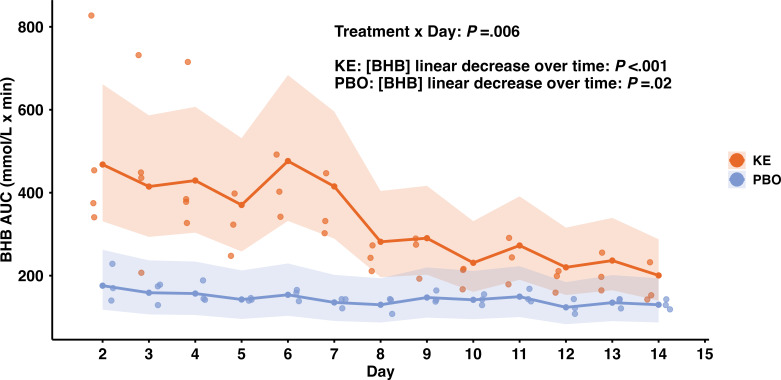 Figure 1
Peer Reviews
No public reviews on file for this paper yet. If you reviewed it on a platform where reviews are public (OpenReview, ICLR, NeurIPS, ICML), you can paste yours below so the community can read it here.
Videos
No videos yet. Explain this paper in a talk, walkthrough, or lecture? Add one.
Taxonomy
TopicsDiet and metabolism studies · Metabolism and Genetic Disorders · Renal function and acid-base balance
Introduction
Continuous measurement of ketone bodies is of scientific and clinical interest, providing insights into type 1 and type 2 diabetes, ketogenic diets, intermittent fasting, and exogenous ketone precursor supplementation. Current finger-prick point-of-care testing (POCT) devices are invasive, intermittent, and fail to capture dynamic fluctuations [1]. Continuous ketone monitoring (CKM), a small device measuring interstitial ketone (β-hydroxybutyrate, BHB) levels, offers a potential solution [2]. CKM research, however, remains in its early stages, with only a single commercially available device at present (SiBio KS1, Hong Kong), to the best of our knowledge. Exogenous ketone supplementations are currently studied for potential therapeutic applications, including weight loss, enhanced exercise performance, and the management of neurodegenerative, cardiovascular, and inflammatory conditions [3-5]. We hypothesized that CKM would accurately track BHB and evaluated its performance under sustained intermittent supraphysiological ketosis.
Methods
Study Design
This work is part of a larger study on exogenous ketosis and erythropoiesis (Thomsen et al, unpublished). CKM became available midway through the study and was therefore applied sequentially in the final 7 of the 16 healthy volunteers. Participants were randomized to receive either a ketone ester (KE) drink (500 mg/kg/d) or a placebo (PBO), matched for volume, taste, and viscosity. Over two weeks, drinks were consumed two to three times daily, with half the dose before sleep. Participants were blinded to CKM readings, while investigators were not blinded. We tested the effects of time, treatment, and their interaction on log-transformed BHB area under the curve (AUC) using a linear mixed-effects model and applied polynomial contrasts to assess linear trends.
Ethical Considerations
The study was conducted in accordance with the Declaration of Helsinki II, approved by the regional ethics committee (#1-10-72-221-22), and registered with ClinicalTrials (NCT06053138). Oral and written informed consent was obtained from all participating patients. Participant data were pseudonymized to ensure confidentiality. Participants received financial compensation for their time and participation.
Results
A total of 7 participants wore CKM devices: 4 in the KE group (3 female, 1 male) and 3 in the PBO group (2 female, 1 male). Median age was 41 years (IQR 28–55). One KE participant’s sensor detached on day 4 and was not replaced, but CKM readings until detachment were included in the analyses. BHB AUCs were significantly influenced by both day and treatment, with an interaction effect (P=.006). In the KE group, BHB showed a significant linear decrease over 14 days (P<.001), and a smaller but significant decline was also observed in the PBO group (P=.02). Consequently, group differences diminished, with KE and PBO becoming indistinguishable by the final day (Figure 1).
Day-by-day changes in total BHB area under the curve (AUC) for both the Ketone Ester (KE) group (n=4, orange) and placebo (PBO) group (n=3, blue). Scatter points represent individual AUC measurements for each participant across the 14 study days. Solid lines depict the back-transformed least-square means of BHB concentrations from a mixed-effects model, estimated separately for each day and treatment group, and the shaded regions represent the confidence intervals. BHB: beta-hydroxybutyrate.
Discussion
This study evaluated the performance of a commercially available CKM device during 14 days with intermittent exogenous ketone supplementation. Our findings demonstrate that the CKM detected increases in interstitial BHB concentrations following KE ingestion but revealed a progressive decline in BHB concentrations over the 14-day study period in the KE group, indistinguishable from the PBO group on the last study day. This contrasts with two prior studies in which participants received KE for 14 days before ingesting 25 g KE in a laboratory setting on day 15 [67]. In those studies, peaks reached ~2.3 mM at 1 hour and declined to ~0.5 mM at 4 hours, with no evidence of a declining peak BHB concentration following a comparable period of intermittent exogenous ketosis. Importantly, we observed a temporal decline in BHB concentrations also in the placebo group, highly suggesting a ketone-independent physiological or measurement-related drift. Therefore, this raises the possibility of sensor-related limitations. Potential explanations include sensor enzyme degradation, biofouling, temperature effects, compression, or interstitial variability [8]. The underlying sensor principle is not fully disclosed but thought to use a modified electrochemical method reacting selectively with BHB in interstitial fluid. In comparison, an in-development multianalyte sensor using a three-electrode system with NAD^+^-dependent β-hydroxybutyrate dehydrogenase and osmium-based redox chemistry has shown stable 14-day performance in 12 healthy, low-carbohydrate-consuming participants [910]. A future study is anticipated with interest since it will assess the accuracy of the same device used in our study, SiBio KS1, in subjects following a 14-day ketogenic diet (NCT06420518). Limitations for our study include not comparing the CKM-derived ketone levels with gold standard blood BHB measurements (eg, finger-prick tests), making it difficult to definitively decide if our observations are due to sensor-specific limitations or not. Additionally, the small sample size and statistical power may impact the generalizability of our findings, and it is important to note that the study was not originally designed to evaluate CKM performance.
In conclusion, CKM captured BHB dynamics during exogenous ketosis but revealed a gradual decline in day-to-day BHB AUC over 14 days in both KE and PBO groups, likely reflecting sensor drift rather than physiological adaptation. Larger controlled studies with direct comparison of CKM and blood BHB measurements are needed to confirm accuracy and clinical utility, and must include more than a single batch of CKM devices.
The reference list from the paper itself. Each links out to its DOI / PubMed record.
- 1Moonla C Reynoso M Casanova A et al Continuous ketone monitoring via wearable microneedle patch platform ACS Sens Feb 2320249210041013 doi 10.1021/acssensors.3c 02677 Medline 38300831 · doi ↗ · pubmed ↗
- 2Kong YW Morrison D Lu JC Lee MH Jenkins AJ O’Neal DN Continuous ketone monitoring: exciting implications for clinical practice Diabetes Obes Metab Dec 202426 Suppl 7Suppl 74758 doi 10.1111/dom.15921 Medline 39314201 PMC 11646480 · doi ↗ · pubmed ↗
- 3Møller N Ketone body, 3-hydroxybutyrate: minor metabolite - major medical manifestations J Clin Endocrinol Metab Sep 120201059 dgaa 370doi 10.1210/clinem/dgaa 370Medline 32525972 · doi ↗ · pubmed ↗
- 4Nelson AB Queathem ED Puchalska P Crawford PA Metabolic messengers: ketone bodies Nat Metab Dec 202351220622074 doi 10.1038/s 42255-023-00935-3Medline 38092961 · doi ↗ · pubmed ↗
- 5Robberechts R PofféC Defining ketone supplementation: the evolving evidence for postexercise ketone supplementation to improve recovery and adaptation to exercise Am J Physiol Cell Physiol 01120243261 C 143C 160doi 10.1152/ajpcell.00485.2023 Medline 37982172 · doi ↗ · pubmed ↗
- 6Berg-Hansen K Gopalasingam N Christensen KH et al Cardiovascular effects of oral ketone ester treatment in patients with heart failure with reduced ejection fraction: a randomized, controlled, double-blind trial Circulation 05720241491914741489 doi 10.1161/CIRCULATIONAHA.123.067971 Medline 38533643 PMC 11081479 · doi ↗ · pubmed ↗
- 7Gopalasingam N Berg-Hansen K Christensen KH et al Randomized crossover trial of 2-week ketone ester treatment in patients with type 2 diabetes and heart failure with preserved ejection fraction Circulation Nov 1220241502015701583 doi 10.1161/CIRCULATIONAHA.124.069732 Medline 39162035 · doi ↗ · pubmed ↗
- 8Teymourian H Barfidokht A Wang J Electrochemical glucose sensors in diabetes management: an updated review (2010-2020)Chem Soc Rev Nov 72020492176717709 doi 10.1039/d 0cs 00304 b Medline 33020790 · doi ↗ · pubmed ↗