P-1717. Temporal-spatial contributions of Candida albicans environmental response genes to pathogenesis of intra-abdominal candidiasis (IAC)
Shaoji Cheng, M Hong Nguyen, Cornelius J Clancy

TL;DR
This study identifies Candida albicans genes involved in causing intra-abdominal candidiasis, focusing on how environmental response genes contribute to infection at different stages.
Contribution
The study reveals new temporal-spatial roles of C. albicans environmental response genes in intra-abdominal candidiasis pathogenesis.
Findings
Genes related to pH, oxidative stress, adhesion, and hyphal growth are active during early peritonitis.
Late peritonitis involves genes for phagocyte responses and nutrient acquisition.
Key regulators like RIM101 and MNL1 contribute to virulence by controlling SAP5 and PHO4/SKO1.
Abstract
IAC, which includes peritonitis and intra-abdominal abscesses (IAAs), is the second most common type of invasive candidiasis, but its pathogenesis is poorly understood.Table 1.C. albicans biologic processes activated during IAC.Figure 1.C. ablicans transcription factor mutants attenuated during IAC. C. albicans biologic processes activated during IAC. C. ablicans transcription factor mutants attenuated during IAC. We used RNA-Seq to measure C. albicans SC5314 gene expression during early peritonitis (30-min), late peritonitis (24-hr) IAA (48-hr) of mice. ≥2-fold differences were significant (false discovery ≤0.01). We screened duplicate signature-tagged, homozygous deletion libraries for 165 C. albicans transcription factors (TFs) in 72-hr IAA.Figure 2.C. albicans weak acid response genes contributing to IAC.Figure 3.Over-expression of PHO4 or SKO1 in mnl1 rescues weak acid…
Genes, proteins, chemicals, diseases, species, mutations and cell lines named across the full text — each resolved to its canonical identifier and authoritative record.
Click any figure to enlarge with its caption.
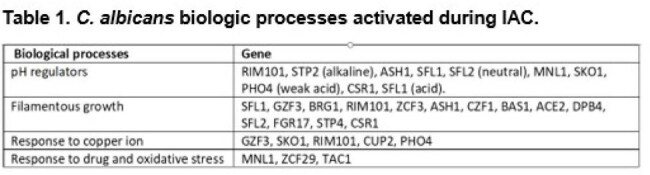 Figure 1
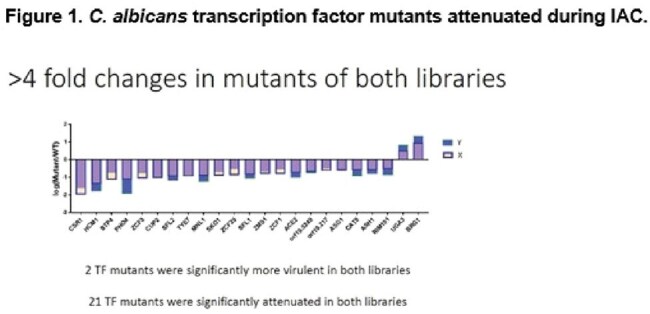 Figure 2
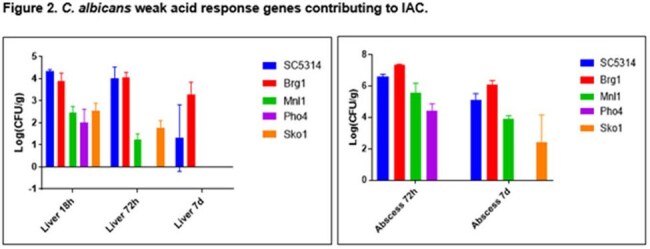 Figure 3
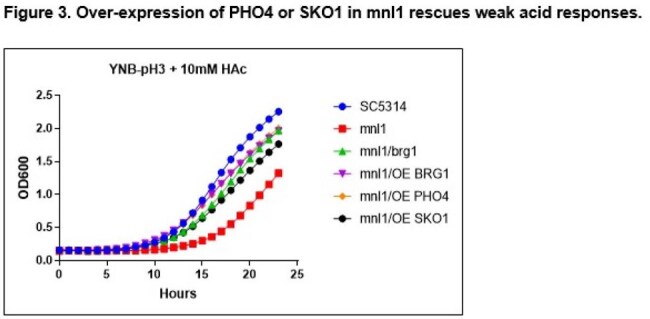 Figure 4
Peer Reviews
No public reviews on file for this paper yet. If you reviewed it on a platform where reviews are public (OpenReview, ICLR, NeurIPS, ICML), you can paste yours below so the community can read it here.
Videos
No videos yet. Explain this paper in a talk, walkthrough, or lecture? Add one.
Taxonomy
TopicsAntifungal resistance and susceptibility · Neutrophil, Myeloperoxidase and Oxidative Mechanisms · Fungal Infections and Studies