P-2007. Accuracy and Precision of Self-Administered Audiograms Using a Smartphone Application
Nabin K Shrestha, Tricia Bravo, Omar Mehkri, Carmen Jamis

TL;DR
This study evaluates a smartphone app for self-administered hearing tests, finding it accurate and precise compared to formal audiograms.
Contribution
The study demonstrates that a smartphone app can provide precise and accurate hearing measurements comparable to formal audiograms.
Findings
Self-administered audiograms using the Mimi Hearing App had a root mean square error of less than 5 dB at all tested frequencies.
The mean error compared to formal audiograms ranged from -7.07 to 4.73 dB across tested frequencies.
Abstract
Risk of hearing loss is a major concern for infectious disease physicians treating patients with prolonged courses of potentially ototoxic antimicrobials. Hearing loss can be detected by audiologic testing, but the logistics of obtaining formal audiograms are often challenging and obtaining serial evaluations for patients on prolonged treatments even more so. The Mimi Hearing App is a smartphone application that allows one to obtain self-administered audiograms. The purpose of this study was to evaluate the accuracy and precision of self-administered audiograms using this smartphone application.Table 1.Precision of measurement of hearing loss by self-administered audiograms using the Mimi Hearing App on repeat testing Precision of measurement of hearing loss by self-administered audiograms using the Mimi Hearing App on repeat testing Personnel working in the department of infectious…
Click any figure to enlarge with its caption.
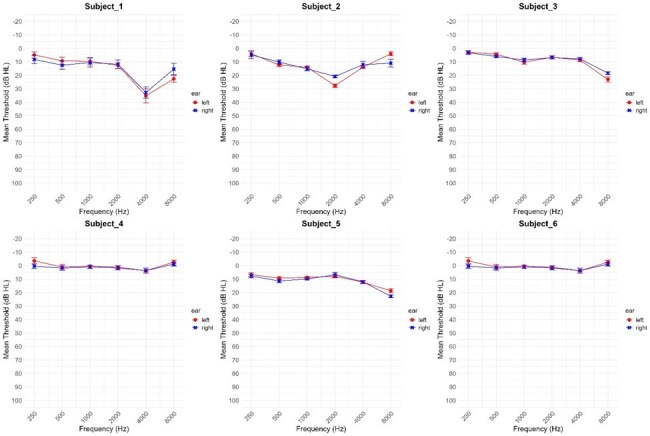 Figure 1
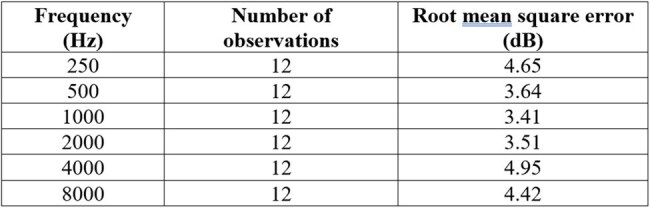 Figure 2
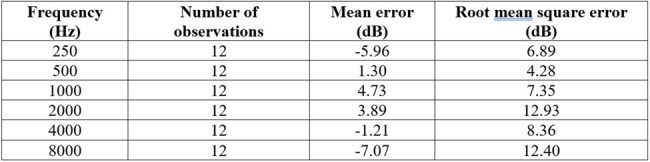 Figure 3
Peer Reviews
No public reviews on file for this paper yet. If you reviewed it on a platform where reviews are public (OpenReview, ICLR, NeurIPS, ICML), you can paste yours below so the community can read it here.
Videos
No videos yet. Explain this paper in a talk, walkthrough, or lecture? Add one.
Taxonomy
TopicsHearing, Cochlea, Tinnitus, Genetics · Ear Surgery and Otitis Media · Hearing Loss and Rehabilitation