Paraneoplastic Raynaud’s Phenomenon: A Case Report
Beatriz Vitó Madureira, Rita Aranha, Rita Soares Costa

TL;DR
A 63-year-old man with lung cancer developed Raynaud’s phenomenon, suggesting a rare paraneoplastic connection that doctors should consider in similar cases.
Contribution
This case report highlights paraneoplastic Raynaud’s phenomenon as a rare complication of lung cancer that requires clinical awareness.
Findings
A 63-year-old with stage IV lung cancer developed Raynaud’s phenomenon with no other secondary causes identified.
The case supports a paraneoplastic origin for the vasospastic symptoms observed.
Early recognition of such paraneoplastic syndromes can improve symptom management and understanding.
Abstract
Raynaud’s phenomenon is a vasospastic disorder that may occur as a primary benign condition or as a secondary manifestation of systemic disease. We describe the case of a 63-year-old man, with stage IV squamous cell carcinoma of the left lung undergoing palliative chemotherapy, who developed asymmetric and transient discoloration of the distal upper extremities. The patient’s clinical history of active cancer, combined with exclusion of other secondary causes, supported a paraneoplastic etiology. Paraneoplastic Raynaud’s phenomenon should be considered in adults with atypical or new-onset vasospastic symptoms, especially in the context of established malignancy. Early recognition is essential to optimize symptom management and enhance understanding of paraneoplastic vascular syndromes associated with lung cancer.
Genes, proteins, chemicals, diseases, species, mutations and cell lines named across the full text — each resolved to its canonical identifier and authoritative record.
Click any figure to enlarge with its caption.
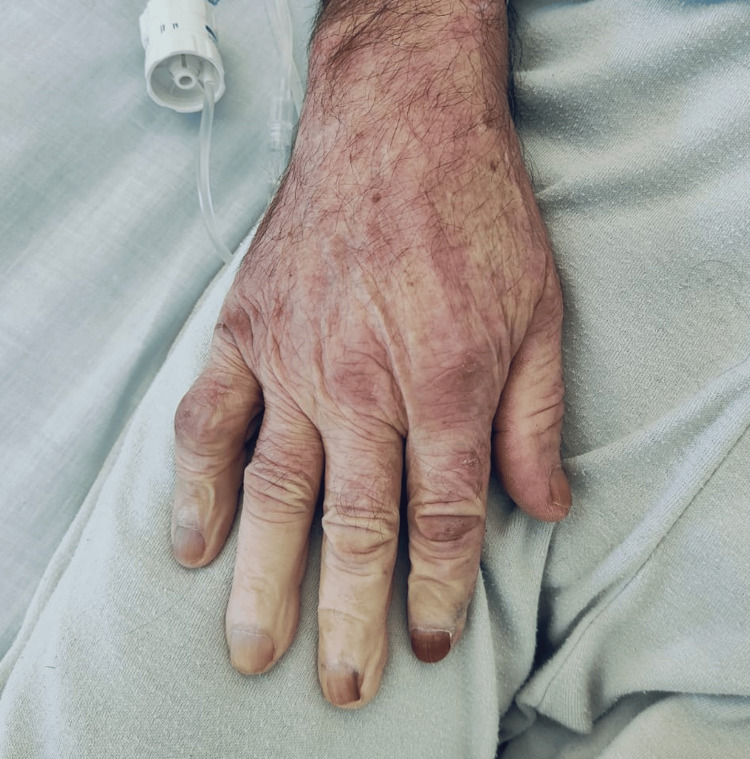 Figure 1
| Parameter | Result | Unit | Reference range |
| Hemoglobin | 11.7* | g/dL | 12.0-16.0 |
| White blood cells | 8.3 | x10⁹/L | 4.0-11.0 |
| Platelets | 291 | x10⁹/L | 150-450 |
| International normalized ratio (INR) | 1.1 | - | - |
| Prothrombin time (PT) | 12.1 | s | Control value: 12.0 s |
| Activated partial thromboplastin time (aPTT) | 30.4 | s | Control value: 31.3 s |
| Urea | 20 | mg/dL | 15-40 |
| Creatinine | 0.6 | mg/dL | 0.6-1.1 |
| Creatine kinase | 58 | U/L | 30-200 |
| Troponin I | 1.7 | ng/L | ≤34.0 |
| Myoglobin | 30.4 | ng/mL | <140.0 |
| Erythrocyte sedimentation rate | >120* | mm | 0-20 |
| C-reactive protein (CRP) | 26.6* | mg/L | 0.0-5.0 |
| Complement 3 | 167 | mg/dL | 82-185 |
| Complement 4 | 34 | mg/dL | 15-53 |
| Complement C1q | 26 | mg/dL | >12 |
| Circulating immune complexes | <0.40 | mcg Eq/L | <4.00 |
| Antinuclear antibodies (ANA)** | 0.1 | U/mL | Negative <0.7 |
| Positive >1.0 | |||
| Myeloperoxidase anti-neutrophil cytoplasmic antibodies (MPO-ANCA) | 0.20 | Ul/mL | Negative <3.5 |
| Positive >5 | |||
| Anti-proteinase 3 antibodies (PR3-ANCA) | 0.30 | Ul/mL | Negative <2 |
| Doubtful 2-3 | |||
| Positive >3 | |||
| Rheumatoid factor | <20 | Ul/mL | <30 |
| Total Proteins | 5.80* | g/dL | 6.40-8.30 |
| Immunoglobulin A (IgA) | 519 | mg/dL | 101-645 |
| Immunoglobulin M (IgM) | 78 | mg/dL | 22-240 |
| Immunoglobulin G (IgG) | 1054 | mg/dL | 751-1560 |
| Protein electrophoresis | Normal | - | - |
| Thyroid-stimulating hormone (TSH) | 3.76 | µUl/mL | 0.35-4.94 |
| Free thyroxine (FT4) | 10.6 | pmol/L | 9.0-19.0 |
| Acute viral serology*** | Negative | - | - |
| Viral hepatitis | Negative | - | - |
| Human immunodeficiency virus (HIV) antibody | Negative | - | - |
| Urinalysis | Negative for proteinuria, leukocyturia, and erythrocyturia | - | - |
Peer Reviews
No public reviews on file for this paper yet. If you reviewed it on a platform where reviews are public (OpenReview, ICLR, NeurIPS, ICML), you can paste yours below so the community can read it here.
Videos
No videos yet. Explain this paper in a talk, walkthrough, or lecture? Add one.
Taxonomy
TopicsSystemic Sclerosis and Related Diseases · Lymphatic System and Diseases · Skin Diseases and Diabetes
Introduction
Raynaud’s phenomenon is a vascular disorder characterized by episodic vasospasm of the digital arteries, typically triggered by cold exposure or emotional stress [1]. While most cases are primary and benign, secondary Raynaud’s phenomenon may signal an underlying systemic disease [2]. Among the less common but clinically relevant causes is paraneoplastic Raynaud’s phenomenon, in which digital vasospasm occurs in association with an underlying malignancy [2-7]. Paraneoplastic Raynaud’s is thought to arise from tumor-related immune dysregulation or circulating vasoactive factors that disrupt normal vascular tone, making it an important clinical clue to occult or evolving malignancy [1,8]. Although it can precede the detection of cancer, it may also arise after the diagnosis has already been established [8,9]. In such cases, treatment of the underlying malignancy often leads to partial or complete resolution of vasospastic symptoms [3,4-7]. We present a case of Raynaud’s phenomenon developing after a confirmed cancer diagnosis and discuss its clinical characteristics and diagnostic considerations.
Case presentation
A 63-year-old man with stage IV squamous cell carcinoma of the left lung, diagnosed in January 2024 and undergoing palliative chemotherapy, was admitted to the Internal Medicine Department in February for uncontrolled cancer-related pain and a tooth abscess.
During hospitalization, he developed transient episodes of asymmetric discoloration of the distal upper extremities (Figure 1). These episodes were characterized by sudden pallor followed by cyanosis and erythematous reperfusion, each lasting several minutes and accompanied by fingertip pain and numbness. Vital signs and radial pulses were normal; however, the digits demonstrated marked temperature asymmetry with cool, thinned skin. No pitting scars, digital ulcers, or muscle weakness were observed. The patient reported experiencing similar episodes over the previous five months, during outpatient follow-up, with increased frequency in cold environments.
Asymmetrical discoloration of the right hand, involving the distal phalangesThe photograph shows well-demarcated areas of digital blanching observed during hospitalization, illustrating the transient vasospasm characteristic of the pallor phase of Raynaud’s phenomenon
A diagnostic workup was performed to evaluate potential secondary causes (Table 1). Laboratory results showed an elevated erythrocyte sedimentation rate (>120 mm), but negative autoimmune serologies, including antinuclear antibodies, rheumatoid factor, and complement levels. Complete blood count was unremarkable. Serum immunoglobulin levels and protein electrophoresis were within normal limits, excluding plasma cell dyscrasias, cryoglobulinemia-related paraproteins, and other gammopathies. Thyroid function and creatine kinase levels were normal. Acute viral infections, viral hepatitis, and HIV infection were excluded. Urinalysis showed no evidence of renal involvement. Further testing was not pursued because there were no clinical features suggestive of sclerodactyly, digital ulcers, or inflammatory myopathy. Nailfold capillaroscopy could not be performed in a timely manner due to the unavailability at the hospital.
Given the recent onset of symptoms occurring shortly after the diagnosis of lung carcinoma, and in the absence of an alternative etiology, paraneoplastic Raynaud’s phenomenon was considered the most likely diagnosis. Following discharge, the patient resumed palliative chemotherapy and began immunotherapy with pembrolizumab. At a three-month follow-up visit, the patient continued to experience similar vasospastic episodes, although they occurred less frequently. Imaging studies demonstrated stability of the underlying malignancy.
Discussion
Paraneoplastic Raynaud’s phenomenon is an uncommon but clinically significant manifestation associated with several malignancies, most frequently lung, breast, and hematologic cancers [3-7]. In this case, the patient’s recent diagnosis of stage IV squamous cell carcinoma of the lung and the temporal proximity of symptom onset strongly support a paraneoplastic mechanism. While primary Raynaud’s phenomenon is usually benign, secondary forms often present later in life and are frequently asymmetric and more severe [1,2]. The asymmetric and transient digital discoloration observed during hospitalization, combined with a five-month history of cold-induced episodes, is consistent with the expected pattern of secondary Raynaud’s phenomenon.
The diagnostic workup excluded other common causes of secondary Raynaud’s phenomenon [2]. Although the erythrocyte sedimentation rate was markedly elevated, this finding likely reflects the systemic inflammatory response associated with advanced malignancy [10]. This interpretation is supported by negative antinuclear antibodies, normal complement levels, and the absence of clinical features suggestive of autoimmune disease. Endocrine abnormalities, viral infections, and other systemic causes were also ruled out. Although capillaroscopy would have strengthened the diagnostic assessment [2], the temporal association with the cancer diagnosis and the absence of an alternative explanation make paraneoplastic Raynaud’s phenomenon the most plausible diagnosis.
Lung tumors are known to produce a variety of paraneoplastic vascular and neurological syndromes [8,9], and Raynaud’s phenomenon may fall within this spectrum [6-7]. Paraneoplastic manifestations can arise before, during, or after the diagnosis of malignancy, and their course often parallels tumor burden [3,5-9]. In this case, the reduction in symptom frequency over a three-month period is noteworthy, suggesting that even subtle changes in tumor activity may have contributed to the attenuation of vasospastic episodes, despite overall stability of the disease.
Management approaches differ between primary and secondary Raynaud’s phenomenon. Primary Raynaud’s is typically addressed with conservative measures (cold avoidance, smoking cessation, and stress reduction) and supplemented with pharmacologic therapy when needed, most commonly calcium channel blockers [11]. In contrast, secondary Raynaud’s requires both symptomatic treatment and management of the underlying condition [2], which in this case included cancer-directed chemotherapy and immunotherapy.
Conclusions
Paraneoplastic Raynaud’s phenomenon, although rare, should be considered in adults who present with new-onset, atypical, or asymmetric vasospastic symptoms, particularly when rheumatologic and secondary causes have been excluded. In this case, the temporal association between symptom onset and the diagnosis of advanced lung cancer supports a paraneoplastic mechanism and highlights the need for heightened clinical suspicion in cancer populations. Nonetheless, the diagnosis in this case is limited by the absence of nailfold capillaroscopy and the reliance on temporal correlation rather than definitive biomarkers. Recognizing this entity in patients with an established cancer diagnosis remains important, as new vasospastic symptoms may reflect tumor-related vascular dysregulation and help guide appropriate symptom management. Reporting such cases expands current knowledge of paraneoplastic vascular syndromes and reinforces awareness of their variable clinical presentations.
The reference list from the paper itself. Each links out to its DOI / PubMed record.
- 1A review of Raynaud's disease Mo Med Temprano KK 1231261132016 https://pubmed.ncbi.nlm.nih.gov/27311222/27311222 PMC 6139949 · pubmed ↗
- 2Raynaud's phenomenon-an update on diagnosis, classification and management Clin Rheumatol Pauling JD Hughes M Pope JE 331733303820193142081510.1007/s 10067-019-04745-5 · doi ↗ · pubmed ↗
- 3Paraneoplastic Raynaud's phenomenon-good palliation after a multidisciplinary approach J Pain Symptom Manage Schildmann EK Davies AN 7797833920102019985210.1016/j.jpainsymman.2009.09.006 · doi ↗ · pubmed ↗
- 4Paraneoplastic Raynaud phenomenon associated with metastatic ovarian cancer: a case report and review of the literature Gynecol Oncol Rep Lai TS Shim MR Shin D Zakhour M 1005753320203254823110.1016/j.gore.2020.100575 PMC 7284054 · doi ↗ · pubmed ↗
- 5Paraneoplastic acral vascular syndrome: epidemiologic features, clinical manifestations, and disease sequelae J Am Acad Dermatol Poszepczynska-GuignéE Viguier M Chosidow O Orcel B Emmerich J Dubertret L 47524720021207758010.1067/mjd.2002.120474 · doi ↗ · pubmed ↗
- 6Paraneoplastic Raynaud's phenomenon manifesting before the diagnosis of lung cancer BMJ Case Rep Madabhavi I Revannasiddaiah S Rastogi M Gupta MK 02012201210.1136/bcr.03.2012.5985 PMC 339138822761213 · doi ↗ · pubmed ↗
- 7Paraneoplastic Raynaud's phenomenon as an initial manifestation of lung cancer?Eur J Case Rep Intern Med Lokineni S Nepal M Mohamed A 8202110.12890/2021_002690 PMC 833674434377697 · doi ↗ · pubmed ↗
- 8Paraneoplastic syndromes: an approach to diagnosis and treatment Mayo Clin Proc Pelosof LC Gerber DE 8388548520102081079410.4065/mcp.2010.0099 PMC 2931619 · doi ↗ · pubmed ↗