Re-sequencing of the complete chloroplast genome of Cinnamomum burmanni (Nees & T.Nees) Blume (Lauraceae) from Indonesia using MinION Oxford Nanopore Technologies
Richard Andreas Salindeho, Fifi Gus Dwiyanti, Rahadian Pratama, Deden Derajat Matra, Muhammad Majiidu, Iskandar Z. Siregar, Jakub Sawicki, Richard Salindeho, Hoang Dang Khoa Do, Richard Salindeho

TL;DR
This study sequenced and annotated the complete chloroplast genome of Cinnamomum burmanni from Indonesia for the first time.
Contribution
The first complete chloroplast genome assembly and annotation for Cinnamomum burmanni using MinION Nanopore sequencing.
Findings
The chloroplast genome is 152,765 bp long with a GC content of 39%.
It contains 173 unique genes, including 96 protein-coding, 19 rRNA, and 68 tRNA genes.
The genome is divided into LSC, SSC, and two IR regions.
Abstract
Cinnamomum burmanni (Nees & T.Nees) Blume (Lauraceae) belongs to the Magnoliids group and is mainly distributed in Indonesia and Southeast Asia. The complete chloroplast (cp) genome of C. burmanni sampled from Indonesia was assembled and annotated for the first time in this study. The length of the cp genome is 152,765 bp with a GC content of 39%, and it consists of four subregions: a large single-copy (LSC) region of 93,636 bp, a small single-copy (SSC) region of 18,893 bp and two inverted repeats (IR) regions (IRA 20,121 bp; IRB 20,115 bp) . The cp genome of C. burmanni encodes a total of 173 unique genes, which are 96 protein-coding genes, 19 rRNA genes, and 68 tRNA genes that can be utilized for advanced genetic and genomic studies of the species.
Genes, proteins, chemicals, diseases, species, mutations and cell lines named across the full text — each resolved to its canonical identifier and authoritative record.
Click any figure to enlarge with its caption.
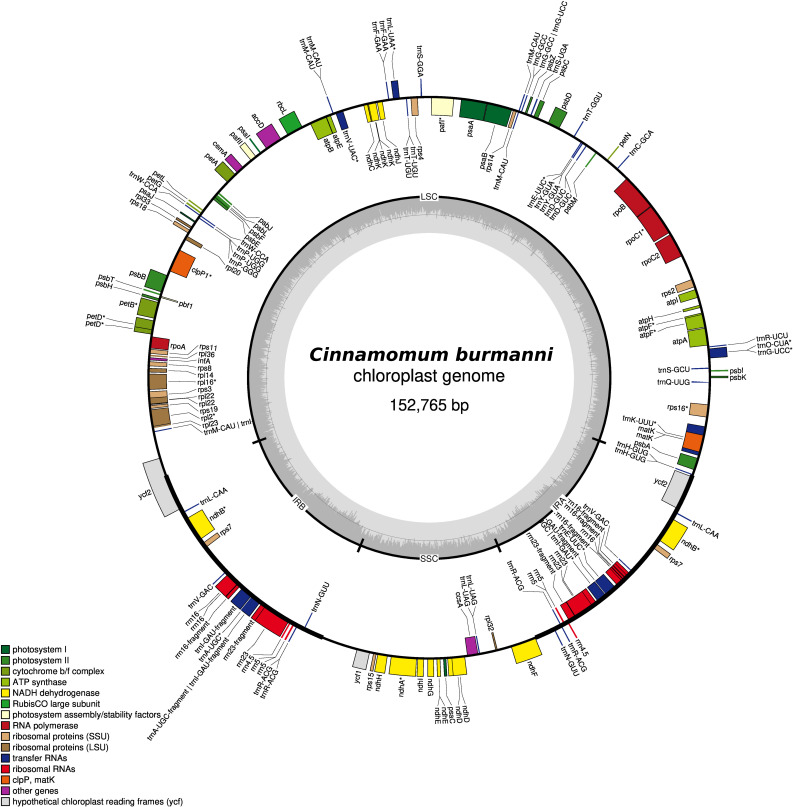 Figure 1
| Functional category | Group of genes | Name of genes |
|---|---|---|
| Self-replication | Large subunit ribosomal proteins |
|
| DNA dependent RNA polymerase |
| |
| Small subunit ribosomal proteins |
| |
| rRNAs |
| |
| tRNAs |
| |
| Subunit of ATP synthase |
| |
| Subunit of NADH-dehydrogenase |
| |
| Photosynthesis | Subunits of cytochrome b/f complex |
|
| Subunits of photosystem I |
| |
| Subunits of photosystem II |
| |
| Subunit rubisco |
| |
| Photosystem assembly factors |
| |
| Photosystem biogenesis factor |
| |
| Subunit of acetyl-CoA-carboxylase |
| |
| C-type cytochrome synthesis gene |
| |
| Other functions | Envelope membrane protein |
|
| ATP-dependent protease subunit P |
| |
| Maturase |
| |
| Conserved open reading frames |
| |
| Transitional initiation factor |
|
- —National Competitive Basic Research 2022-2023
- —National Competitive Basic Research 2022-2023
Peer Reviews
No public reviews on file for this paper yet. If you reviewed it on a platform where reviews are public (OpenReview, ICLR, NeurIPS, ICML), you can paste yours below so the community can read it here.
Videos
No videos yet. Explain this paper in a talk, walkthrough, or lecture? Add one.
Taxonomy
TopicsPlant and Fungal Species Descriptions · Genomics and Phylogenetic Studies · Cocoa and Sweet Potato Agronomy
Introduction
Cinnamomum burmanni (or cinnamon) is an endemic woody shrub belonging to the Lauraceae family, which is widely distributed in Indonesia covering West Sumatra, North Sumatra, Jambi, Bengkulu, Java Island, and Maluku Islands ( Suwarto et al., 2014). The species grows in altitudes between 0 and 2000 m above sea level. The tree can grow up to 15 m tall, and the wood is grey with a very distinctive aroma and sweet taste, so its wood is widely used for spices, cosmetics, and herbs. The active compounds contained in cinnamon wood are cinnamaldehyde, flavonoids, alkaloids, tannins, saponins, coumarins, steroids, eugenol, and phenols, which act as anti-bacterial, anti-tumor, antioxidant, anti-inflammatory, anti-cancer, and anti-diabetic agents ( Indarto et al., 2022).
The chloroplast (cp) genome sequence of C. burmanni from China has been previously generated by Yang et al. (2019) using 11 universal primer pairs to perform long-range PCR for next-generation sequencing. However, the study of the cp genome C. burmanni from Indonesia using PCR-free library preparation method and long-read sequencing generated by MinION Oxford Nanopore Technologies (ONT) has not been carried out, whereas this information is needed to improve correct species identification and to optimize the sustainable use of genetic resources for this species. MinION is a third-generation sequencing technology with nanopore technology ( Oxford Nanopore Technologies (ONT), 2017). Furthermore, the present study aimed to re-sequence and assemble the complete cp genome C. burmanni from Indonesia using MinION Oxford Nanopore Technologies (ONT).
Methods
Fresh leaf samples were collected from one individual C. burmanni tree in Lembang Subdistrict, West Bandung Regency, West Java Province, Indonesia. The collected leaf sample was subsequently used for DNA extraction and sequencing in the field. The data analysis of the chloroplast genome was performed at the Laboratory of Forest Genetics and Molecular Forestry, Department of Silviculture, Faculty of Forestry and Environment, IPB University.
C. burmanni genomic DNA was extracted using the Qiagen DNeasy Plant Mini Kit (cat. nos. 69104 and 69106) following the protocol provided by the manufacturer with slight modifications. Extraction was carried out first by grinding fresh leaf samples to which 400 μl of Buffer AP1 and 1 μl of mercaptoethanol had been added using a mortar and pestle. The disrupted sample was placed into a 1.5 ml microcentrifuge tube. The mixture was then incubated for 10 min at 65°C using Mini Heating Dry Bath Incubator MD-MINI (Major Science Co., Ltd). Afterward, 130 μl Buffer P3 was added into the microtube and then vortexed using Biosan V-32 Multi-Vortex and incubated for 5 min on ice. The mixture was centrifuged for 2 min at 8000 × g using a portable microcentrifuge on the Bento Lab device (Bento Bioworks Ltd). The lysate was pipetted into a QIAshredder spin column placed in a 2 ml collection tube. The lysate was centrifuged for 2 min at 8000 × g using a portable microcentrifuge on the Bento Lab device (Bento Bioworks Ltd). The flow-through was transferred into a new tube without disturbing the DNA pellet. 1.5 volumes of Buffer AW1 were then added and mixed by pipetting. 650 μl of the mixture was transferred into a DNeasy Mini spin column placed in a 2 ml collection tube and subsequently centrifuged for 1 min at 6000 × g. The flow-through was discarded and the spin column was placed into a new 2 ml collection tube. 500 μl Buffer AW2 was added to the spin column and centrifuged for 1 min at 6000 × g. The flow-through was then discarded and the spin column was transferred to a new 1.5 ml microcentrifuge tube. 50 μl Buffer AE was added for elution and subsequently incubated for 5 min at room temperature (15–25°C) before centrifuging for 1 min at 6000 × g. The quantity of genomic DNA was measured by the Invitrogen Qubit 1.0 fluorometer with the Qubit dsDNA BR assay kit.
The high molecular weight of 400 ng evaluated DNA proceeded to PCR-free library preparation, which followed the Nanopore protocol for Rapid sequencing gDNA – Field Sequencing Kit (SQK-LRK 001) version FSK_9049_v1_revR_14Aug2019. The prepared DNA library was sequenced using the MinION R9.4.1 flow cell (FLO-MIN106D) on a MinION Mk1B sequencer (Oxford Nanopore Technologies). The runs were visualized by MinKnow v3.6.5 software ( http://community.nanoporetech.com Oxford Nanopore Technologies).
Basecalling with super accuracy mode (SUP) to translate Fast5 raw data into Fastq (DNA-Seq of Cinnamomum burmanni. NCBI Accession number SRX22198906) data was performed using the Guppy program (RRID:SCR_023196) v4.2.3+8aca2af8 ( Wick et al., 2019). Quality control was done using NanoStat v1.5.0 and NanoPlot (RRID:SCR_024128) v1.28.2 ( De Coster et al., 2018). Chloroplast genome assembly was performed using Galaxy Server (RRID:SCR_006281) version 23.1.1.dev0 ( Sloggett et al., 2013). The assembly includes a filtering step to filter reads quality (Q>7) and length minimum of reads (>500 bp), using the Flye program (RRID:SCR_017016) v2.9 ( Kolmogorov et al., 2020) and polishing the assembly results using the MEDAKA consensus program (RRID:SCR_005857) v1.4.4 ( Oosterbroek et al., 2021). The cpDNA data was then annotated using the GeSeq (RRID:SCR_017336) on the CHLOROBOX platform ( Tillich et al., 2017) to assign functions to the predicted genes and generate a map representation of the chloroplast genome.
Results
The cp genome showed a typical quadripartite structure ( Figure 1) with a length of 152,765 bp, consisting of small single copy (SSC 18,893 bp) and large single copy (LSC 93,636 bp) regions separated by a pair of inverted repeat A (IRA 20,121 bp) and inverted repeat B (IRB 20,115 bp) regions ( Figure 1). The C. burmanni chloroplast genome contained 173 unique genes, including 96 coding sequences, 68 transfer RNA (tRNA), and 19 ribosomal RNA (rRNA) genes ( Table 1). The C. burmanni sequence had a GC content of 39% (LSC 38%; SSC 34%; IR 44%). The results of the typical quadripartite structure were similar to the C. burmanni reported by Yang et al. (2019).
The complete chloroplast genome of Cinnamomum burmanni.
Table 1.: List of genes in the chloroplast genome of Cinnamomum burmanni.
The reference list from the paper itself. Each links out to its DOI / PubMed record.
- 1De Coster W D’Hert S Schultz DT : Nano Pack: visualizing and processing long-read sequencing data. Bioinformatics. 2018;34(15):2666–2669. 10.1093/bioinformatics/bty 149 29547981 PMC 6061794 · doi ↗ · pubmed ↗
- 2Indarto Isnanto T Muyassaroh F : Efektivitas Kombinasi Ekstrak Kayu Manis ( Cinnamomum burmanni) dan Mikroalga ( Haematococcus pluvialis) sebagai Krim Tabir Surya: Formulasi, Uji In Vitro, dan In Vivo. Jurnal Kefarmasian Indonesia. 2022;12(1):11–24. 10.22435/jki.v 12i 1.5085 · doi ↗
- 3IPB University: DNA-Seq of Cinnamomum burmanni. Sequence Read Archive by NCBI. 2023. Reference Source
- 4Kolmogorov M Bickhart DM Behsaz B : meta Flye: scalable long-read metagenome assembly using repeat graphs. Nat. Methods. 2020;17(11):1103–1110. 10.1038/s 41592-020-00971-x 33020656 PMC 10699202 · doi ↗ · pubmed ↗
- 5Oosterbroek S Doorenspleet K Nijland R : Decona: From demultiplexing to consensus for Nanopore amplicon data. ARPHA Conf. Abstr. 2021;4:e 65029. 10.3897/aca.4.e 65029 · doi ↗
- 6Oxford Nanopore Technologies (ONT): Nanopore sequencing the advantages of long reads for genome assembly. 2017. Reference Source
- 7Sloggett C Goonasekera N Afgan E : Bio Blend: automating pipeline analyses within Galaxy and Cloud Man. Bioinformatics. 2013;29(13):1685–1686. 10.1093/bioinformatics/btt 199 23630176 PMC 4288140 · doi ↗ · pubmed ↗
- 8Suwarto Octavianty Y Hermawati S : Top 15 tanaman perkebunan. 2014. Reference Source