The complete chloroplast genome and phylogenetic analysis of Fraxinus paxiana Lingelsh. 1907 (Oleaceae)
Hong Feng, Wei Sun, Xiangxiao Meng, Shilin Chen

TL;DR
This paper presents the complete chloroplast genome of Fraxinus paxiana and its phylogenetic relationships with other Fraxinus species.
Contribution
The study provides a new chloroplast genome sequence and phylogenetic insights for Fraxinus paxiana.
Findings
The chloroplast genome of Fraxinus paxiana is 155,692 bp with a GC content of 37.87%.
Phylogenetic analysis reveals two branches in the genus Fraxinus, with F. paxiana and F. insularis being most closely related.
Abstract
Fraxinus paxiana distributed in Shaanxi, Gansu, Hubei, Hunan, and Sichuan provinces, is used as a local medicine in Shaanxi and also serves as an adulterant of traditional Chinese medicine Qinpi. Here, we assembled its 155,692 bp chloroplast genome (GC content 37.87%) with a typical quadripartite structure. A total of 133 genes were annotated, including 88 protein-coding genes, 37 tRNA genes, and eight rRNA genes. We identified 43 SSRs, predominantly composed of mononucleotide repeats. Phylogenetic analysis showed that the genus Fraxinus is divided into two branches, with F. paxiana and F. insularis having the closest phylogenetic relationship.
Genes, proteins, chemicals, diseases, species, mutations and cell lines named across the full text — each resolved to its canonical identifier and authoritative record.
Click any figure to enlarge with its caption.
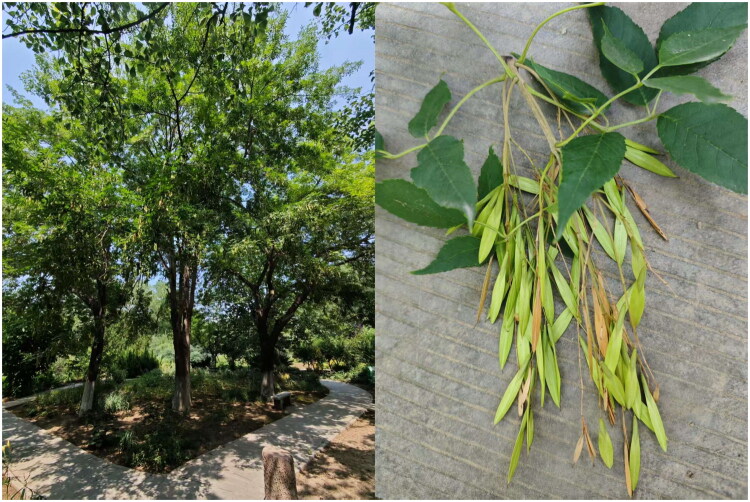 Figure 1
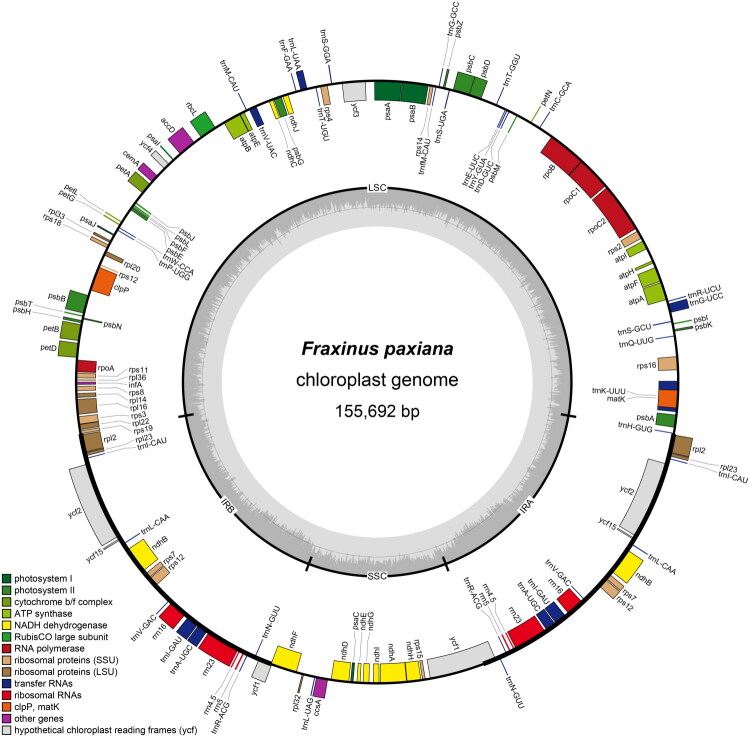 Figure 2
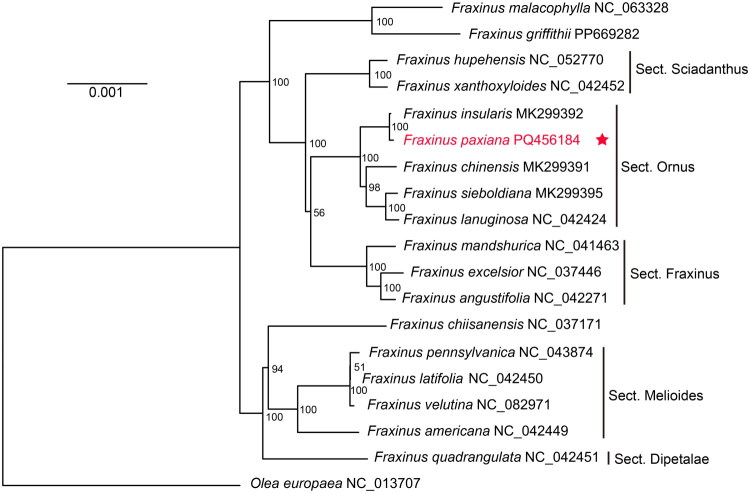 Figure 3
Peer Reviews
No public reviews on file for this paper yet. If you reviewed it on a platform where reviews are public (OpenReview, ICLR, NeurIPS, ICML), you can paste yours below so the community can read it here.
Videos
No videos yet. Explain this paper in a talk, walkthrough, or lecture? Add one.
Taxonomy
TopicsGenomics and Phylogenetic Studies · Traditional Chinese Medicine Analysis · Biological and pharmacological studies of plants