Real-world evaluation of ceftriaxone-related safety events: a stewardship call to action
Kristen Paciullo, Sujit Suchindran, Leila S. Hojat, Benjamin Albrecht, Sarah B. Green, K. Ashley Jones, Daniel J. Rogers, Trinh P. Vu, Lucy S. Witt

TL;DR
This study evaluated ceftriaxone safety in real-world use and found few serious adverse events, similar to other cephalosporins.
Contribution
The study provides real-world evidence on ceftriaxone safety, addressing a recent safety alert with large-scale data.
Findings
Ceftriaxone-related adverse events were rare despite high usage.
Event rates were similar to other intravenous cephalosporins.
Findings support continued cautious use of ceftriaxone.
Abstract
A ceftriaxone safety alert prompted a review of rapid response and cardiac arrest events in relation to the timing of intravenous cephalosporin administrations across a large health system. Despite high utilization, we found a low rate of significant ceftriaxone-related adverse events with a similar incidence as other intravenous cephalosporins.
Genes, proteins, chemicals, diseases, species, mutations and cell lines named across the full text — each resolved to its canonical identifier and authoritative record.
Click any figure to enlarge with its caption.
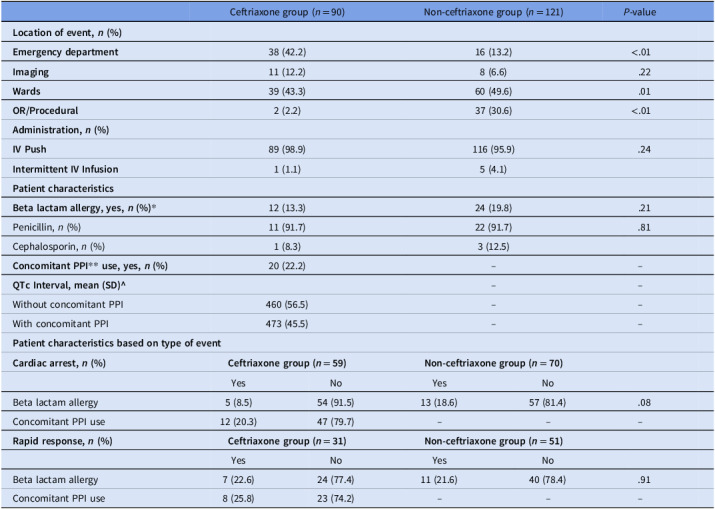 Figure 1
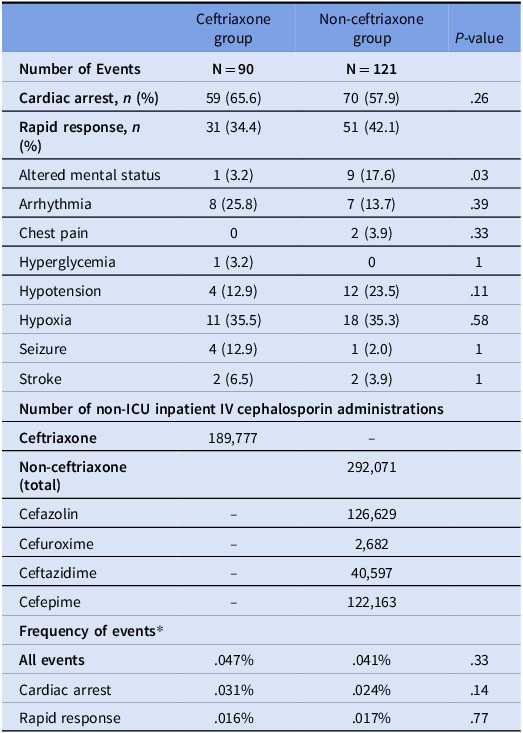 Figure 2
Peer Reviews
No public reviews on file for this paper yet. If you reviewed it on a platform where reviews are public (OpenReview, ICLR, NeurIPS, ICML), you can paste yours below so the community can read it here.
Videos
No videos yet. Explain this paper in a talk, walkthrough, or lecture? Add one.
Taxonomy
TopicsAntibiotics Pharmacokinetics and Efficacy · Pharmacovigilance and Adverse Drug Reactions · Blood disorders and treatments